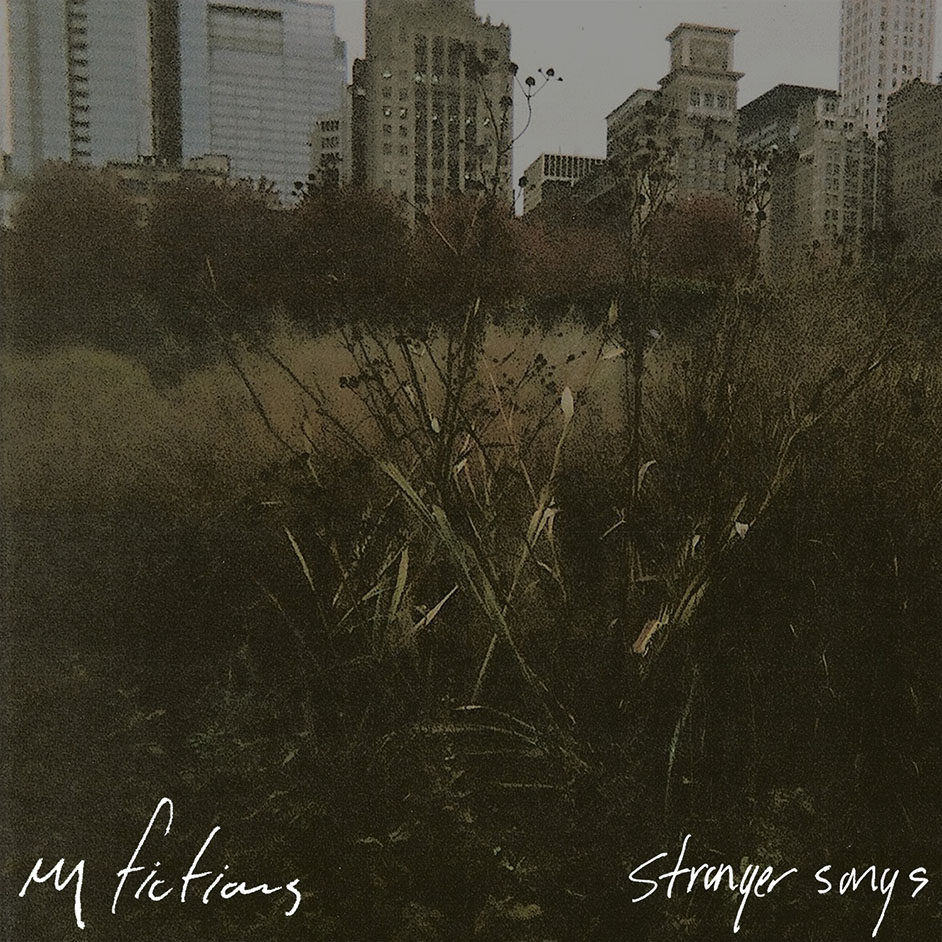
My Fictions – “Stranger Songs”

Grade: A-

Key Tracks: “Mt. Misery” “Postcard”

Boston group My Fictions know how to do hardcore right. Their new album, “Stranger Songs,” is fast, slick and uses volume to punish the listener’s emotions, not just their eardrums. At 10 songs and 28 minutes, it’s the work of a band that sounds frustrated and confused by the world around them, and they take out their feelings as quick as they can, with no unnecessary embellishments. “Stranger Songs” is loud and assaulting, with a dark and uncertain tone to boot.

The album’s opening track, “Mt. Misery,” starts with a bit of a cop-out intro, before jumping suddenly into a menacing, hardcore blast. Its follow-up, “Postcard,” the shortest track on the album, is an all-out assault on the listener. It is, as many of the songs are, centered on the frantic and explosive drumming that drives the beat further and further into submission. “Parking Lot” and “Stranger” also play around with false or building openings, and the energy behind the kit never lets up throughout the album.

But the album isn’t just about volume, it’s about using it properly. The album has an almost tantric feel to it, quickly softening and building back up, sometimes hitting a huge climax, sometimes not. “Airport Song” drops off completely at the end, leaving just faint bass notes and distant vocals. “Lower (A Selfish Song)” slows down towards the end for a punishing mid-tempo climax that’s as abrasive as they can get. My Fictions don’t come out of the gate and pound the listener into the ground with speed and volume – they welcome the quieter moments and tempo changes that enhance the hardcore sound.

“Stranger Songs” is not a summer album. I’d been receiving e-mails from (the excellent) Topshelf Records about the album’s release for months prior, but it’s a little difficult to get into it when I have the air conditioner running. It’s a dark and dense album, with the lyrics’ emotions coming out through the strained vocals. The band have an aura of unbridled frustration, no more apparent than on the aptly-named “Wake Anxious.” The guitars are dissonant and thundering, the drums heavy and the vocals distant and screamed. They sound disturbed by something, just in general, and use this album as their release. The album’s midpoint, “Concern,” is centered around a soundclip of someone asking a poet, “How can you write poetry if you’re not bothered by something?,” a line that comes up again in the final song. Taking a thunderous approach to your music only works if we believe there’s the frustration and anger behind it, and it’s on display here. They’re bothered. And it comes on full force. So prepare yourselves.

On an unrelated side note, I will be attending grad school in the fall. That does put this blog’s name in jeopardy, for sure. But I will be going to Emerson which is, by sheer coincidence, partially pictured in the cover of this album. I would like to promise this didn’t influence this review but no guarantees.

If you like this, try: I’m not up on my hardcore, I’m usually floored by a hardcore band’s stability throughout an album. So I’d like to suggest fellow Boston band Defeater’s recent “Letters Home” album, a continuation of their insane multi-album concept.

White Lung – “Deep Fantasy”

Grade: A

Key Tracks: “Drown With the Monster” “I Believe You”

In a world where punk is an ever-increasing and subjective term, we’re seeing more and more bands stretch the limits of the genre – the Waxahatachees and Andrew Jackson Jihads take a more acoustic-driven approach, and the Menzingers and the Modern Baseballs opt for deft poetry instead of angst. So it’s almost surprising to hear a band like White Lung, a well-oiled machine of anger and energy. They have a ferocity normally reserved for hardcore, and indeed, their music tends to hover towards hardcore and thrash metal, but it stays distinctly punk. Their excellent third album, 10 songs and 22 minutes, is a sweaty and kinetic burst that never once lets up.

White Lung aren’t changing anything on “Deep Fantasy.” This album isn’t an increase in power – they’ve always been as intense as they are here. But it’s still impressive. All ten songs on “Deep Fantasy” are at a non-stop, ferocious volume, as if they don’t know anything except that. White Lung have the ability to make a song that’s 2:26 feel long. The music is no frills – no drum fills, no theatrics, no breakdowns, no intros, no outros. Just volume. And yet, it doesn’t quite align with punk or metal. If they were to rely more on chords – which I’m glad they don’t – they’d veer into thrash metal. But the verses are usually marked by guitarist Kenneth William’s shearing, high-pitched rhythms, adding a shrieking element that isn’t metal at all.

Mish Way’s vocals dominate the album. She inverts some typical vocal structures by letting her voice fly high over the verses and taking a backseat, sometimes in a deeper pitch, during the choruses. Her voice is more stable on this time around, actually sounding intentionally conventional at most times. It creates a weird disparity – there’s clear, common vocals centered around a mass of volatile, unstable music. Her voice, at least on this record, actually resembles that of Debbie Harry’s, and the result is the album that Blondie always sounded like they wanted to experiment with, but never did.

To refer to a band, especially a punk band, as “female-fronted” in 2014 is ineffectual and stupidly ignorant, but for “Deep Fantasy,” it’s important to point out the album’s feminism. With blinding punk like this, you’d expect angry lyrics, whether personal, political, etc. And sometimes that’s the case – the repeated line “the water looks good on you” on “Drown With the Monster” speaks volumes. But some of the songs are poignant and rational. The album’s most intense track, the 1:42 blast “I Believe You,” is in response to sexual assault. Elsewhere, Way sings about other issues that society has laid on women – eating disorders, sexual fantasies and body image. To present rational and balanced lyrics in an otherwise aggressive setting brings home the importance of what Way presents – forcefully saying we need to address these issues in a safe manner.

White Lung only does one thing, and they do it extremely well. At 22 minutes, the album is a chugging engine that never gets repetitive or tired. It just keeps going, until you’re starting to break a sweat, and ending before the actual pain comes. Years ago, White Lung turned their instruments all the way up, and they haven’t adjusted them since. “Deep Fantasy” is an aural assault, and one of the best punk albums of the year. The band is a driving force in punk, and “Deep Fantasy” establishes them as a deafening group to watch out for.

If you like this try: an obvious comparison is equally feminist group Perfect Pussy, but they include effective moments of silence and feedback as major song points, that White Lung instead totally eschews. So, a better comparison might be noise-punk group So Stressed’s album “Attracted to Open Mouths.”

-By Andrew McNally

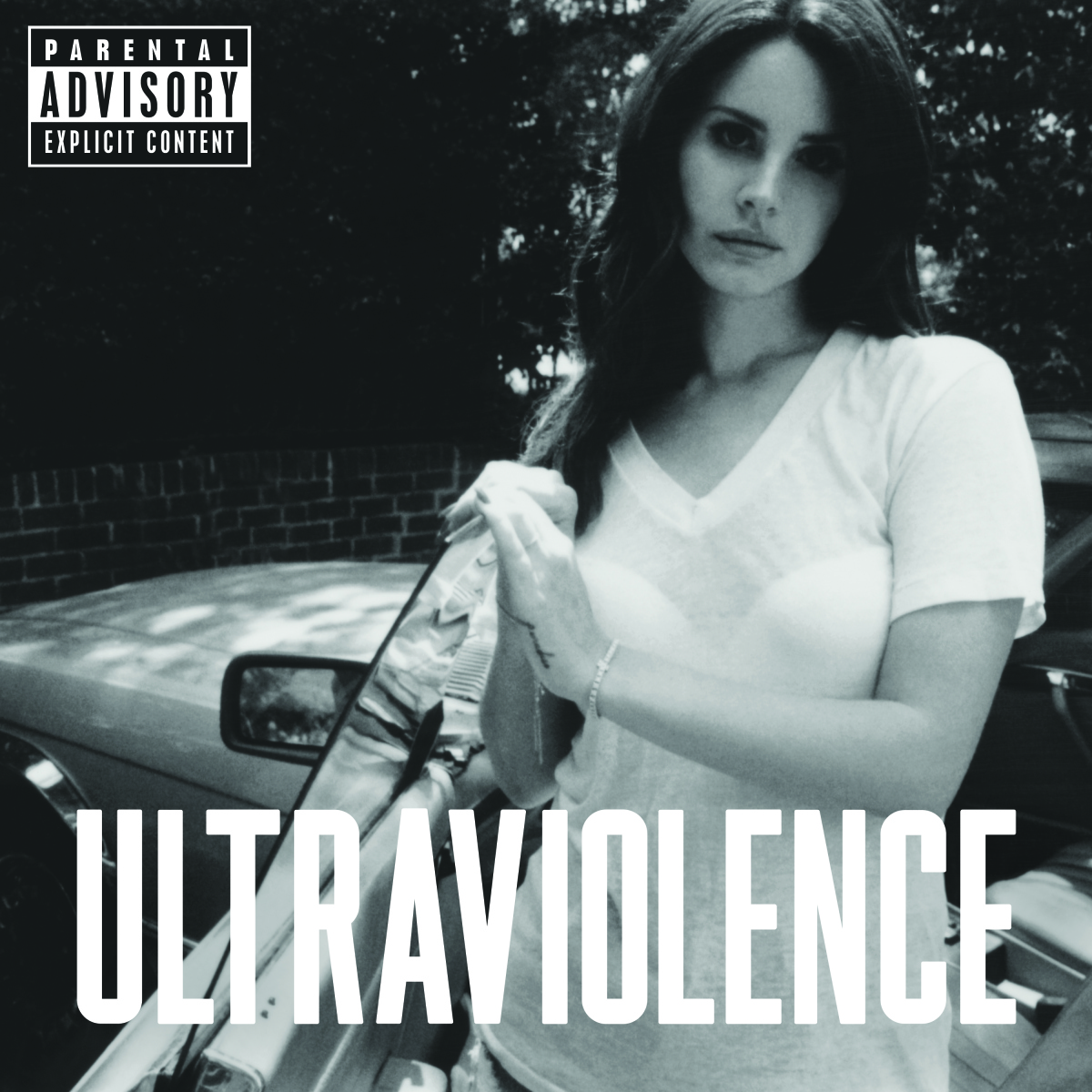
Lana Del Ray – “Ultraviolence”

ultraviolenceGrade: A-

Key Tracks: “Cruel World” “West Coast”

“Ultraviolence” is a slow album. It’s easy to overlook the album as a long, long wick attached to a room full of fireworks, burning slowly and ending before the big bang. But to look at “Ultraviolence” like that is to ignore the music’s subtleties, and the complexity of the album’s subject matter. “Ultraviolence” is a dark record, one that examines a woman who tries to ride her way to the top, but never excels past being “The Other Woman” (as evidenced by the final track). Given Del Ray’s recent, questionable comments on feminism, the album isn’t a critique on women in society today as much as it is a semi-personal narrative. It helps to strengthen the cinematic quality of the album. And it doesn’t hurt that Del Ray’s vocals are stronger this time around, rationing out a few strong performances across the album.

The album’s opener, “Cruel World,” is also the longest, at 6:39. It’s a building and intricate song, one that sets the tone by really taking it’s time to get to an engaging climax. It’s a slightly captivating song, and an unexpected one to open an album, even for Del Ray. What follows is a number of polarizing songs – sometimes engaging, other times putting up a strong barrier. Nearly all of them are a medium tempo, which should be a distraction or even a boredom, but when almost every song has it’s own identity, it doesn’t even matter. The only real exception is the excellent “West Coast,” full of tempo changes and a low-key funk that isn’t present anywhere else on the record.

Del Ray’s lyrics focus on struggling to find your identity and struggling to find success, accepting defeat in both. They’re typically dark – with titles like “Old Money,” “Pretty When You Cry,” and, of course, “Fucked My Way to the Top.” They call back memories to the pratfalls of luxury in the 20′s-50′s, even with modern references and a decidedly more provocative and profane tone. And her vocals are stronger; she’s allowed herself to open up and expand her range. “Shades of Cool” finds her in a high pitch, alternating between beautiful and off-setting. “Money Power Glory” is another track where her voice flourishes in big, grand ways. She’s often cooled down, but the rare times when she wants to take control – she does. These rare moments highlight the album’s otherwise restrained times, both benefits.

The album is bolstered by fine production, as well, courtesy mainly of Dan Auerbach (singer for the Black Keys and producer of everyone). The production is borderline cavernous, adding a faint echo and an ungraspable dark feeling throughout. It’s slickly produced – but not to the point where it’s actually pop.

“Anti-pop” isn’t a phrase, outside of a long forgotten Primus album, but it’s almost something that could describe Del Ray. With meandering tempos, cinematic music, dated lyrics and often 5+ minute lengths, her songs aren’t designed for radio. Yet they’re distinctly pop, a type of dream-pop. It’s melodic, and catchy, but in a low-key way. It isn’t possible to dance to this (as we now know, thanks to SNL). Like Nico long before her, and Lorde shortly after, Del Ray’s pop music is one of depth and density, not one of rapidity and popularity. You probably have a strong opinion of Del Ray, good or bad, and “Ultraviolence” isn’t going to change that. But it’s a strong pop release, ripe for analysis, and an improvement over her still notable debut. Like her or not, Del Ray’s strongest quality has been her ability to establish a persona in no time. And “Ultraviolence” really runs with it.

-By Andrew McNally

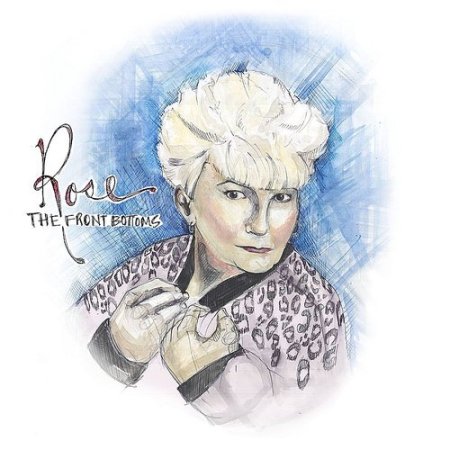
The Front Bottoms – “Rose”


Grade: A-

Key Tracks: “12 Feet Deep” “Jim Bogart”

Leave it to a band like the Front Bottoms to put a reviewer in a tough spot on whether to call these songs “new” or not. Because these songs are freshly recorded. But they certainly aren’t new. The first five tracks that make up “Rose” – “Flying Model Rockets,” “Lipstick Covered Magnet,” “12 Feet Deep,” “Jim Bogart,” and “Be Nice to Me” – are re-recordings of older songs, with “Awkward Conversations” the only freshly recorded one. The Front Bottoms released three albums before their perfect 2011 ‘debut’ self-titled, “Brothers Can’t Be Friends,” “I Hate My Friends” and “My Grandma vs. Pneumonia,” respectively. But all three are only available in the deepest corners of the internet, so buried that even some of their more adamant friends aren’t even aware of them. They’ve played these songs live, though, and they’ve become staples, so they’re getting a proper release in the first of a set of EP’s named after the duo’s grandmothers.

The song with the most remarkable difference is “12 Feet Deep,” always one of my personal favorite Front Bottoms songs. “Because you are water twelve feet deep / and I am boots made of concrete” proved in c. 2010 to be an emotionally impacting line, reflecting a relationship that isn’t healthy but still committed. But in 2014, a more steady drumline and more inspired vocals transform it into a more optimistic and hopeful relationship, without altering any of the words. All throughout the EP, there’s lyrics about school and parents, which still sound fresh in Brian Sella’s non-aging voice. The poetry of early Front Bottoms is more natural; less forced than some of the corny couplets on last year’s “Talon of the Hawk.”

Musically, the band has it more together now than they did then. That’s another added bonus of re-recording – the only real fault of their early albums is some messy music, when they were still learning what they were doing. It’s more refined on “Rose,” though still a little off the rails, of course. “Jim Bogart” ditches the inside-a-box production, and adds trumpet and and a slick little keyboard rhythm to build up to the drum entrance. In one way, the songs feel stripped down on this EP – more confined and controlled, sometimes fewer instruments, and with a better production. But in another way, they feel even more expanded and in your face than they did before – the benefit of a band that’s since settled into a signature sound.

It was a smart idea for the band to release these older songs, revamped. Relative fame, a constant touring schedule (and a namedrop alongside the National and Daft Punk in this NYT article) have had the unfortunate drawback of their youthful, innocently downtrodden lyrics sounding less believable. A decidedly terrible full-length didn’t help that, either. So although the band is reaching a wider and wider audience, their music is sounding less personable and less impacting. These six songs show how youthful and energetic the Front Bottoms really are, and by re-recording them, they’ve proven that they haven’t really changed at all. It’s sad, it’s fun, it’s poetic and easy to relate to, so it’s all you’ve come to expect from them. The only criticism? It doesn’t include “The Cops.” And that’s really a personal criticism. Maybe on a future EP.

-By Andrew McNally

Phooey! – “A Collection of Sins”

Grade: B+

Key Tracks: “This Ain’t No Picnic” “Charted Trips”

Just a few weeks ago I compared and contrasted two albums done by Phooey!, praising the pseudo-collective for both the diversity of their music and the speed that they put out releases. And indeed, “A Collection of Sins” shows both – it’s a full-length, coming out on the heels of an EP and a split, and this time, it’s a little more baroque and psych-pop than it is noise/pop/twee/punk. And Phooey!, an ever-changing band, exists on this album solely as bandleader Nikita. It’s an 18 song collection of some covers and some originals, not aligning as much to any sort of subgenre than their past releases, instead making itself resemble a collection of vignettes. Only one song, “This Ain’t No Picnic,” is over three minutes, and nine are under two. The album’s strongest quality is probably how much it feels like someone in their bedroom, playing some little songs they’ve learned along the way.

There’s a lot going on during this album, a number of different ideas. “This Ain’t No Picnic,” the album’s first real song (after a Bugs Bunny soundclip intro), is calm and heavy on background percussion instruments. It has a baroque resemblance, without any of the grand ambitions. “Waiting Room,” is closer to psych-pop, “Charted Trips” is an acoustic semi-ballad and “Unfinished” sounds more like some of Phooey!’s earlier pop-punkish tunes. And “Rebel Gurrrl” is a much weirder, somewhat psychedelic finish to the album. In between are a number of alt-pop and fuzzy guitar songs, all ideas that don’t stick around too long.

“A Collection of Sins” is a pleasant album, the sound of a man recording some music in his alone time, messing around with the Replacements and Sam Cooke, among others. Each song is like a small offering of what Phooey! does, some more different than others. And at only 35 minutes, the “collection” feel to it doesn’t get too quick or repetitive. Not every song is as memorable as the album’s best, but since they’re all samples, it’s easy to overlook the less grabbing ones. So overall, it’s a fun release, just as varying as Phooey! is in general, and a good mix of covers and originals. If Phooey! was avoiding falling into any genre of music before, they certainly are now.

The album is available for stream and download here.

If you like this, try: Last time I compared Phooey!, as a whole, to Japanther. But this album’s varying style of vignettes is much more reminiscent of Guided By Voices and their offshoot, Swearing at Motorists.

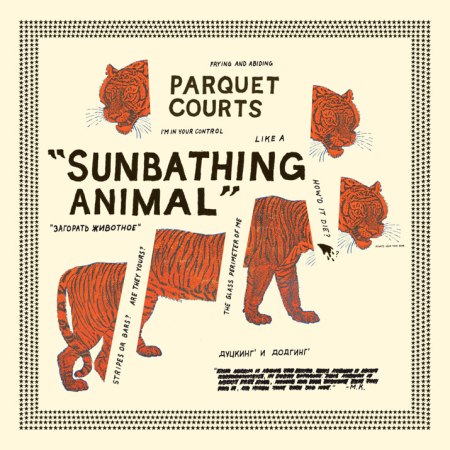
Parquet Courts – “Sunbathing Animal”

Grade: A-

Key Tracks: “She’s Rolling” “Sunbathing Animal”

The men of Parquet Courts are growing older, but just in the sense that we all are. “Sunbathing Animal,” the second accessible full-length and third release from the band in barely a year and a half, shows hints at maturity. It’s a reluctant maturity, one of attempts at denial but eventual acceptance. The band, as they did on last year’s “Tally All the Things You Broke” EP, open up to more influences and more ideas. The always-terrific “Light Up Gold” mixed garage-rock and country influences, but was filled with a boundless youthful energy that is roped in and controlled here.

Parquet Courts seem to know that they can’t just keep playing hybrid country-punk forever. “Stoned and Starving” is one of the best songs in years, but at 5:12, it’s the only song on “Light Up Gold” that’s over 3:30. Of the 13 songs on “Sunbathing Animal,” five break that threshold, with two more only seconds away. The band is, in one way, slowing things down and introducing some more developed songwriting. “Bodies Made Of” starts the album on a deceiving, medium tempo. “Dear Ramona” follows a narrative and shows more mature songwriting. “She’s Rolling” goes past six minutes, and “Instant Disassembly” past seven, with the latter being a pseudo-ballad and the former ending in crazy, layered harmonicas.

But in another way, they’re not slowing things down at all. They’re still a punk band, and “Ducking & Dodging” shows its love for 8ths and 16ths. Its “vocals over a drum and soft guitar line” is one of the most garage-y rhythms in years. The title track provides a volume and energy blast after the slow-burning “She’s Rolling.” And there’s musical interludes, just as on “Light Up Gold.” “Vienna II” and “Up All Night” provide brief break-ups throughout the album. “Sunbathing Animal” is more drawn-out, and more expansive, but it packs as many punches as their previous works.

“Sunbathing Animal” pairs nicely with “Light Up Gold,” as a band exploring the width of their own sound. “Sunbathing Animal” is no better or worse than “Light Up Gold,” and it doesn’t immediately demand any comparisons. It’s a lot more structured, and the band is more in control of their energy. It’s still very youthful and tongue-in-cheek, still fun but serious. “Sunbathing Animal” is a distinctly different album for the band, but it’s still definitively Parquet Courts. And that should be enough of a reason alone to pick the album up.

If you like this, try: together PANGEA’s “Badillac,” a less exciting (but still agreeable) example of a garage-punk band expanding.

-By Andrew McNally

Fucked Up – “Glass Boys”


Grade: B

Key Tracks: “Echo Boomer” “DET”

The most immediately jarring thing about Fucked Up’s fourth proper full-length is it’s running time. At 44 minutes, it’s barely half the length of their previous album, “David Comes to Life.” It’s only ten songs, and only three are over five minutes. This isn’t to say Fucked Up are taking a backseat after the success of their last album – instead they’re taking a whole new approach. “David Comes to Life” was an unequivocally ambitious rock opera with many characters and four parts. And it was so good that they forced publications like The Chicago Tribune into not only putting a hardcore album in their 2011 “Best Of” lists, but finding ways to blur the name. It did leave the band in an accidental awkward position though – as one of the most unique and unconventional bands in music, they were suddenly mentioned in the same breath as bands like Foo Fighters, who they’d previously spoken out against. So to continue fighting from the inside, they released “Glass Boys” – their attempt at a skewering, conventional rock record.

First off, it doesn’t really work. Asking Fucked Up to release a typical rock record is like asking Charlie Kaufman to direct the next “Transformers” movie – it just isn’t going to be as dumb as it should be. “Glass Boys” is still littered with narratives, references to mythology and dark, convoluted poetry. And furthermore, Fucked Up is a hardcore band at heart. Even if the band has never been as raging as most hardcore bands, Pink Eyes’ vocals are still as throaty and guttural as before. They’re just too ambitious to try to pull off a normal rock record – even if it’s not done seriously. This is the band that’s doing “Year of the…” EP’s in between albums, with 10+ and 20+ minute songs. Fucked Up are too imaginative, and exist in too many genres, to really pull this off.

So what results is a batch of moderately regular songs. On one hand, it’s interesting to hear Fucked Up go back to some traditional hardcore roots, with songs that are easier to wrap your head around. It’s all high energy, still. On the other hand, it does sound like a bit of a failed experiment. The biggest case is on “Warm Change,” where they mimic classic rock by ending with a pointless, meandering guitar solo and a keyboard fade-out. It’s a bit of a parody, sure, but one that doesn’t fit alongside any other song on the album.

But still, if you take the album at a base level and don’t look at it like a certain concept, it’s still a strong hardcore album. “Echo Boomer” is a raging intro to the album, and songs like “Touch Stone,” “Sun Glass” and “DET” are just as loud and abrasive as you’d expect from Fucked Up. And in some ways, their ambition works – the drums and guitars were recorded differently. Jonah Falco recorded four different drum tracks throughout the album, and the guitars are layered and smoothed out to make more of a drone noise than a lead melody. They’ve released a whole alternate version of the album, with half-time drums. Even at their least ambitious, Fucked Up is still incredibly ambitious. So even if this is a grand idea that provides little fruitful, it’s still a solid record from the most inventive band in music. The fact that Fucked Up even thought to make the exact opposite of their previous album shows they’re still at the top of their game.

If you like this, try: Tonally, Fucked Up has always been a tough band to place. Hardcore-inspired rock, built for the indie crowd – there’s no specific audience. So thematically, I recommend two of my favorite albums: Titus Andronicus’ “Local Business,” where the band was similarly finding a way to make a post-magnum opus album, and Queens of the Stone Age’s “Songs For the Deaf,” an earlier attempt at an overly-regular rock album.

-By Andrew McNally

Mariah Carey – “Me. I Am Mariah… the Elusive Chanteuse”

(Photo Credit: NY Daily News)

Grade: B-

Key Tracks: “You’re Mine (Eternal)” “Money ($ * / …)

Mariah Carey has worked herself into an interesting point in her career – she’s already heralded as one of the most successful and talented pop singers, ever. So there’s a few directions she could go – she could sit back and enjoy all of the reaped benefits, or she could keep putting out albums that challenge other singers to get to her level. She doesn’t need to do anything too ambitious or original, especially as a pop/R&B singer. She’s just keeping active and adding more notches to her career. And that’s exactly what her fourteenth album is – it’s a collection of personal and reflective songs that feel right at home with her other works.

Of course the most important thing to analyze on any Carey album is her voice, even though it never falters. Carey, famously, has a five octave vocal range, which is almost inhuman. There are times on this album where, had I been playing the songs louder, her vocals would’ve upset the neighborhood dogs. Carey’s voice is as strong as it’s ever been, like on “Camouflage,” where different octaves are layered over each other until she becomes her own back-up singer. And on “You’re Mine (Eternal),” where her voice gets looped at the closing, into a slightly haunting drone. All throughout, her voice remains smooth and high flying, hitting extreme highs sparingly (to allow those moments to shine), and sounding typically relaxed and polished through every song.

There’s four effective guest spots on the album, all of which add some energy at the right times. “Dedicated” is saved from being too murky by an all too brief appearance from greatest rapper of all-time Nas, and the follow-up, “#Beautiful,” is helped by Miguel. Wale anchors “You Don’t Know What to Do” surprisingly well, and adds some much needed energy after a number of midtempo songs. And towards the album’s end, Fabolous delivers a strong spot on the extremely unfortunately titled “Money ($ * / …)” (I have no idea how to pronounce that title). For the most part, the guest spots are spread out, so they can provide some kicks throughout, and so it doesn’t get too bogged down at any point.

The album does have it’s faults, most of which lie more in the structure and the make-up of the album rather than in the songs themselves. As mentioned, there’s that terrible song title, which should be something to overlook, but I can’t get over it. And there’s the title: “Me. I Am Mariah… the Elusive Chanteuse.” The title track and last song is actually spoken word, with Mariah explaining what it means. “Me. I Am Mariah” is a self-portrait she drew when she was a child, that shows up on the album’s back cover, and “The Elusive Chanteuse” is the most recent of many nicknames she’s been given. They both have significance, and they both make excellent titles, but put them together and you have what will be a $2000 Jeopardy! question someday. (Also, I’m glad Carey takes time to explain the title on a spoken word track and I wish there was a way for it to fit less awkwardly into the album). The album’s 62 minutes and 15 tracks is hefty, too, especially considering she delayed the release when some early songs didn’t catch on with the public. There’s a lot of great tracks here, but there’s some dead weight, too, and it should’ve been cut. It’s daunting to the point where it’s far too overlong.

Structural issues aside, it’s great to see Carey still be herself. And there’s a lot of her on this album – its lyrics reflect back on the highs and lows of her life thus far. It’s personal and open, sometimes fun and sometimes contemplative. There’s a George Michael cover, and an ode to Reverend James Cleveland in the gospel choir finale “Heavenly (No Ways Tired / Can’t Give Up Now).” “Me. I Am Mariah” isn’t a wholly fulfilling album, but it succeeds with it’s diversity, flowing through different genres and emotions, while never straying too far away from a consistent pop/R&B sound. Carey shows she’s still as powerful as she was in 1991. She can belt like no one else, and she’s hit a point where she can do whatever she wants. And she’s very comfortable with that.

-By Andrew McNally

Marc Maron – “Thinky Pain”


Grade: A-

Key Bits: “Bill Hicks Was a Poet” “Israel”

It’s very possible that nothing has ever sounded more ‘Maron’ than the beginning of his 2013 special “Thinky Pain,” now available on audio. He starts by wrapping up a podcast with Tom Scharpling and walking out on stage to tell a story about crazy Bill Hicks was, and then himself admitting he didn’t prepare anything for the night. Maron didn’t prepare any set or anything for the special – and it comes off in the most Maron way possible – 50% confidence, 50% apathy. He starts the Bill Hicks story with an oral history of the venue, killing time before figuring out where to start (like an “Odyssey” bard recounting a name). What follows is exactly what you’d expect from Maron – self-pity, unwarranted anger, and the thin line between insensitivity and offensiveness.

Most of “Thinky Pain” is personal stories. Maron recounts how missing a pop-out in baseball changed his life, and how he overcame hypochondria, and his trip to Israel with his Jewish wife, among many others. Since this special was unscripted, it reassures us that Maron really is the always-slightly-upset man behind the comedy. He even says at the beginning that he might end up not telling jokes but working through some things. Even though he does end up working through things, it’s riotously funny throughout.

Maron is usually at his funniest when he’s talking about himself, self-deprecating or not. He covers his Jewish upbringing and now-aversion to religion in “Born a Jew” and “I’m Not an Atheist” and how that translated a religious vacation with his wife in “Israel.” He talks about how the religious vacation was basically just looking at rubble of buildings that were and were not Jewish. He discusses his druggy past and how he doesn’t trust people who can’t let drugs take them over for a few years on “Drug Wisdom,” and he acts out what his first time trying out autoerotic asphyxiation would probably be like on “Autoerotic Asphyxiation.” Maron switches from angry to self-involved to reluctant on a dime, and occasionally comes off as a ranting man who just happens to be funny.

The only real fault of the special is that, since it’s all off-hand and unprepared, Maron’s stories get a little tired towards the end. He ends with bits on roosters, a vacation to Kauai and having a ‘porn brain’ that are funny, but not as funny as the stuff at the special’s midpoint. “Thinky Pain” ends up coming off as a little top- and middle-heavy, going on maybe a little longer than it needs to. But then again, he has a lot of stuff to work out.

With his now very successful WTF podcast, and an IFC show in it’s second season, Maron picked a very good time to drop a new special. “Thinky Pain” helps Maron milk this opportunity without overworking it. And it establishes Maron as someone who is unfazed and unchanged by a surge in popularity. In fact, in five to ten years, we can probably look forward to a special about all of the pratfalls of success. The special’s title even comes from understanding the mental turmoil he’ll go through after missing that routine fly ball when he was a kid. Maron hasn’t changed a bit, and “Thinky Pain” is just as angry, whiny and honest as Maron’s ever been.

If you like this, try: It seems like such a softball pitch to compare a comedian to Louis CK, but Maron’s comedy has aligned with CK’s for years, even if the two have a rocky past together (or at least as documented on Louie). Maron is every bit as self-deprecating, angry, perverse and in control as CK.

-By Andrew McNally

Owen Pallett – “In Conflict”

(Photo Credit: alpentine.com)

Grade: A-

Key Tracks: “I Am Not Afraid” “The Riverbed”

Although quick enough to be mistaken for an interlude, my favorite song off of Owen Pallett’s 2010 album “Heartland” is “Flare Gun.” The song, reflective of the album as a whole, sounds ripped out of a carnival. It’s got nearly a full orchestra behind it, and an almost sickeningly catchy rhythm. The song, and the album, is pop music, for sure. But it’s a puzzle. Pallett’s music has always been layered and difficult to grasp, and it’s what makes him the talented force he is today. “In Conflict” represents a drastic departure from “Heartland,” looking a whole new direction, with equally great results.

Pallett is, occasionally, described as “baroque pop.” It’s fair to say this isn’t really a popular genre of music today, and indeed, a Wikipedia search of the genre lists a number of very famous, very long-gone bands (Beach Boys, Moody Blues, and, confoundingly, the Beatles). But Pallett’s use of a wide number of instruments sets him aside from other alt-pop acts of today. On “Heartland,” he used those instruments to create a whole universe that he didn’t let the listener into. It’s a fun album, on the surface, and one whose storied lyrics gift many re-listens. But on “In Conflict,” his fourth solo album, he lets the listener come inside the puzzle and see the man inside. And he manages to do this without sacrificing any of the ambition.

The immediate thing to notice on “In Conflict” is a notable turn towards darkness; this album is gloomy, rarely offering anything promising. While “Heartland” sounded like a cryptic carnival, “In Conflict” resembles the longest night of the year – sure, things will get better, and there’s good things happening, but it isn’t enough. The album’s first song, “I Am Not Afraid,” mixes calming piano over industrial beats, starting off a bit unsettling. There’s fewer instruments, but they’re just as effective. Pallett goes for strings and synth rhythms to convey some convoluted moods. “On a Path” and “The Passions,” for example, use string sections to hit melodic, ballad highs. “Song For Five & Six” and “The Sky Behind the Flag,” meanwhile, benefit from their use of synth rhythms and space-y moods to add a bit of uncertainty to the mix.

The lyrics on “In Conflict” really help to open the album up to the man behind the music. Early on the album, he sings about growing up without a heart. Later, on “The Passions,” he invites the listener into the bedroom with him, solely as a viewer. “In Conflict,” on it’s most immediate level, shows Pallett as a human that never existed on “Heartland.” It’s dark, sure, but what’s to be expected of a man who can pull off baroque pop in 2014?

It’s also worth noting that, to go along with the album’s theme of pulling away the curtain and revealing the wizard, Pallett offers more vocally. He really shines on “On a Path,” but his voice is more present throughout than it was before. Whether he’s delivering some sort of devastating lyrics, or merely singing pitches – he’s more apparent on this album, more upfront and more available. His vocals add a personal force throughout; stronger and more frequent.

“In Conflict” isn’t the album for people looking for something fun. Its title sums it up pretty well – there’s a lot of conflicting emotions going on here. Ballads are interspersed with forceful tracks. It’s all personal, and ambitious, but humanly so. If “Heartland” was a puzzle the listener could never crack, “In Conflict” is one where Pallett has himself given up and left it to the listener to complete. It’s moodier and more contemplative, with effective music to go alongside. On “In Conflict,” Pallett fully proves himself as an ambitious alt-pop force who can’t be reckoned with, even if he wants to be.

If you like this, try: I’ve never shied away from a chance to promote Dirty Projectors’ last full-length, “Swing Lo Magellan.” It’s in a similar vain or something, just listen to both.

-By Andrew McNally