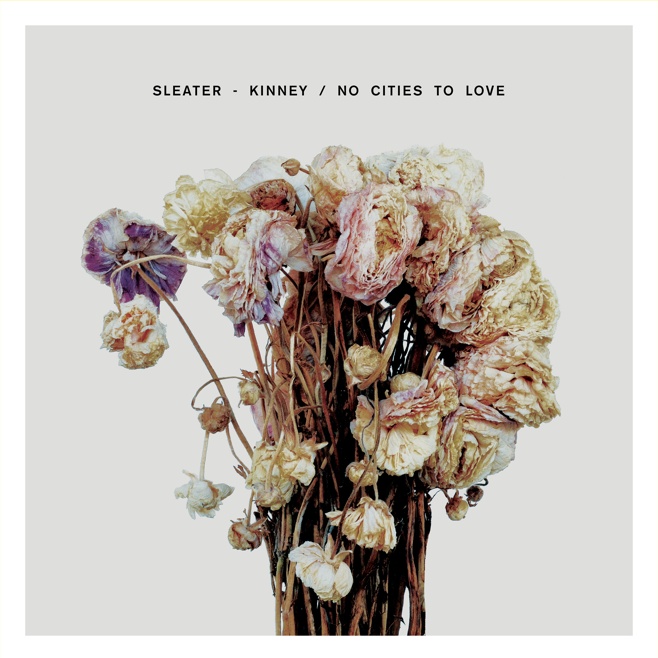
Sleater-Kinney – “No Cities to Love”

Grade: A-

Key Tracks: “Price Tag” “No Cities to Love” “Bury Our Friends”

Confession: This isn’t my first review of 2015. That belongs to Meghan Trainor’s “Title.” But do you know how cliche the metaphor is to start the year with a review of a debut? No, the first review of the year needs to be something more momentous – a comeback (and one that fits in well with my recent post on feminism in music, something Trainor does *not* fall under). So here, one of the biggest comebacks a blog like this could ask for – the first Sleater-Kinney album in 10 years.

Sleater-Kinney never really gave us a reason for their hiatus in 2006. It just seemed like they suddenly appeared, and suddenly disappeared. So, nine years after, it seems just as odd that they’d come back, especially given their successes – Janet Weiss has since played with the Shins, Wild Flag, Stephen Malkmus, and the densely uncrackable trio Drumgasm; Corin Tucker has found solo success; and Carrie Brownstein has found mainstream success as one-half of the largely improvised IFC show Portlandia (as well as Wild Flag). But 2015 needs Sleater-Kinney more than Sleater-Kinney needs 2015. We’ve caught up to their third-wave feminism; their leftist politics may have been “radical” for music in the 90’s (sad) but sound more anthemic today. There’s a revolution looming, and we’ve left Sleater-Kinney’s throne open for their welcome return.

Nearly needless to say, it’s an incredibly successful return. While Sleater-Kinney have never been a challenging band, their varying albums do rely on the listener to interpret the music, rather than the band. And for a band that’s woven through indie rock, riot grrrl and classic rock, “No Cities to Love” feels like a retrospective, that lets the listener reflect on which Sleater-Kinney exactly they’re listening to. Although “No Cities to Love” often sways sonically towards an indie S-K, it packs punk punches, and it’s brimming with energizing, political lyrics that are seemingly banned from indie otherwise. S-K’s political and social lyrics have never sounded fiercer, stronger, and Tucker’s vocals have a catchy scowl to them that entice the listener into their fury.

The album starts, by no coincidence, with “Price Tag.” The band sound like they’re restraining energy, not wanting to exhaust the listener from the get-go; but the lyrics about overspending on both political and personal levels rival the most ferocious and specific lyrics Against Me! or Sonic Youth could dream of. “A New Wave” matches the album’s catchiest, bounciest music with equally anthemic lyrics. “Surface Envy”‘s lyrics about making and breaking rules might sound a little tired, but S-K always have a way of putting out their own spin. And late-album highlight “Bury Your Friends” isn’t as political, but looks at the apathy of burying and reviving friends and idols (kind of like early songs by, well, Sonic Youth).

Musically, “No Cities to Love” leaps around. The title track is one of a few songs that’s outright catchy, with the band exploring its indie side. But “Surface Envy,” “No Anthems,” and “Fade” are all aided by a heavier, denser sound. Brownstein’s guitar is heavy throughout, reinforcing her importance and virtuosity in the guitar world. “Hey Darling” sounds like an indie track but has an unexpected heavy guitar, and “Surface Envy” has a dissonant chord running through its verses. “Bury Our Friends” even takes on a more mechanic tone at times, sounding more rehearsed and intentionally repeating than other tracks.

The Sleater-Kinney we get in 2015 is a mix of previous Sleater-Kinney’s, and it’s necessary blending. Indie and punk have come a long way in 10 years, and can go hand-in-hand now (whereas separated by sharp divides in 2005, unless you were Karen O or a member of Sleater-Kinney). “No Cities to Love” is rarely uneven, often totally complete, and serious in its beliefs. Comeback albums are tricky, but I don’t think there was much doubt that Sleater-Kinney could succeed in a world even more in need of political anthems. Leftist, catchy, angry and energetic, “No Cities to Love” is exactly what you want from a Sleater-Kinney album, just in the year 2015. Setting the bar high early, we’re 1-0 in great albums so far.

If you like this, try: Aside from rechecking your teen angst, rehanging posters you had in your bedroom in 1998, and remembering why you picked up a guitar in the first place, check out Potty Mouth’s 2013 debut, “Hell Bent.” Although more outwardly punk, Potty Mouth owe a lot to S-K’s feminist indie-punk sound.

-By Andrew McNally

(Okay. 1-1. Meghan Trainor review to be posted later.)
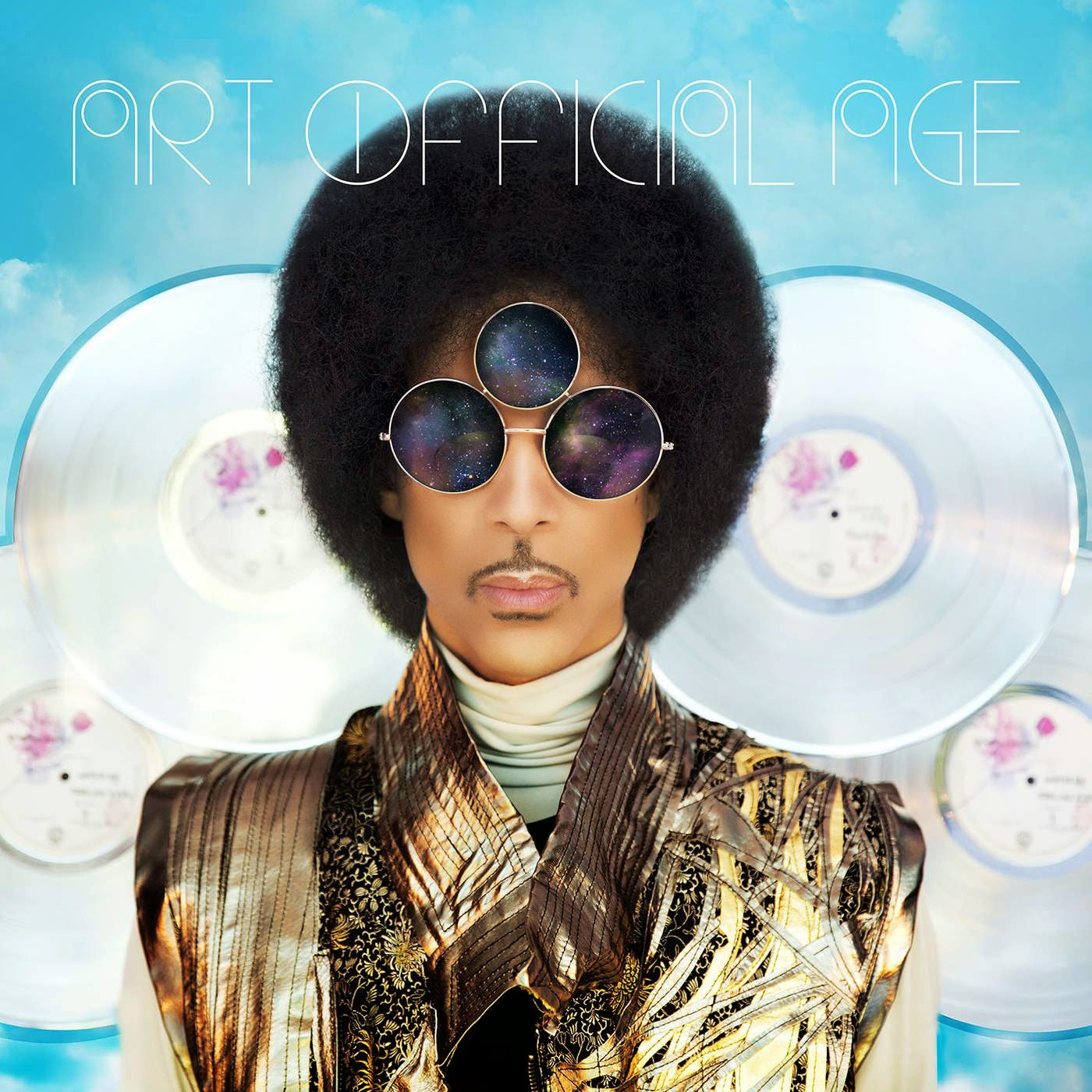
Prince’s “Art Official Age” and 3RDEYEGIRL’s “Plectrumelectrum” – A Review From the Uninitiated

Grades: Art Official Age: B+

Plectrumelectrum: D+

As a music critic, there’s been plenty of times where I’ve faked knowledge of an artist to give some insight into the recording of an album. I’ll admit it, I can’t say I’m on an equal playing field when I talk about both Ariana Grande and Foxygen, I have to look up information on someone like Grande because I’m much more inclined to listen to Foxygen in my own time. But I can’t fake Prince. Not admitting that I don’t know the first thing about Prince’s back catalog and topsy-turvy history would be unfair to him. Prince is a legend; a hero of pop music, and trying to fake my way through a review would not do him any justice. I know that he and Warner Bros. got into a bitter, bitter feud in the ’90’s, partially the reason for him to change his name to a symbol – so Warner would have to find a way to market it. And I know that he’s both feminine and seductive, yet legendary and encompassing enough for the NFL to pick him to play a Super Bowl halftime show (and one of the better ones). What I do know about Prince is that his music has jumped all around, and that’s exactly what his solo album, “Art Official Age,” does. So if you’re not familiar with his music, know that the album is inconsistent but often fun and honest. And if you are familiar, then you probably made up your mind before it even came out. Okay? Okay.

“Art Official Age” starts with a track titled “Art Official Cage,” and it’s a song that would have never existed in the “Purple Rain” years. It couldn’t have. It’s ripped from hip-hop and EDM, with big beats and air horns. It’s fun, and there’s way too much going on, but that’s part of the joy. The album jumps across fun, funky songs and big ballads, all of which are distinctly Prince and neither of which are aligned with any other pop artist. It’s the album’s best and worst quality, that it jumps so frequently and unexpectedly. Luckily, it’s good far more often than it’s bad.

The ballads come early, with the third track “Breakdown.” Prince hits some cringingly high notes, and pulls them off, obviously. “U Know” is a pseudo-ballad two tracks later, but one that has Prince rapping a bit. The hip-hop element is palpable on “U Know,” and is throughout the album. Prince constantly feeds off of genres that fed off him thirty years ago. Ballads aside, the album is a lot of fun, and Prince sounds like he’s truly enjoying it. Late album track “Funknroll” is exactly what it sounds like, a huge disco bash that’s a ton of fun and could easily be thrown on repeat for an hour without getting old. Second track “Clouds” is a strange track, with a strong spoken word that sets up the album’s loose premise of waking up in a world without gender pronouns. And leadoff single “Breakfast Can Wait” is an oddly specific, sexual song that’s exactly what you’d expect from Prince.

“Art Official Age” isn’t all great. The theme of waking up without gender pronouns are neat (and Prince to the max), but it never shows up outside of spoken word bits that are great on “Clouds” and finale “affirmation iii,” but are weak on the other tracks. And Prince seems to be borrowing just a tad too heavily from Daft Punk’s disco playbook – in that he tries lengthy, funky songs, but doesn’t pull them off as well as the duo. There are two tracks, “The Gold Standard,” and “Time,” that are far too long. The former is almost six minutes, the latter almost seven, and there isn’t much of a reason. They just inflate the album’s 53 minute runtime. But it starts strong and it ends strong, and it’s fun in between. People hanging out under rocks like myself should find a lot to groove to on this record, and find a lot of originality in it’s melting of both genres and themes.

On the inverse of that is the debut album from Prince’s backing band, 3RDEYEGIRL. Their album, “Plectrumelectrum,” flows through different genres and influences just as “Art Official Age,” but does so in a much more murkier and standard way. The band, who Prince is proudly touting as being all-female, gets off on the wrong foot with the lackluster “Wow,” a song that lacks the energy to be a true leadoff song, but has enough energy to not be a cop-out slow intro. After that, the album is a topsy-turvy ride, hitting high highs and low lows.

A low low is “Boytrouble,” an overlong and inane pop song that’s stylistically similar to far too many songs that have come before. Another low low is that the album appears to start off with a classic rock vibe for the first four or five songs, before slowly diverging into funk and hip-hop, without seeming to have any real reason. It flows well at the beginning, but the longer it goes on, the more it becomes a collection of songs instead of a fluid album. The album never seems to come to having any point, other than Prince showing off his (talented) backing band. Likewise, on “Fixurlifeup,” he sings lead, and he sings about misogyny in music and how bands shouldn’t be called “female” bands, yet he prides himself on showcasing his handpicked female backing band, contributing to the problem himself. (Not that he shouldn’t have an all-female band, just that he’s being pretty hypocritical about it).

The album isn’t all bad, though. There’s some great, exploratory songs. The title track (and longest on the album) is an instrumental classic rock jam that shows just how talented the band is. And the follow-up, “Whitecaps,” is a pleasant vocal-based pseudo-ballad. And the album has a better pacing, clocking in at a tighter 42 minutes, with some fat trimmed. The album certainly has it’s moments, it’s just very inconsistent and never has a sense of purpose. Perhaps the thing that summarizes it best is that the album’s final track is a different version of “Funknroll,” from “Art Official Age.” It’s a slightly different version that’s still good, but just not as much.

Not knowing anything about Prince didn’t harm me in listening to 3RDEYEGIRL. Their album is more direct, even if it hits different genres. It isn’t a great album and I give only a reserved recommendation for Prince fans only, but it still has some fun moments. And, they’re talented. they’re extremely talented. Non-Prince people like myself can at least enjoy it just as much (probably more) than Prince fans. As for “Art Official Age,” it’s also inconsistent, but it’s fun and energetic, and it might be a refresher for his fans. Or at least that’s what it sounded like to me.

-By Andrew McNally

Pink Floyd – “The Endless River”


Grade: C+

Key Tracks: “Skins” “Anisina” “Allons-y”

Let’s get this out of the way – in high school, I owned or had a burned copy of every Pink Floyd album. I knew every album, it’s themes and intricacies. I was with the band in the highs (“Dark Side of the Moon,” “Animals”) and the lows (“Obscured by Clouds,” “The Final Cut”). I was on-board for big hits and deeper, 20+ minute cuts. So when I heard there was a new release, I was understandably a bit tentative. It’s worth noting, before anything, that the album is almost entirely instrumental and comprised of outtakes from sessions recorded for their proper swan song, 1994’s “The Division Bell.”

This album has eighteen tracks, but really only 4. It channels some of their crazier 70’s albums that only had 4 or 5 tracks, but maintains a steady, standard and more traditional post-Waters calmness. The four tracks are broken up every few minutes, as the members saw fit, and are further broken up by record side. I don’t personally think that David Gilmour and Nick Mason would want you to think of this as a great Pink Floyd record, it’s more self-serving to fans. And it acts as a sequel to “Wish You Were Here,” in that it’s a proper sendoff to a past member. Richard Wright, longtime keyboardist, was the only member besides drummer Nick Mason who was with the band for their entire run. He passed away in 2008, but this album’s strongest points are his.

Pink Floyd had a long, legendary run. It started with “Astronomy Domine,” in 1967, and ended with “High Hopes” in 1994. The biggest problem with “The Endless River” is that it upsets this legacy. The band never went more than a few years without releasing an album, even in the midst of a bitter Waters v. Gilmour feud. And while “The Division Bell” wasn’t a great send-off, “High Hopes” was a decent closing song. So, twenty years later, when the surviving, recording members decide to release an album of unused, ambient tracks, it seems a little tarnishing.

But, isn’t that a Pink Floyd thing to do? Think about their discography – they followed up two of the biggest rock albums of all time – “Dark Side of the Moon” and “Wish You Were Here” with the almost utterly incomprehensible “Animals” – and pulled it off. “The Division Bell” was disappointing because it was too close to normal post-classic rock classic rock. What better way to follow that up than with an almost entirely instrumental album? One that’s four songs, split up into eighteen?

I’ve been pretty back and forth so far, so let’s review this album, idea to idea. The first three tracks make up the first side, and although they’re little more than a dreamy intro, they’re Wright-heavy. His presence is felt, and it feels like a proper tribute, recorded by the man himself. At points, the opening tracks sound similar to “Welcome to the Machine,” in their frozen, abrasive keyboards. The next section, four tracks, is a little less ambient and gazy, and a little more rock oriented. It’s cool overall, although it strongly favors the odd-numbered tracks. “Skins” features some energetic contributions from both Mason and Gilmour, and “Anisina” is backed by an unexpected horn section.

Side three is the strongest, if not the most bogged down in tracks. It takes up seven tracks in just under fourteen minutes. It would work a lot better as just one thirteen minute song, but in this day and age, this isn’t the Pink Floyd we get. There’s two tracks called “Allons-y,” two parts, and they’re similar to the “Another Brick in the Wall” segments, in that they’re small segments of a bigger rock song. And they both have that tremolo guitar, too, going after that 1979 sound. It closes with the track “Talkin’ Hawkin’,” which features Stephen Hawking on a vocal sample. It’s weird simply because it isn’t fully pulled off, and you know it should work better. The album’s last section, four tracks, are another more ambient section. But the section closes with “Louder Than Words,” the album’s only song with lead vocals. Gilmour sings lead, and it has a semi-unintentional effect of building up to it.

Floyd fans, read this: this album is no better or worse of a send-off than “The Division Bell.” Casual fans, read this: this album is an experimental work, focused solely on music, that was released 20 years later not as a reminder but as a requiem for the former keyboardist. Either way, although it isn’t a great album, it’s nice to simply hear from the guys behind it. Without Wright or Barrett, or Waters, Floyd is simply Gilmour, Mason and supporting characters. So to hear these throwbacks to a time when they were winding down, but not closing out, is a little special. “The Endless River” has almost no lyrics, but for a band that once put out “Several Species of Small Furry Animals Gathered Together in a Cave and Grooving with a Pict,” that’s not much of an issue. So Pink Floyd’s swan song isn’t the masterpiece they deserve, but it is at least a solid collection to go out on. RIP Floyd, thanks for defining high school for me.

-By Andrew McNally

Foo Fighters – “Sonic Highways”

Grade: C-

Key Tracks: “Something From Nothing” “What Did I Do?/God As My Witness”

Ever visit a coffeeshop or restaurant enough that the staff knows your order? You walk in and they’re already making it? That’s what the Foo Fighters are like. Their albums are entirely softball pitches, the musical equivalent of treading water. 2007’s “Long Road to Ruin” sounds just like 1995’s “This is a Call” which sounds just like 2002’s “All My Life.” They gleefully play music that’s expected. And there’s nothing wrong with that, other than new albums being predictable almost to the song. It’s to the point where I never even bothered listening to 2011’s “Wasting Light.” But this album is different – it’s a proto-concept album. Eight tracks, each recorded in a different city, “in the vein” of that city’s music scene. It’s a great concept – but they don’t pull it off all that well. It varies heavily by track. They tried to keep their signature sound, but it’s similar to someone hugging you and letting go just enough so you can breathe again.

The cities they cover are, in order: Chicago, DC, Nashville, Austin, Los Angeles, New Orleans, Seattle, and New York. And each track offers a guest musician from that city, although like the songs themselves, both their involvement and the marquee quality of their names vary wildly. Since “Sonic Highways” is so inconsistent, it’s best just to discuss the album track by track. Ready? This might take a while. Let’s go:

1) “Something From Nothing” – Chicago. It’s fair to say that, with exception maybe to LA, Chicago has the weakest music scene of the cities done. This is the leadoff single, and arguably one of the album’s better songs, though hurt unintentionally by a lack of uniform scene in the city. Contributing baritone-guitarist Rick Nielsen (of Cheap Trick and 5-neck guitar fame) adds a weird and jarring dimension to the song with a murky rhythm that sinks the song’s pitch. The song builds, slowly, to a nice climax too. The band take their time more on this album – five of the eight songs are over five minutes. Sometimes it doesn’t work, but this is a pretty strong Foo Fighters song.

2) “The Feast and the Famine” – DC. There’s no reason why this one shouldn’t work, but it’s a mixed bag. Every Foo Fighter grew up playing in punk bands – most notable being Pat Smear founding Germs. So the band tries to rope in the 80’s DC hardcore scene, even so much as bringing in members of Bad Brains on vocals. But what results isn’t a punk song, just a fast radio rock song, intense, but no more so than, say, “Low” or “I’ll Stick Around.”

3) “Congregation” – Nashville. I’m just going to come out and say that this track is boring. It lost my attention as it drags past five minutes, far too long in this case. It’s also impossible to tell what Nashville’s music scene is from it. The inclusion of Zac Brown should be an indicator, but it’s just an average, dull rock song. There’s no Tennessee in it at all.

4) “What Did I Do? / God as My Witness” – Austin. This, by contrast, is by far the most interesting and enjoyable song. It’s titled twice, and there is a stoppage in the middle – but it’s distinctly one song. It’s one of the Foo’s more inventive tracks, and it doesn’t feel long even though it’s 32 seconds more than the long-feeling “Congregation.” Blues guitar virtuoso Gary Clark, Jr., is brought in, and although his inspiration isn’t felt until the solo-heavy climax, it’s worthwhile. He’s one of the better used guests, and the it’s one of the more city-inspired tracks. It has just the faintest blues and country elements, both musically and lyrically.

5) “Outside” – Los Angeles. This is an energetic track, though pretty average. It’s helped by a great solo from Joe Walsh. There’s very little to say about, other than it gives me an excuse to listen to a Joe Walsh solo without having to suffer through an Eagles song.

6) “In the Clear” – New Orleans. Foo Fighters bring in Preservation Hall Jazz Band, the legendary, decades-running collective, and completely waste them by burying them under their own guitars. Foos could’ve made a cool, jazzy track, but it’s got no Jazz Band and no New Orleans, just another Foo Fighters song with some occasional, distant horns.

7) “Subterranean” – Seattle. This is another city that they really shouldn’t have messed up given, you know, Dave Grohl being in Nirvana and all. But it doesn’t represent Seattle’s music scene very well. It’s a boring, midtempo song, completely devoid of the insanity that blessed Nirvana, early Pearl Jam and Alice in Chains. That might be the work of sadsack crybaby guest musician Ben Gibbard, of Death Cab for Cutie and Postal Service fame. His music is dryer and more medium paced, much like this song. Then again, given that he is entirely indiscernible on the song, it might not be.

8) “I Am a River” – New York. Taken just as a closing song, this one’s pretty strong. It creeps along, building ever so slowly into a proper album finale climax. Put it on a different album, it would work great. I just didn’t get what faction of New York it was representing. New York’s “music scene” is largely punk-based, but there’s indie and, well, Frank Sinatra thrown in too. The only NY band I could come up with that this resembled was Interpol, and while I love Interpol, I don’t know that they’re quite the caliber band that the Foo Fighters are going to play off of. Also, this track has the most disappointing guest in Tony Visconti. No disrespect to Visconti – his work with David Bowie throughout decades is tremendous. It’s just that when you’re combing the biggest city in the country, the one that is the music home of Karen O, Patti Smith, Julian Casablancas, BB King, and the surviving Beastie Boys, Tony Visconti seems like an oddly subtle choice. Visconti, like every guest except Bad Brains and Preservation Hall Jazz Band, contributes guitar.

This is a weird album. Foo Fighters, or at least Grohl, seem deeply wrapped up in this concept of music scenes in cities. We’re not really getting let in on that concept as much as the band thinks. We can’t celebrate the music of Seattle or DC when it’s just another Foo Fighters song that happens to have a guest star you can hardly decipher. So my recommendation, if you’re going to listen to this album – don’t play into the concept. Just listen to it as a straight Foo Fighters album. It still won’t be great – the tracks will go on too long and it won’t quite have the flow that its predecessors do. But it’s probably more enjoyable when you don’t factor in the effort of an extensive and expensive recording process, with city influence. Just don’t think about it. Foo Fighters have never been a challenging band, there’s no reason for them to start now.

-By Andrew McNally

The Jazz June – “after the earthquake”

Grade: B

Key Tracks: “over underground” “edge of space”

The dream of the 90’s is alive, and it’s a sad, forced dream. The Jazz June are back for their first album in 12 years, willfully back to participate in the emo movement that they helped spawn. Nothing has really changed in the interim – they’re still playing invitingly intimate songs with a half-forced energy that are equally ready for the radio and for the underground.

Most of the songs on the album deal, at least seemingly, with relationships and self-confusion. “stuck on repeat” has a repeated section of the line “I’m still trying to figure it out,” a line that lands harder coming from a band that’s been inactive for over a decade. The album is marked by lyrics that are somewhat vague but appropriate – “I still don’t know where you are” on “nothing to see here,” “You thought I was perfect / But you got it wrong” on “it came back.” “edge of space” is also pretty noteworthy, a track about Felix Baumgartner and the former astronaut who helped plan his famous dive. These somewhat muddy lyrics are more indicative of the 90’s emo scene that the Jazz June were heavily involved in, instead of the often hyper-specific lyrics of newer bands. And, it couples better with the equally muddy music.

The Jazz June, like many of their second wave-emo contemporaries, played relatively standard music. It’s distinguishably alternative, with an emo twist – think being influenced by early Weezer and actively trying not to sound like early Weezer. The downside is that some tracks don’t stand out. The upside is the ones that do really do. Opener “over underground” starts with a screeching guitar, sirening their return. And late album treasure “nothing to see here” has a big and unexpected guitar crunch in its chorus, one that helps to break up the album’s general midtempo nature. Otherwise, it’s pretty standard alternative fare – inoffensive, kind of inconsistent, but fitting.

To someone first coming into emo, being exposed to bands like, say, the Front Bottoms, or Glocca Morra or Radiator Hospital, the Jazz June might not make that much of a lasting impression at first. But their return is all about the melding of two eras – the Jazz June are back, Mineral are back, Braid are back. The Jazz June were and are a band’s band – though never famous, they’ve set the template for bands that have come since. The shoving out of third-wave emo and welcoming of fourth-wave has brought the once-young sad and melodic people of the 90’s out of hiding. The Jazz June are back, and hearing something so straightforward is really pretty refreshing.

The album comes out tomorrow, 11/11/14, on – where else – Topshelf Records.

If you like this, try: I just recommended this in a different review, but Prawn’s recent “Kingfisher” album speaks more of an older, bigger sound, than a newer, more condensed one.

-By Andrew McNally

Pharmakon – “Bestial Burden”

Grade: B

Key Track: “Bestial Burden”

One of my biggest regrets of 2013 was never getting a chance to review Pharmakon’s proper debut album, “Abandon.” Pharmakon, industrial-noise based project of Margaret Chardiet, is one of the harshest acts out there, and “Abandon” still serves as just a brutal listen start to finish. Due to unforeseen health circumstances, Chardiet had to cancel the first major Pharmakon tour and get emergency surgery. While she was recovering, she wrote a follow-up: “Bestial Burden.” The album is menacing and brutal, more inward and deprecating, but also with its moments of honesty and musicality.

I take notes when I listen to albums. For the first track, “Vaccuum,” my notes only say “just breathing.” It’s an intro, one that is just the sound of heavy, panicked breaths. Sure, it’s nothing compared to the sonic assault of “Abandon,” but it sets the album’s tone. This album is frantic, not just devoted to volume but to dissonance and to issues of health and well-being. The first true track, “Intent or Instinct” is noticeably more industrial than anything on “Abandon.” For eight and a half minutes it soldiers on – the first scream comes in around the three-and-a-half minute mark, and the industrial beat never sways, even as the screaming gets more intense.

This constant, industrial tone is one that stays throughout the album. It marks a departure from the abrasive synth blasts of before, although it is still an assault on the ears. But the album is structured in its noise. The tracks have steady, unfaltering industrial beats that oftentimes border on the verge of being rhythmic. Or at least, consistent. Pharmakon have always had a way of finding rhythms in pure noise, but this album does it more cleanly and more directly than before.

After Chardiet had to undergo emergency surgery before her first European tour, she began writing a more introspective work. This album is the result. It’s noticeable in the album covers alone – “Abandon,” with a pair of skinny legs (presumably Chardiet’s), covered in maggots, to this one – insides. This album is inside the body. Songs about health and the body. The title track has the repetition of the line “I don’t belong here,” coupled with laughing.

Both “Abandon” and “Bestial Burden” have bonus tracks, and they’re indicative of the albums themselves. “Sour Sap,” from “Abandon,” is a blistering 27 minute hell journey through screaming and pure white noise. But “Bang Bang,” on “Bestial Burden,” is the straightest song Pharmakon’s ever done. Sure, it’s about getting murdered, but it gives Chardiet a chance to actually sing, instead of screaming, and she has a pretty accommodating voice. The longest track on “Bestial Burden” is “Intent or Instinct,” at eight and a half minutes. Though longer than any of the non-bonus songs on “Abandon,” the album’s songs feel shorter. And they are – there’s more shorter pieces, instead of a few long ones. It allows the album to feel like a journey through the mind and body; a disturbing trek through a broken and disturbed being. Interlude “Primitive Struggle” is just a man coughing over an increasingly fast heartbeat – so simple, but so demanding.

To jump into Pharmakon, you have to know to expect screaming, slammed-down synth notes, and a perpetual feel of pure terror lurking around the corner. “Bestial Burden” takes an inward stance, and the result is more structured, but no less full-frontal. If “Abandon” challenged insanity, then “Bestial Burden” challenges injury. It isn’t for the faint of heart. It’s abrasive and brutal, almost palpable in its intensity. Industrial-noise is called so for a reason, and although the album might not be as immediately terrifying or numbing as “Abandon,” it is still confounding and abrasive, and only for the most committed and toughest listeners. Have fun picking through it, Pharmakon is here to stay.

If you like this, try: Spinning Death Grips records backwards or something, I have no idea.

-By Andrew McNally

Foxygen – “…And Star Power”

Grade: B

Key Tracks: “How Can You Really” “Cosmic Vibrations” “Can’t Contextualize My Mind”

All day I’ve been trying to come up with outdated words to describe this album. Rad? Killer? Kickin’? Foxygen are a classic rock band for the digital age. They always have been. But their new double album, “…And Star Power,” is so classic rock inspired that it explores it as a concept. The album is split into five parts on four sides, all of which represent some faction of a standard classic rock album. And although at 82+ minutes, it’s way, way too long, it provides for an interesting listen as a 24 track album where each song gets crazier than the last.

Side One of this album is split into two parts – the first half of a classic rock album, with the radio hits, and the second half, where only the band’s real fans keep listening. What this means for Foxygen is a start to a lengthy album with a few midtempo, standard-ish songs. It’s a risky move, trusting your fans to keep listening even though the opener is shaky. But it does provide a few great songs – “How Can You Really” is the most Foxygen-y song ever produced, a song that sounds just like any classic rock standard, except for it’s indescribable sloppiness. It and “Cosmic Vibrations” have provided two singles for Foxygen, on an album that’s otherwise devoid. Part Two of the side is one suite – the four-part Star Power Suite. The four songs, including an opening overture, are all speedy garage-rock bruisers that are a lot of fun. Only one of them stretches over three minutes, so they don’t overstay their welcome.

Side Two is subtitled “The Paranoid Side,” and it’s easily the weakest side of the album. The loose concept of this section is songs that are more psychedelic and free than standard rock settings. “I Don’t Have Anything/The Gate” and “666” are interesting songs, but it’s the longest section from a track number standpoint, and it’s got some of the most forgettable songs. “Flowers” and “Cannibal Holocaust” might sound better on a shorter album, but on one that’s already overly bloated, they just take up time.

Side Three, or Scream: Journey Through Hell takes a sudden detour into songs classic rock bands wish they could’ve pulled off, but couldn’t have at the time. The section is kicked off by the nearly seven minute “Cold Winter/Freedom,” which never has a discernible rhythm but some haunting tempo changes. The section is marked by chaos – screaming, hyper rhythms and drastic volume increases. “Can’t Contextualize My Mind” sounds exactly a Stones song left on the floor because it broke an album’s flow. “Brooklyn Police Station” “Freedom II” and “Talk” are all equally intense, hitting chaotic levels even for Foxygen. The few lyrics the songs have are often unintelligible. It’s jarring and off-putting at first, but they’re tracks that demand a few listens, and the listener is drawn back to them almost immediately.

The final side is just two tracks, sweeter outros which don’t exactly fit, given the predecessors, but they’re decent enough as is. “Everyone Needs Love” is a sweet, lengthy song, and “Hang” is a calmed and fitting finale. Their placement doesn’t really work but there isn’t much to comment on them.

“…And Star Power” sounds like their previous album, “We Are the 21st Century Ambassadors of Peace & Magic” on an immediate level – it’s classic rock inspired lunacy, with brilliant flow, quick switches between melodies and chaos, and a permanent garage feel. But it’s a very different album. (Full disclosure: “21st Century” is one of my two or three favorite albums, so take any analysis with a few grains of salt). “21st Century” is only 36 minutes long, nearly a third the length and fifteen songs fewer. And where “21st Century” prouds itself on dense, bizarre and witty lyrics (“On Blue Mountain/God will save you/Put the pieces back together” shows up in at five of the nine songs), this album centers itself on more conventional lyrics, instead aimed at the flow and the grandiose concept. Much of “…And Star Power”‘s rough transitions, competing ideas, and sheer length come from the band’s inner-fighting, well-documented since their break early last year. This album actually serves to clarify that things aren’t as bad as they seemed to us, but the output still goes to show some issues.

Foxygen have always been a high-concept band. Don’t forget, their first album was a 30 track space opera. So the concept, on the whole, works well on “…And Star Power.” They’re a classic rock band incarnate, evident in Johnathan Rado’s utter devotion to singing like Lou Reed and Mick Jagger. The album’s only fault is that it’s just long – so, so long. Twenty minutes could probably be chopped off and it would have the same effect. On top of multiple songs in each section, there’s interludes that just take up more time. But still, Foxygen are cool as hell. There’s a reason they were able to get members of the Flaming Lips, White Fence and Of Montreal to guest on the album. “…And Star Power” is the album that MGMT wishes they could make – expansive, ambitious not to but past a fault, flowing but inconsistent and downright bonkers. If you have 82 minutes to spare, and you’re into indie-garage bands taking pages from psychedelic classic rock, then “…And Star Power” is by all means worth a listen.

If you like this, try: This one’s easy. Jordaan Mason & Horse Museum’s 2009 album “divorce lawyers i shaved my head,” a concept album about a failed marriage between two people confused about their sexual identities. Each song escalates in it’s disturbing and bizarre qualities, but does so at a slow pace so the listener doesn’t pick up on it at first. It’s a confounding work. Mason does his best Jeff Mangum impression throughout.

-By Andrew McNally

Dads – “I’ll Be the Tornado”

Grade: B+

Key Tracks: “Grand Edge, MI” “Sold Year/Transitions”

Gone are the days of “Groin Twerk” and albums with ‘Radass’ in the title. Dads’ perpetual lyrical theme of growing up and drifting away comes stronger, as the Jersey duo mature in leaps and bounds over their last record. We saw this transition coming, on the decidedly not-so-emo “Pretty Good,” an EP that never really found it’s place. “I’ll Be the Tornado,” an LP, completes the transition into a serious, adult band. Except, they’re still punk.

Much like last year’s “Pretty Good,” the guys bounce around in a few different influences. This album has much more flow than “Pretty Good,” not trying to make any statements about the music, instead letting the audience accept it as it comes. The album’s acoustic opening isn’t a copout, it’s part of a build-up, and it’s unexpected. (And it’s reminiscent of this year’s largely acoustic Cardinal Cardinal EP, the side project of John Bradley). We’re still kind of expecting disassembled, roaring songs like “Get to the Beach!” but they’re not present. Instead, we get a number of flowing rock tracks, with occasional punk jams (“You Hold Back”), emo ballads (“But”) and some slight, leftover twee rhythms (“Chewing Ghosts”). “I’ll Be the Tornado” is more straightforward and accessible, if not still tough around the edges. Two part track “Sold Year/Transitions” has a rough and straining transition in the middle that’s fresher than most of the album’s other music. Dads feel comfortable falling into more traditional rock, but they can still pull it all off.

And they can pull it off because John Bradley’s lyrics, vocals and drums haven’t changed a note. “I’ll Be the Tornado” is a drum-heavy work, logical when you’re a duo with a drummer who sings lead. And Bradley’s lyrics are as ‘fresh’ as they’ve ever been. They have a certain ‘creative writing 101 course’ feel to them – poetic only in their specificity, direct, regretful and reminiscent. His lyrics are always unique, opting for straight punches rather than anything subversive. “I want to be happy,” Bradley starkly admits on “You Hold Back,” which seems a contrast to everything before and after it on the album. Bradley, and Scott Sharinger, explore feelings of unease and uncomfortable maturity, not knowing what to want or expect out of life. As with previous albums, many of their lyrics are based around falling back on memories because you can’t make anything of the future. “I need something new to obsess over,” says second track “Chewing Ghosts.” And reflections on others are present, as always. “You wanna hang Christmas lights in the summer/An excuse to spend time with each other” Bradley sings on “Sold Year/Transitions.” And Bradley also sings about his own dad’s health struggles, with references peppering the album throughout. The album is honest, even for Dads, with frank poetry and gut-hitting remembrances.

The only real fault of the album is that in its embrace of more traditional rock music, it sputters out towards the end. The album ends with “Take Back Today” and the 7+ minute “Only You,” both of which are musically pleasing songs, but aren’t the big finish the album needs. They’re both kind of ho-hum songs, not hitting the same level that the rest of the album does. So it dampers the album a bit, but not enough to discredit the eight songs before it. “I’ll Be the Tornado” is still a wildly and unexpectedly progressive album for the band, one that’s also regressive in many ways. It’s definiably Dads, but it’s more open, grittier, slower, clearer, and even more honest. Gone are the punk blasts, and they’re missed, but the replacements are more than welcomed.

If you like this, try: Prawn’s recent album, “Kingfisher,” another more mature sounding emo album, albeit one that takes an entirely different lyrical approach.

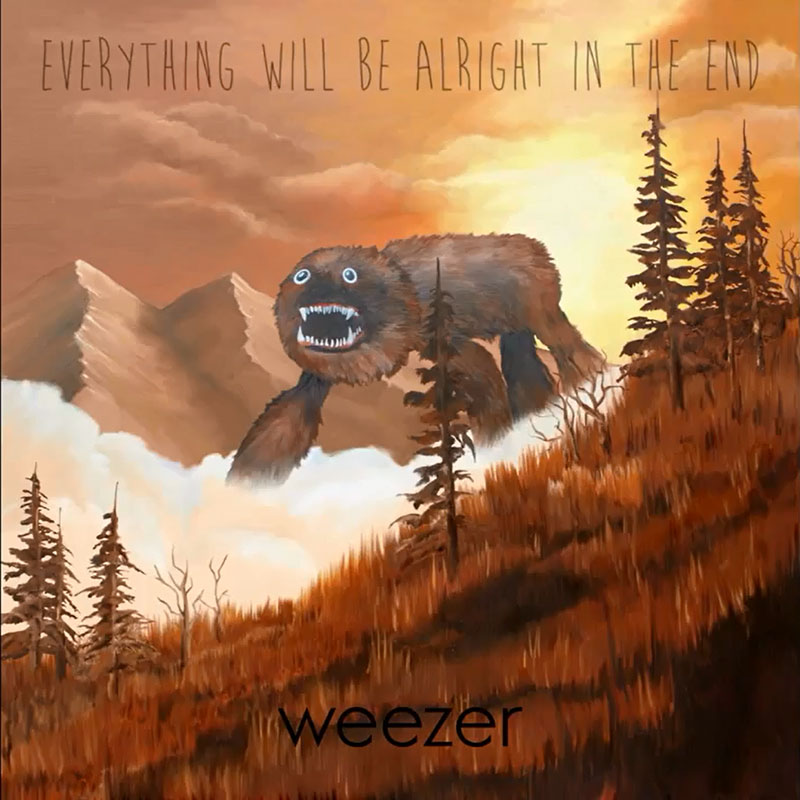
Weezer – “Everything Will Be Alright in the End”

Grade: B

Key Tracks: “Ain’t Got Nobody” “Foolish Father”

Baby steps, people. Baby steps. It’s been a longtime since we’ve seen a Weezer we can trust, but we’re getting closer.

It’s no secret that Weezer fans, and fans of basic alternative radio, have suffered over the past decade. Since the excruciating “Make Believe” in 2005, Weezer has released a string of five largely terible albums. And most of them roped us in with great singles – 2005’s “Perfect Situation,” 2008’s “Pork and Beans,” 2009’s “If You’re Wondering If I Want You, I Want You To,” 2010’s “Memories.” But after a four year break (no, not some more undergrad studies), Weezer are back with an album that comes closer to revisiting their roots than they’ve seen in 12 years.

You may have heard leadoff single “Back to the Shack.” It’s honestly a pretty terrible song. Something about the weird hip-hop influence over the fuzz guitar doesn’t work, like something is just off. But the sentiment is there – an apology to fans and bandmates, from Rivers Cuomo, for years of music that didn’t sound like “My Name is Jonas” or “El Scorcho.” Indeed, Weezer go back to the basics on this album. It’s the closest thing to 90’s fuzz-rock we’ve gotten since 2002’s underappreciated “Maladroit.” And while it’s inconsistent and largely less than exciting, it’s still a nice refresh on a legacy that had become more asterisks than not.

The album deals with relationships – Cuomo’s relationships with others, women, and his father. They might be tried topics, but not for a band that’s trying to reclaim a lost sound. The last of those – Cuomo’s relationship with his father – comes through the strongest. The album’s last four tracks deal with it. “Foolish Father” is direct, but the last three songs – a trilogy – are not. “I. The Waste Land,” “II. Anonymous,” and “III. Return to Ithaka” close out the album on a big note, a booming finale of tracks that’s reminiscent of bands bigger than Weezer. Parts I and III are instrumental, but it doesn’t matter, because they hit a sound they’ve never really hit before.

Weezer also smartly give a nod to bands they’ve influenced. Bethany Cosentino, of Best Coast fame, sings on “Go Away.” And Patrick Stickles, frontman for (the best current American band) Titus Andronicus, contributes guitar on “Foolish Father.”

The 90’s garage-nerd fuzz comes back, finally, though it isn’t as strong as it used to be. This album is about on par with the Green Album – the kind of Weezer we like to hear, even if it isn’t their best work. Most of the songs aren’t that memorable, but it still makes for a good listen. Cars frontman and early Weezer producer Ric Ocasek seems to have roped the band back in, too, with his production sounding similar to the band in their heyday. It seems like we can finally say, “gone are the days of mediocre, scattershot Weezer.” “Everything Will Be Alright in the End” doesn’t have the standout songs that “Ratitude” or “the Red Album” have, but it instead offers more than just two good songs. Nearly every track on “Everything” is 90’s era garage-rock, and the only ones that aren’t are the mid-album slow jams. “Everything” isn’t going to go down among “the Blue Album” and “Pinkerton,” but it’s a serious step in the right direction, and it’s the album that we, or at least I, never thought I would hear Weezer put out anymore.

-By Andrew McNally

Interpol – “El Pintor”

Grade: B+

Key Tracks: “All the Rage Back Home” “Everything is Wrong”

This album is refreshing, in the sense that waking up to find a glass of tepid tap water on your nightstand at noon on a Sunday is ‘refreshing.’ Old Interpol isn’t back – even literally, as Carlos D’s departure has left the band a trio – but this album is the closest they’ve come to vintage Interpol in a decade.

“El Pintor” is both an anagram for “Interpol” and Spanish for “the painter.” Both titles fit – this is an album worthy of being self-titled, if they hadn’t already done that on their murky 2010 album. And painting – making something from nothing. The band has basically re-kickstarted themselves; Paul Banks absorbed the bass parts, and they’ve returned to a tighter and denser sound. They’ve made the best out of what was becoming a bad situation – a legacy of people saying “Well, their first two albums were great…” The trio sounds like they’ve shelved some ideas and put “Our Love to Desire” and “Interpol” behind them. To put it more simply, Interpol has not, as you would exactly expect, been affected by critics at all.

Interpol isn’t doing any flexing here. There’s nothing extravagant – no time for that. “El Pintor” is just 40 minutes long. They trimmed everything they could, leaving just the tight, existential journey that was their first two albums. “El Pintor” is structured phenomenally well, with blast after blast. “Interpol” ended on two huge duds, but there’s none of that on “El Pintor.” All ten songs are in the same vein, guitar-heavy proto-post-punk that’s fueled equally by small garages and big cities. Interpol’s tightness in their writing and production has been one of their strongest points in the past, and it is again here.

The album’s best quality may also be it’s most immediate fault. Where “Our Love to Admire” and “Interpol” were insufficient Interpol albums, they did provide some highly listenable songs – “No I in Threesome,” “The Heinrich Maneuver” and “the Lighthouse” from the former, “Barricade” and “Lights” from the latter. There aren’t any songs that demand immediate re-listens on “El Pintor.” It’s an interesting imbalance, that exists within Interpol, where their better albums work well as a whole and and don’t have more standout songs. “El Pintor” works as a whole, and it’s a little tough to just causally listen to any track. But at the same time, it makes it such a stronger album. I listen to “Barricade” all the time, but I’ll gladly say “El Pintor” is a better album. This imbalance exists on their still classic first two albums, “Turn On the Bright Lights” and “Antics.” The better an Interpol album is, the tougher it is to digest.

But, look, so much of reviewing any type of media is comparing it to something done before. And that’s usually not fair to the thing being reviewed. So let’s talk about what makes “El Pintor” subtly, but radically different from any other Interpol album – optimism. It isn’t outward, but it is noticeable. The band is still singing gloom and doom, but it’s a new light – gloom and doom has an end. Even the excellently-titled “Everything is Wrong” has an optimistic streak. It doesn’t overwhelm the album; don’t think the band is suddenly sunshine and fresh fruit, “El Pintor” is still dark and complex. But there’s a slight optimistic streak that’s never existed in the band before.

“El Pintor” might not quite live up to it’s early predecessors, but it’s a great album in its own right. It’s never more evident than in the opening track, “All the Rage Back Home,” which starts with a typical Interpol-ly broody intro before kicking into a pseudo-club beat. It’s unexpected – way unexpected – but it all works. And as much as I, personally, have enjoyed every Interpol album almost equally, it’s refreshing to say that it’s working. Interpol have adjusted to new circumstances remarkably well. They seem to be doing well. They seem happy, or, at least, content.

If you like this, try: the Strokes kinda-comeback album, “Comedown Machine.” “Angles” was garbage so that’s their true comeback.

-By Andrew McNally