Ross Hammond & Grant Calvin Weston – “Blues and Daily News”

Grade: B+

Key Tracks: “Blue Teeth” “Aquarium Salt”

“Blues and Daily News,” a collaborative album between jazz guitarist Ross Hammond and drummer Grant Calvin Weston, came about by Weston recording improvised drum parts and mailing them to other artists. Hammond’s contributions led to the track “Little Melon Head,” which led to a full album recorded in the same vein. The 10 tracks are all short blasts of improvised guitar and drums, spiraling through jazz, funk and country rhythms, amongst other influences.

Hammond’s guitar is virtuosic throughout, as he improvs his way through many different styles. We get glimpses of rock, in opener “Huff, Puff, and Blow It All Down” and “Blues and Daily News.” “Aquarium Salt” is led by an ambient, minimalistic rhythm in the background. And “Blue Teeth” is centered around very twangy, slide-heavy country rhythms. “Little Melon Head” even has a Latin flare to it. Hammond’s musical knowledge of genres, and his ability to bounce through and around them is impressive. “The Big Dipper” is also a noteworthy track, simply because Hammond hits an intensity higher than any other track. Hammond’s improvisation style is structured, as much as improv can be. He feeds off his own rhythms and ideas, maintaining a consistent sound in each track without falling into doing anything actually repetitive.

But one of the album’s most interesting qualities is how the two musicians vary in their improv styles – Weston’s drumming is much more unfiltered and manic. It is impressive and technical from start to finish, and it’s more unstructured style provides a stark contrast to Hammond’s guitar. It adds a chaotic balance. Weston also shines on “The Big Dipper,” his strongest track. His drumming complements the quicker-than-normal guitar of the track. Weston is prominent on “Aquarium Salt,” as Hammond takes a backseat and lets Weston work. Weston often adds rock drumming to his jazz, as much Ginger Baker as Buddy Rich.

As mentioned, the album blends influences together. Country, ambient, rock, jazz and others are explored. The final track, “Get Ready to Meet God,” is even centered around a snippet of an interview with Muhammad Ali. There are a number of interesting ideas on “Blues and Daily News,” and although some of them could have been extended more, it makes for a unique listen. Hammond and Weston play off each other nicely, and the combination of non-jazz styles in a jazz platform makes for some fun and independent songs.

This album is especially surprising, given how it stands as a stark contrast to Hammond’s “Humanity Suite,” which I reviewed in March. Stream and download “Blues and Daily News” here.

-By Andrew McNally

The World is a Beautiful Place & I Am No Longer Afraid to Die – “Broken Bodies”

Grade: B

Key Track: “If And When I Die”

Nine-member band The World is a Beautiful Place & I Am No Longer Afraid to Die aren’t exactly known for palpable, conventional music. You can probably tell by staring at their eighteen syllable name. Their mix of emo, ambiance, twee-pop and dissonance has, for a few years now, brought a fresh voice to a scene dominated largely by straight pop-punk. Their new EP, recorded alongside spoken word artist Chris Zizzamia, is even more confoundingly complex and headache-y than their previous works.

The band, who I’m going to shorten to The World Is to avoid carpal tunnel (no offense!), brought on Zizzamia to bring a form of intense narration to their ambient music. They knew it would polarize fans – only the people truly onboard with them would appreciate it, because it is tough to swallow. Zizzamia spits some beautiful poetry throughout the EP, about human bodies making up stars, intertwining, and facing invincibility, all capping off with the beautiful line “I think my name is safest in your mouth” in the finale, “Autotonsorialist.” Another great line, “I like you like I like the dark/Why would I aim to defeat it?” peppers the track “Shoppers Beef.” Zizzamia is an interesting addition to the band – it isn’t just that spoken word works well alongside the band’s music, it’s that his spoken word works well. His flowing poetry, moving through anger, hope and experiment, is told with a spitting clarity and a scathing touch. It’s a strange fit, but that’s kind of the band’s MO, after all.

The band takes pages out of every section of their own playbook on “Broken Bodies.” Through the eight tracks, there’s a long, experimental opening, build-ups to climaxes that don’t happen, a conventional song (“$100 Tip”) that fades out into a multi-minute drum segment, and a track with a full, driving beat (“Space Explorations to Solve Earthly Crises”). They hit all their own notes. There are actual vocals throughout the album, in a few tracks. Some are just Zizzamia, some are both, and occasionally we get them simultaneously.

The fault in the EP’s experimentation is that it doesn’t have quite the same cohesiveness that their full-length, “Whenever, If Ever,” had. The EP flows, but each song is it’s own distinct being, where the tracks on their album all need each other to work. Still, spoken word alongside experimental emo makes for a very unique listen, like a sadder version of the Moody Blues’ “Knights in White Satin.” The World Is have already proven themselves to be one of the strangest, most difficult and original bands we have today, and “Broken Bodies” just extends this. This would probably never work for a full album, but it’s a consistent and consistently ambitious work, one that takes a few listens and aims for both the heart and the head.

Give them yr money and download it here.

If you like this, try: I don’t know, Pink Floyd? drugs?

-By Andrew McNally

Tony Bennett & Lady Gaga – “Cheek to Cheek”

Grade: B+

Key Tracks: “Cheek to Cheek” “I Can’t Dance”

I left my heart in an interdimensional meat planet.

So let’s just get it out of the way that a small part of me hoped this album would fail, so I could write “I Left My Heart in San FranciscNO.” Okay? Moving on.

This is a strange collaboration, and it might seem like a flash in the pan for two singers who are struggling to stay relevant – but it makes a lot of sense. The younger, Lady Gaga, has a history of professional jazz singing, and getting to try her hand at some jazz standards is a branch she could never explore solo. This isn’t Lady Gaga, this is Stefani Germanotta singing. She’s exercising a side to her music that Lady Gaga won’t allow for, and she’s coming back from a relatively terrible album. And the former is a singer who was forced to reinvent himself for a younger generation in the 90’s, and has managed to stay in the public light since then – despite always performing almost entirely covers. What better way to stay relevant than to record with Lady Gaga? The biggest recording artist of ~2009-~2011, trying to stay relevant herself.

So, reasoning aside. Does this album work? Yes, pretty much throughout. The standard version of the album is 11 tight songs, not quite hitting 35 minutes. It’s quick, melodic, and fun. All eleven tracks are jazz standards, a plus since it results in two relaxed musicians having fun in the studio. A majority of the songs are quick hoppers, so the album never drags at all. The album’s best quality is that Bennett and Gaga, products of two very different generations, are clearly enjoying working on standards older than both of them.

Gaga’s and Bennett’s harmonies don’t always work on the album, sometimes they’re just two singers singing at the same time. On standards like “Cheek to Cheek” and “It Don’t Mean a Thing (If It Ain’t Got That Swing),” though, their interplay resembles that of a jazz club in the 40’s, singing through some energetic, fun, early dance songs. Each singer gets one solo song, too – Bennett handles “Sophisticated Lady” while Gaga nails the incredibly difficult “Lush Life,” a song that’s plagued jazz singers for generations. It’s worth noting that, in many of the harmonies, Gaga takes the lower registers. When given their moments, both singers shine as much as you’d expect them too. And even when their interplay isn’t at it’s strongest, the tracks are still fun.

One notable surprise is some strong music in the background. The duo step aside for a lengthy sax solo on “Let’s Face the Music and Dance,” and the band is allowed to flourish throughout the album. Jazz is about the music, and Bennett and Gaga give the musicians their due space, not taking up all of the light themselves. The band sounds tight, adding a briskness to the songs that’s sometimes missing from them.

Tony Bennett’s entrance into professional music is cited as being in 1949, six years before Lady Gaga’s mother was even born. But the beauty of these jazz standards is that they never get old. Any singer can put their mark on a jazz standard. A song like “I Can’t Dance” can sound as fresh in 2014 as it did when Sinatra did it in 1957. These eleven songs are inter-generational, and hearing two extraordinarily different singers tackle them together is a pretty unique listen. Bennett isn’t really stepping out of his normal territory, but Gaga really is – and it’s refreshing to hear, especially after the questionably re-tread routes of her last album. “Cheek to Cheek” may not be ‘great’ per se, but it’s a fun, upbeat and surprisingly successful collaboration – essentially, if you’re a fan of any part of this machine, you’ll find something to enjoy.

-By Andrew McNally

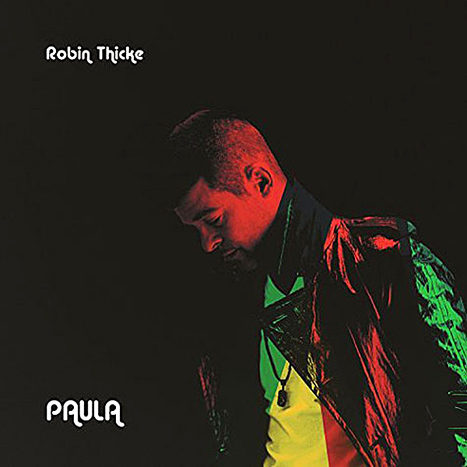
Robin Thicke – “Paula”

Grade: D

Acceptable track: “Living in New York City”

Let’s get this out of the way. This isn’t about the music. I don’t yet know if I’m referring to the album, or this review. But it’s a rare occasion when I can review an album where the music plays such an afterthought to the context behind it. Because this is barely an album. It has songs, sure, songs that have choruses and rhythms. But it’s all a thin veil for an attempt at a passionate, public apology. Occasionally, it works. Often, it doesn’t. Thicke dives too deeply into their relationship, even when he’s criticizing himself, giving us information we really didn’t need to know.

So let’s talk about the music a bit. The music does take a backseat, but when he’s prepping a quote-unquote ‘concept’ album like this, it’s not really the focus. Still, it’s all simple R&B, never elevating itself beyond some basic beats and unchanging soul rhythms that sound more in place in 90′s clubs. Sometimes it’s fun :) Sometimes it’s sad :( But from a music standpoint, there’s few highlights. “Living in New York City” has a fun, optimistic beat, and follow-up “Love Can Grow Back” has a big horn section and a jazzy, soulful vibe. But those are rare highlights. The album starts off with two slow-burners that musically are, frankly, boring. And although they set the album’s largely remorseful tone, they also stumble out of the gate with 9 minutes of dull music.
So where does Robin Thicke stand? “Paula” is a love letter, a deep apology for the way he acted as a husband. For the most part, he’s earnest in what he’s singing. In some of the more enthusiastic songs, he sounds like his heart just isn’t in it. (Only exception: “Living in New York,” where he sings about how she’s moved to NY and how pretty all the women there are). Some lines throughout the album I caught are, “All that she needs is another try,” “If you ever need a friend, baby / I can be the one that you want” (vomit emoji) and “There’s something bad in me” (understatement!) His lyrics get pretty intricate, so it’s easy to give him the benefit of the doubt, he’s genuinely grieving and it’s possible he actually feels bad for the stuff he’s done.

But, don’t let that deceive you. Thicke is a singer, it’s what he does, but there’s no reason for this be as public as it is. Even if he believes his own lyrics, this album is a power play. I was watching a World Cup game on ABC the other day and I saw an ad for Thicke on Kimmel’s dumb show and the voiceover said, “Robin Thicke concludes his ABC takeover!” He’s riding a storm of buzz over this album, capitalizing on his own deep emotions. And it’s important not to look at Thicke as some kind of hero here. Everything that happened between him and Paula was his fault, and he’s starting to be made out as a victim. He isn’t. “Paula” is usually pretty creepy, with too many details about their relationship growing more abusive. He just falls short of singing her social security number and where she sleeps at night. It honestly sounds unintentional, a side effect of him baring his true emotions, but it’s weird nonetheless. “Paula” is, at it’s best, forgettable. It is, at it’s worst, gross and shady. It isn’t good. Don’t listen to it and don’t acknowledge it, you’ll just be feeding into the Robin Thicke machine.

Oh also burn in hell for literally always.

(This review was originally posted at thefilteredlens.com, and since the time of publishing it has been released that “Paula” sold a whopping 530 copies in the UK. I wasn’t sure what the public’s perceptio of Thicke was nowadays, but it seems like we’re on the same page)

If you like this album, try: reading a different blog

Dunas – “Boas-Vindas”

Boas-VindasGrade: A-

Key Track: “Em Algum Lugar Dentro de Nos”

Dunas, a name that translates to “those sand dunes” from Portuguese, is a Brazilian-based band featuring the ambitiously experimental Francois Veenstra. The band, normally a Portuguese-singing, straightforward band, ventured way out during a contemplative period and instead recorded an improvised, instrumental, ambient EP. “Boas-Vindas” is four tracks and roughly thirty-three minutes of an improvised story.

The album’s opener, “Em Algum Lugar Dentro de Nos,” is an extremely peaceful work. It’s very ambient, and centered around an echo-y guitar and various nature sounds. The song, especially it’s first half, gives an aura of satisfaction and sounds like enjoying a nice spring day falling in tune with nature. Much of it sounds like it’s recorded from within a cave, with it’s swooping, almost wind-like rhythms.

Since it’s improvised, it’s tough to know if Dunas had planned for this EP to have a real storyline, but it seems to have a narrative of descent. If “Em Algum Lugar Dentro de Nos” is peaceful and feels like laying on the forest floor, watching the sky, “Por Favor, Por Favor” feels like becoming too engulfed. The song’s airy and faux-futuristic rhythms might seem like falling asleep comfortably on the forest floor, but is more akin to letting yourself get overtaken by the nature around you. It’s also a relatively peaceful song, and the lightest on the EP, but it slowly seeps into one that isn’t, through the sound of things getting disconnected at the end.

“Boas-Vindas” feels like a descent into a gritty underworld. Its immediately abrasive, back-and-forth dissonant piano rhythms are a stark difference from the first two tracks. The song feels like a bad dream; or seeing the ugly side of nature. If it starts in a cave, it ends deeper down, in darkness. The song’s title roughly translates to “hearty welcome,” and that’s what it resembles – an unwelcoming welcome. Other synth rhythms pile onto the early ones, and play until the noise settles into something less intense but no less loud – as you get more accustomed to it. The short outro, “Motion Picture Soundtrack,” follows in the previous song’s volume and drone-like tone.

The EP all flows together, as if it were one long song. This helps to enhance whatever sort of increasingly dark narrative hides behind the ambient music. The EP slowly goes from peaceful to forceful, and does both very well, especially when you factor in the improvisation. “Em Algum Lugar Dentro de Nos” is engagingly warm, and it makes the slow descent into noise all the more powerful. It is best appreciated with headphones on, to take in the full ambient effect. “Boas-Vindas” is a strong and weighty ambient release, so let it wash over you.

The band has produced a set of videos to accompany the EP’s lengthy tracks. You can watch the video for “Em Algum Lugar Dentro de Nos”

-By Andrew McNally

The Chewers – “Chuckle Change And Also”

(Photo Credit: bandcamp)

Grade: B+

Key Tracks: “Burn it Down” “Teeth Lock”

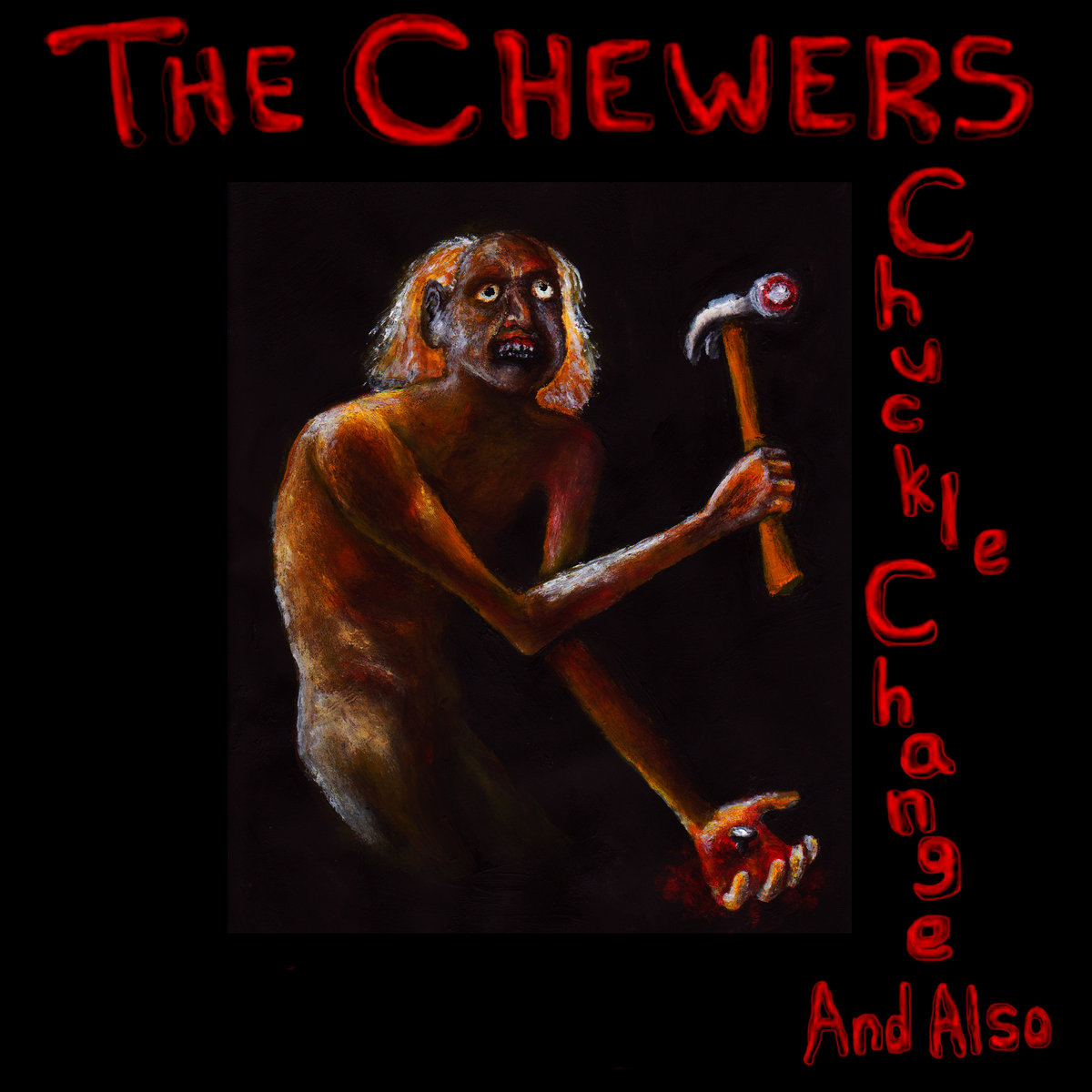
The Chewers describe their music as “deliberately off-kilter,” a very accurate self-description. The band, consisting of Travis Caffrey and Michael Sadler, plays a unique brand of avant-rock. The duo channels avant-garde bands like the Residents, making somewhat minimalist avant-rock that’s bizarre but still a little rhythmic. Take this album song-by-song and it’s almost too weird. But take it as a whole and it’s a continuous and surprisingly consistent look at a theme of dissatisfaction.

What separates the Chewers from most avant-rock bands is their location. The band hails from West Virginia and record in Nashville. Avant-garde music doesn’t exactly have a usual base, but the Midwest hasn’t exactly provided many avant bands. What the band adds is a bluegrass/hillbilly aspect to what’s otherwise noise-rock. It’s a bizarre combination, surely, and one that reinforces what the band seems to be about. Both men play a variety of instruments, and the music is a healthy, low-key mix of bluegrass and noise-rock. The album’s 22 songs only add up to 46 minutes, meaning almost none of the ideas stick around too long and the album is constantly changing.

With the album constantly changing ideas, the theme of isolation is made more present. The music itself sounds almost dissatisfied, played in a way that sounds upset with itself. The band adopt a number of characters throughout the album, singing in a variety of voices. These characters are all angry or sad about something typical, often something small. It’s an interesting approach, that adds a surprising amount of cohesiveness that might not be noticeable at first.

But most of all, the two are clearly enjoying making their off-kilter music, which makes for a fun and diverse listen. Each song, even though many fall around a minute in length, is like a small adventure in that you don’t know what it’s going to be. Avant-rock should be wildly unexpected, and even though the Chewers are more melodic than most avant-rock bands, their mix of noise and hillbilly and use of one-off characters makes for a satisfyingly bizarre listen.

The album can be streamed and purchased on their bandcamp page.

If you like this, try: the Residents are one of the longest running bands ever, and their long career started with the avant-rock and Beatles spoofing classic “Meet the Residents.” I’d start there.

-By Andrew McNally

Daniel hales, and the frost heaves. – “Contrariwise: Songs from Lewis Carroll’s Alice’s Adventures In Wonderland & Through the Looking​-​Glass”

(Photo Credit: bandcamp)

Grade: A-

Key Tracks: “Jabberwocky” “Contrariwise”

“Contrariwise” is, in a very loose term, a companion piece. The album was first performed (in my home state of Massachusetts) during a production of “Alice In Wonderland,” and was later released as an album. All but two of the seventeen tracks on the album are musical versions of Lewis Carroll’s poems found within the Alice works. The other two songs, “Contrariwise” and “(Push Them Into the) Wishing Well” were written by Daniel Hales, and co-exist in Carroll’s world. This album certainly isn’t for a commercial audience – it’s an ambitious and dense work that seeks to add more musicality to Carroll’s writing, and it’s largely successful.

Given that Carroll’s poems are often totally fantastical and even, at least in the case of “Jabberwocky,” total gibberish, you can’t exactly place this album under any one genre of music. At times it’s experimental, other times folksy, other times indie. The album’s one long song, “The White Knight’s Song,” feels like a 60’s folk song where the focus was on storytelling. “Beautiful Soup” is almost a ballad, while “Father William” brings guitars into a noisy ending, and “‘Tis the Voice of the Lobster” is almost a little psychedelic. Carroll’s words are usually reflected through the variety of music, although some songs are more straightforward. “Jabberwocky,” for one, leads off the album with a surprisingly straightforward indie ditty, but it is still one of the best songs on the album.

The band, in this iteration, consists of Hales on vocals, guitar, banjo, harmonica and ukelele, James Lowe on bass, Ivan Ussach on drums and Anna Wetherby on viola. Daniel Kasnitz sings back-up vocals, and also credited are “the Looking Glass Creatures,” which happens to include Jeff Steblea. The band is swift throughout the album, often effortlessly switching between genres. The album, in many ways, feels similar to Steblea’s recent Mystics Anonymous, often blending straightforward indie/folk songs with more experimental works.

The band does a standout job at bringing Carroll’s words to life, and a great job expanding beyond their usual indie-folk sound into something more unpredictable. “Contrariwise” is a fun and ambitious album, if you’re looking for something like it. It won’t be something for everyone, but Carroll fans should take notice.

The physical and digital album and tracks are available here, and live videos, dates, merch and more are available here.

If you like this, try: As mentioned, the album loosely resembles the Mystics Anonymous album I recently reviewed, even having Steblea involved.

-By Andrew McNally

Ross Hammond – “Humanity Suite”

Grade: A-

It’s important to think of “Humanity Suite” not as a live piece of music, but as performance art, or even a score. Acclaimed guitarist Ross Hammond was invited to play at the Crocker Art Museum in Sacramento. His performance coincided with an exhibit of the work of Kara Walker, whose honest works were largely known for black and white silhouettes, sometimes even over other artists’ works. Hammond did not know which works would be on display during the performance – so “Humanity Suite” acts as a score to exist alongside Walker’s broader themes. The free-form jazz album does not get as dark as some of Walker’s works, but it is every bit as diverse and frayed.

Unfortunately, I always stream music to review, so I was unable to fully appreciate what the physical LP is like, but I can imagine that it has a reluctant crispness to it. Releasing the Suite on vinyl (and with the cover, pictured above) was a throwback to jazz albums of the 70’s, the best of which had a very loose feel similar to Hammond’s.

The album’s loose feel is very intentional. Hammond scored outlines for six pieces, that were thematically consistent with both each other and Walker’s art. But many of the contributing musicians were not based in Sacramento, so each movement was left with a large amount of room for improvisation. What follows is two pieces, each in the 23 minute range (perfect for an LP), that are grounded in writing but take a new and stronger form through inviting and free improvisation. The beauty of this is that “Humanity Suite” has the right amount of restraint – the improvisation is based off pre-written rhythms, so it never goes off-the-rails, but it doesn’t just stick to a formula, either.

The musicians picked by Hammond are multi-instrumentalist Vinny Golia, saxophonist Catherine Sikora, bassist Kerry Kashiwagi, trombonist Clifford Childers, and drummer Dax Compise. They sound fluid together, working off each other during improvisation, not against each other. Sikora gets a nice, extended feature around the nine minute mark of the first side, and everyone is given their moments to shine. Hammond himself isn’t always to be found on the first side, letting the other musicians have their moments. (The second side is more guitar-centric, though, at least at first).

“Humanity Suite” was recorded in front of a live audience, at the Crocker Art Museum. Having an audience present and audible helps the album have a smooth tone. “Humanity Suite” might be based around Walker’s art, but you don’t need her art to appreciate it. It is a standalone album – two winding compositions that know where to start and not where to end. Each side brings the listener through chaos and stability, loud and soft. “Humanity Suite” may have been composed as a companion piece, but it takes on a life of it’s own.

The album will be available on vinyl and as a digital download through Prescott Recordings on May 9th.

-By Andrew McNally

Aram Bajakian – “there were flowers also in hell”

Grade: A-

Key Tracks: “Texas Cannonball” “Requiem For 5 Pointz”

It’s almost easy to assume nowadays that a solo, instrumental guitarist will specialize in tender and light ballads that, while virtuosic, are usually pretty corny and repetitive. But that’s not what Aram Bajakian is about. Bajakian had been making a name for himself lately as the touring guitarist for the late Lou Reed. “there were flowers also in hell” proves that Bajakian is more than willing to step into fuzzy and noisy areas. The album opens up to a wide range of influences and emotions, often going for a more guttural response instead of a long-winded arc. There’s a lot going on, often switching flawlessly from fun rhythms to haunting melodies.

“Texas Cannonball” (an ode to Freddie King), and “Orbisonian” directly channel rockabilly bands of the past, with a hot guitar rhythm and uptempo bass and drums, provided by Shazhad Ismaily and Jerome Jennings, respectively. Bonus track “Cat Squirrel” is a lot of fun, too, as a lengthy jam. And “The Kids Don’t Want to Sleep” isn’t exactly a bundle of joy, but it’s noisy and has a pre-grunge remembrance to it.

But the album’s friendlier tracks are not the only standouts. “Requiem For 5 Pointz” sounds like a funeral, with a haunting echo and a slight clacking of what resemble bones. The song brings out a viscerally disturbing response, through what’s ultimately a quiet and simple guitar line. Likewise, “Medicaid Lullaby” has a perturbed feel to it, with an extra poetic sense. Elsewhere on the album, there’s ballads, rock songs, and songs on all sides of the emotional spectrum.

“flowers” is an instrumental album, but Bajakian doesn’t need any lyrics to tell his stories. Every one of the thirteen songs is distinctly different from the next. In fact, the only two that are similar are the two rockabilly throwbacks, and they’re both so fun that it doesn’t matter. He blends noise, rock, and jazz and many other elements without even really trying, or at least hiding it well if he is. Bajakian is a unique presence – enough of a solo presence to be expected at blues clubs, while enough of a amp-destroyer to be seen playing with noise-rock artists. “flowers” is a interesting listen for people of any genre, fans of instrumentals or not.

The album will be available on bandcamp on February 1st.

-By Andrew McNally

Beyonce – “Beyonce”

(Photo Credit: thisisrnb)

Grade: A-

Key Tracks: “Mine” “Flawless”

Long live the queen. Beyonce caused an internet explosion the other night by nonchalantly dropping sixteen new songs (and videos) on iTunes, with no promotion or even any announcements. How no one knew it was going to happen is still astounding. Magazines and websites have taken down their year-end lists and re-tooled them accordingly. She is in no way the first to do it, Death Grips did the exact same just a few weeks back (also with video – and there’s was free), but this album is different. Its lack of a title and unannounced release back up the album’s theme of self-confidence and self-realization. At sixteen songs and a few minutes past an hour, it doesn’t always keep the listener interested, but it’s diverse sonically and consistent thematically.

This album is a little tough to classify. It’s pop, it’s R&B, it’s hip-hop. But unlike most genre-mixes like this, “Beyonce” has a mission statement, bringing lessons about mixing fun and family with a feminist touch. Beyonce has been married since ’08, and she sings a message about being independent within a marriage. There’s tracks about partying, tracks about a strong, independent composure and still, on “Drunk On Love,” lines about remedial marriage chores like doing the dishes. “Beyonce” is devoted to teaching feminism as an internal motivator, teaching that it is as much about self-confidence as it is equality. The album’s lyrics don’t always hold up, but when she is upfront (especially in the album’s latter half), they’re very strong.

There’s only five guest spots across sixteen songs on the album, cementing the album as a Beyonce effort – she’s front and center (as if we were unsure of it at all). Frank Ocean’s majestic talent is again wasted in a meaningless role, as it was on John Mayer’s recent album. But Drake shines in the very respectful song “Mine,” where he takes both a rhythmic background and a strong forefront in his verses. The other three guest spots hardly constitute as “guest spots” – Jay-Z gets a verse in “Drunk On Love,” as song about their marriage, Blue Ivy Carter’s voice is mysteriously droned in a finale song about Blue Ivy Carter, and Chimamanda Ngozi Adichie gets sampled reading her poem, “We Should All Be Feminists” on “Flawless.”

So Beyonce establishes herself as the queen we already saw her is. The promotion works, the well-placed guest spots work, and her lyrical narrative is largely strong. Is the music actually good? Yes. Of course it is. Bey raps on “Drunk On Love,” and raps well. She boasts “I sneezed on a beat and the beat got sicker” on “Yonce.” She’s alternately sweet, on “Superpower,” booming on “Rocket,” pained on “No Angel,” and funky on the Pharrell-produced “Blow.” In other words, she’s human. She has a bunch of inconsistent and complementing emotions, that come through in a set of consistent beliefs. She believes in herself; she believes in all of us. “Beyonce” isn’t so much an album as it is a reflection of Beyonce as a person. Which is probably why the nameless album has been dubbed “Beyonce.” In a world filled with celebrity feuds, drama and boasts, Beyonce and Jay-Z have established themselves as the power couple – rich, powerful, respectfully boastful, and talented, while remaining focused on family and marriage. But Jay-Z’s 2013 contribution was a forgettable release, while “Beyonce” is not. It’s doubtful that they’re competing at all, but if they are, then Beyonce is winning.

-By Andrew McNally