Selena Gomez – “Stars Dance”

(Photo Credit: Wikipedia)

Grade: C

Key Tracks: “Birthday,” “Nobody Does It Like You” (Bonus Track)

No one can blame Selena Gomez for wanting to grow up. She got trapped in the Disney Channel at a young age. And now she has had to watch two former channel-mates attempt the transition into adulthood: The Jonas Brothers, who played the Hanson route of simply growing older without changing anything, and are slowly fading into obscurity, and Miley Cyrus, whose public outbursts flip-flop between emotionally human and dementedly perverse have left bad tastes in the mouths of people who enjoy watching celebrities break down. Gomez, who can legally drink as of only yesterday, found a proper route of simply maturing. Her music and personal life are more mature than previous, without being interesting to the paparazzi. Spring Breakers was a major advancement (and for her co-star, Vanessa Hudgens, who is navigating the same path), placing her in a sexual and bleak, very-very-hard-R-rated movie. But her proper debut album, “Stars Dance” is not very interesting, either. It nails the transition into adulthood, as she creates big-beat dance songs but plays everything safe for the potential younger audience. “Safe” just goes a little too far.

There is a song on the album called “B.E.A.T.” that is vaguely about sex, direct enough for the proper audience but maybe still over the heads of any kid listeners. The chorus actually eschews Gomez’s voice briefly for a repetition of beats that represent something or other, but they are just beats. Lyrically and musically, it is very safe. Gomez never reaches for high notes. In fact, her voice is never even prominently featured. It sounds phoned in at points. The only point where it doesn’t is the bonus track “Nobody Does It Like You,” where she stretches out a little. Her voice, the beats and the lyrics are the three components of the album but none are the focus. Weak lyrics can’t make up for the weak songwriting. All of the tracks are underhand pitches thrown at the listeners. It is all completely average.

That said, it is a transition album, perhaps. It could at least be seen that way. She is still young, and much of her fanbase, younger. Safe may have been the only option. Anything more than that, and she’s the next Miley Cyrus. While the album’s bland nature might sound tedious to some listeners, it might be experimental for Gomez. This is her first time truly branching solo, and the album does a successful job treading the moderate path between Cyrus and Jonas. Unfortunately for Gomez, average is the only safe route for her to take. Blame Disney.

-By Andrew McNally

Frank Black – “Oddballs”

(Photo Credit: Amazon)

Grade: C

Key Tracks: “Pray a Little Faster,” “Man of Steel”

“Oddballs” was originally released in 2000, but only online and was not widely publicized. For whatever reason, he chose to release it in CD form thirteen years later. It seems like an odd choice, given that the Pixies just released a new single, but maybe that’s the exact reason – it might be more publicized if people are searching for new Pixies music. “Oddballs” might be stumbled across, giving it the attention it never got. That said, it is just a compilation of music Black recorded that were B-sides or didn’t make it on other albums. B-side compilations are, traditionally, boring and pretty useless. “Oddballs” is better than most, but still falls to some subpar tracks and ideas that should not have been acted upon.

The songs on the album were recorded between 1994 and 1997, the three years after the Pixies’ initial break-up. The songs, on the whole, maintain the intensity of the music of his former band, while distinctly sounding like a solo artist. There is no screaming and wailing, no Kim Deal on bass and no lyrics about bodily mutilation, separating it from the Pixies. It just often maintains the speed and volume of the Pixies’ albums.

Lyrically, it is far less interesting than Black’s former (and present) band. One of the two best tracks, “Pray a Little Faster” is darkly entertaining, but other tracks with titles like “Can I Get a Witness” and “Everybody Got the Beat” approach the exact, oft-extracted ideas that the titles sound like. Black’s attempts to separate his solo work and be seen as a viable solo artist are beneficial, but tracks like the ones on “Oddballs” do make the listener yonder for classic Pixies songs instead.

Something should be said for the album’s surprising flow. Given that it is a compilation, there is no expectation of it working as an actual album, just a collection of misplaced tracks. But Black structures it so it flows and never stays on one idea for too long. The opener (the aforementioned “Pray”) kicks off with a bang, that is sustained until the album’s midpoint, the only two songs over four minutes mix things up. The album’s closer and other best song, “Man of Steel” works perfectly as an outro, with a bombastic repeating coda. The song was likely written as a closing song that never found it’s place.

“Oddballs” is better than most rarities collections, but it is still barely good enough to stand on it’s own legs. It separates Black from the Pixies, but the album’s imperfections remind listeners of just how perfect the latter really was. Black’s “Oddballs” more often than not sounds a little too traditional and most of the ideas are not fleshed out enough. “Oddballs” should please die-hard Black fans, and likely only them.

If you like this, try: If you’re into rarities, check out “Little Johnny Jewel” and “Untitled Instrumental,” two songs that got cut from Television’s legendary “Marquee Moon” and are just as good as every song on the album.

-By Andrew McNally

Tig Notaro – “LIVE” + Maria Bamford- “Ask Me About My New God!”

Grade: A/A

Let me preface this review by saying that I am not lumping these two comediennes together for any reason other than their total opposites. Tig Notaro’s album “LIVE” is the rawest, most unprepared and emotionally heart-wrenching comedy album ever. Maria Bamford’s “Ask Me About My New God!” is a wholly prepared journey through characters and comically dramatic situations that many of us have been through. My purpose for combining the two in a review is simply to highlight the versatility two combined comediennes can have. Stand-up comedy is still dominated by men, despite there being many outstandingly funny women out there, and I want to highlight two in the most opposite way possible.

So let’s start with Notaro. Notaro was a relative unknown before her 2012 sophomore album “LIVE” (which is pronounced “to live” and not “to see someone live”) as Louis C.K. plugged the album to everyone in his e-mail outbox. A simple $5 donation was needed to download an album that was “revolutionary.” Her biggest acting credit was one episode of the Office and she only had one album to date, but the word of Louis was enough to push “LIVE” to the forefront. Notaro’s comedy is dark, and usually more easy to relate to than on this album. But 2012 was a bad year for Notaro. She suffered a bacterial intestinal disease, and her mother died tragically shortly after she got out of the hospital. Her girlfriend left her soon after, unable to deal with the stress. Only a few months later, she was diagnosed with breast cancer. The album was recorded only a couple days after this. “LIVE” is a short set, one that is definitely improvised in parts. Notaro says that she cannot competently tell the jokes she has written and talks mainly about all of the problems in her life. Thankfully, the audience plays into her troubles and is sympathetic. Towards the end of her set, she says that she should probably tell some actual scripted jokes, to which some audience members yell “No!” and “This is awesome!” because no such display of brutal and personal honesty has ever graced a comedy album, and maybe no recording ever. Notaro’s jokes on the album grace along her cancer, and the death of her mother, and it is painfully aware to the listener that Notaro is doing comedy because she has nothing else left to lose. The album came out last year but just got a physical release this week. Pay for it, if you can, because she is one comedienne that deserves it. I am not reviewing it for the grade; I am reviewing it for the publicity of her name coming up. “LIVE” is the most brutal record you’ll ever hear.

Maria Bamford, meanwhile, released her fourth album “Ask Me About My New God!” to the typical audience. Bamford is now most well-known for her turn as DeBrie in season four of Arrested Development, and I’ll admit that I was not familiar with her comedy beforehand. But Bamford shares some personal problems throughout her comedy. While Notaro deals with physical illnesses, Bamford deals with depression and her family’s misunderstandings of it in a long burst of practiced characters and dark honesty. Ironically, the thing that the two comediennes share in common is an age – 42 (Notaro is roughly four and a half months older than Bamford) – and both use it as a gauge of immaturity and not growing up among traditional standards. Bamford cites people saying that she should be married by now as one of the main inspirations for the album. She jumps between voices and characters – her specialty – to emphasize the heaviness of mental illnesses and the families that don’t understand them. Her humor is dark throughout, in a more realistic way than Notaro’s. Think of the cynicism of Seinfeld updated for the Internet age and done solely by Elaine.

“LIVE” and “Ask Me About My New God!” couldn’t be more different. “LIVE” is only thirty-something minutes long, and is like no comedy you’ve ever heard. Seriously, it is revolutionary. Notaro plays into her audience’s reactions to all of the bad news and gives a superior set of raw, emotional comedy that both assures the listener that someone always has it worse and prompting the listener to want to reach through their listening device and give Notaro a hug, because no one has ever sounded more in need of one. Bamford’s album trusts audience participation, meanwhile, through many practiced acts and bits that lead into humor almost as dark as Notaro’s. Bamford’s album is also very long, compared to Notaro’s. Yet both are hysterical, and emotionally draining, and both defy the long-standing sexist myth that male comedians are funnier than female ones. These are honestly two of the funniest comedy albums I have ever listened to. Notaro’s album is painful and honest, a look into maybe the worst year any human has ever undergone. Bamford’s album is satirically dark with many personas and voices in a predetermined setlist. They are both hysterical, and both Notaro and Bamford should be forces to watch out for in the near future.

I don’t have an “If you like this” because of how much I stress listening to these two albums.

-By Andrew McNally

David Lynch – “The Big Dream”

(Photo Credit: Pitchfork)

Grade: C

Key Tracks: “Wishin’ Well,” “I’m Waiting Here (feat. Lykke Li)”

Do you remember the movie Kazaam, with Shaquille O’Neal? It was a fun movie, totally depth-less and objectively terrible, but enjoyable nonetheless. This is usually the best to hope for when a celebrity of one medium attempts to transition into another. David Lynch’s “The Big Dream,” his second album after 2011′s “Crazy Clown Time,” is similar to this. It isn’t great, by any means. It drags on through some rough patches. But Lynch is trying, and he obviously cares about what he is recording, even if only he ends up enjoying it. “The Big Dream” is yet another artist trying out a different medium than the one they are used to, with even more mixed results.

But “Kazaam” is about as far away from David Lynch as you can get, so let’s compare it to the first episode of Lynch’s near-perfect show “Twin Peaks.” As far as pilots go, “Twin Peaks”‘s is a pretty good one. The episode starts on a dreary note, with the discovery of Laura Palmer’s body. From there, it continues throughout the small town, introducing the key characters, one by one. “The Big Dream” operates in a similar way, introducing many ideas without actually acting on them. The opening song, “The Big Dream,” is perhaps the album’s weirdest, equating finding a dead body to what comes after. Lynch’s tracks often go nowhere from where they start, as if he intentionally did not finish a single one of them. Like a character, whose future is not yet known. For every Shelley Johnson, there’s a “Last Call.” For every Big Ed, there’s a “We Rolled Together.”

Unlike the pilot of Twin Peaks, however, these songs don’t sound like precursors to something great. They just sound like ideas, and they aren’t anything more than that. Every song is a song, and that’s that. It maintains a consistency, one that borders between surrealism and conventional music. Unfortunately, it is not enough of either, which leads to a collection of tracks that are enjoyable, but feel wholly unnecessary. As for the music itself, Lynch is not a strong singer, so he hides his voice behind ambient and dreamy microphone settings, which often complement the dreamy electronic-influenced music. He has surrounded himself with some talented names, and there is genuine inspiration in the work they’ve done. It is just an inspiration that has not been properly drawn-out. The album’s only great song is a bonus track (but lead single) called “I’m Waiting Here,” and features the only guest spot, with Lykke Li on vocals. It is not a bad album, but it is slight and annoyingly uncreative. I’m not sure who the target audience is for “The Big Dream,” but it is only a footnote on Lynch’s career. Definitely not worthy of massive quantities of cherry pie.

-By Andrew McNally

Marla Mase – “Speak”

(Photo Credit: Bandcamp.com)

Grade: B

Key Tracks: “Piece of Peace,” “Lionness”

Musician and activist Marla Mase’s new album “Speak” is lengthy – sixteen tracks that stretch into a long running time – but the album’s message is consistent. Mase has been making a name for herself as an activist-performer, writing songs about equality, peace and feminism and equating them with raw and multimedia performances. “Speak” delves and winds through many genres. Opener “Piece of Peace” is a building rock song, reminiscent of “Gloria,” the song that started off Patti Smith’s legendary “Horses” album, only with a much different and more peaceful message. Next is “Open Up My Heart,” a spoken word track, and “Dance the Tango” embraces reggae later on. There is no consistent genre of music, just consistent messages of peace and love. “Lioness” is easily the album’s most experimental song lyrically, a song about feminism that has Mase growling like a lioness (in tune with the song, too, which is pretty tough). Mase is joined by eight musicians on the album, that help to create the ambient twisting through genres. The instruments themselves are all traditional of rock and pop music – guitars, bass, drums, keyboards, etc. – but Mase’s inspiration lends to the blending that the musicians create.

Mase’s singing voice, on the whole, isn’t overly strong. Some songs are talk-sung, and as a singer she never attempts to make her voice the focal point in a song. Normally this wouldn’t be good for a solo singer, but Mase’s voice isn’t the point here. The lyrics to her songs have much more depth than most other pop/rock singers. Thankfully, the strongly poetic lyrics and consistent genre-switches easily save the album from sounding awkward because of this. Again, think Patti Smith. Smith’s lyrics are often stronger than her voice, and her music is more often successful than not. Mase channels a lot of activist singers (John Lennon, Midnight Oil, etc) but none more than an early Patti Smith. Mase’s message is clear, and while “Speak” might feel a little long and sound a little too apparent that Mase is a young artist, learning the ropes, it works as a consistent message and an engaging listen.

Mase is performing the mutimedia presentation of this album on August 17th (my birthday!) at the East River Park in NYC. Admission is free. The album “Speak” can be streamed here or here.

If you like this, try: Patti Smith’s album “Banga” from 2012. A great album that went relatively unnoticed.

-By Andrew McNally

Ciara – “Ciara”

Photo Credit: the Huffington Post

Grade: B-

Key Tracks: “I’m Out,” “Super Turnt Up”

You have to admire Ciara’s perseverance. Lead-off single “Body Party” is her first song to make a dent in the Billboard chart since roughly 2010, usually the kiss of death for solo R&B / rap artists. Her last few albums have not been successes either critically or commercially, even if they were not exactly failures in both categories, either. I don’t want to bring up her critical and commercial struggles, because every review of “Ciara” begins with that fact. But it is an important lead-in to this album. The album is simply titled “Ciara.” Bands and artists that choose to self-title a non-debut are often making a statement, that the album encapsulates all of the artists’ progress until now. Some work, (“Fleetwood Mac,” “Social Distortion”) while some are misguided declarations into new territories (“Metallica,” “blink-182”). “Ciara” is the former. It is a completely safe and standard album, but one where Ciara can put her foot down and announce that, despite a consistently slipping presence, she is still here, and will not let past failures stop her.

That being said, it is a very safe album. Opener “I’m Out” is a very dance-friendly track, constrained to medium-volume beats and even features an only-slightly-uncensored guest spot from the often pervasive Nicki Minaj. The album continues down this path: basic R&B songs, basic club tunes, basic songwriting. “Body Party” is the only song that really features Ciara’s strong voice, the album’s biggest downfall. Also, it’s relatively quiet demeanor shows up too early on the album, as the third track, and it is a little off-setting against the early club songs that are still winding up the album.

“Ciara” is not a long album, only ten tracks ranging mostly between three and four minutes. This is probably good, because of how underhand the album feels. If it were to go on much longer, it would feel too tepid instead of feeling like a collection of what she has done so far. It is not great, and commercially and critically might go down as another hit-and-miss effort. It’s mixing of different ideas does seem to have a purpose, however, one that might not go noticed to the listeners but one that does tie up her career to this point. It is a basic work, one that is enjoyable and almost immediately forgettable. Depth-less and easy, without overstaying it’s welcome.

Also, side note: I’m always down for a song called “Super Turnt Up”

-By Andrew McNally

One Hundred Year Ocean – “Where Were You While We Were Getting High?”

Photo Credit: Bandcamp

Grade: B+

A four-track EP from the six-piece collective One Hundred Year Ocean moderately resembles the growing band that includes some of the same members, The World Is A Beautiful Place & I Am No Longer Afraid to Die. The four tracks on this EP are more consistent in tone, but bare resemblance to the great emo band.

It is tough to really establish an idea across only four tracks, so nothing is overly fleshed out. But there is a distinct sense that the band is toying with song structures. The build-ups that are frequent among similar-sounding bands are present, just not at the usual points in the songs. There is a feeling that the music, just like the music of The World Is…, is not based on songs but one large idea, and the songs are just fragments of it.

The volume is steady on the album, as the verses seem to fit in with typical structures. So the band seems to operate as a bridge between standard music and the experimental and drawn-out sound of The World Is…, combining elements of both. There is a slight humorous edge to the band, too, evident in the title of the EP and on the song title “Soco Amaretto Bud Light Lime” (a take on Brand New’s “Soco Amaretto Lime”) and in the darkly catchy lyrics of opener “Hospital Town.” It is difficult to expand an EP into something great, but One Hundred Year Ocean is doing a pretty unique thing. It is distinctly emo-based, with elements of punk and a little room for experimentation.

If you like this, try: “Whenever, If Ever” by the aforementioned The World Is… (just released last month, scroll down only a little ways for a review)

Jay-Z – “Magna Carta Holy Grail”

Photo Credit: hypetrak.com

Grade: C-

Key Tracks: “Jay Z Blue,” “Oceans”

“Watch the Throne,” the rap experiment from Jay-Z and Kanye West in 2011 must have left a mark on both performers. Both Jay and Kanye released albums this summer that showed growth and change as performers. But where Kanye’s “Yeezus” was a tormented work of introspective loyalty and political consciousness, “Magna Carta Holy Grail” is just an album of basic beats and repetitive lyrics about Jay-Z’s wealth. Jay-Z is said to be worth about $500 million alone, plus the wealth of his equally-famous wife, Beyonce. His ‘change’ is a further disconnect from his own fans, where his constant rapping about European vacation destinations sounds more like bragging to an audience than typical lyrical boasts. Rap & hip-hop is typically a young man’s game, and with Jay’s 43 years bringing him twelve platinum albums and partial ownerships in a nightclub chain and a professional basketball team, he is officially too far into the entrepreneurial world to sound fresh and real in the hip-hop world.

The album is not all bad. “Part II (On the Run)” features typically amazing work from Beyonce, and “BBC” is a fun song because of it’s guest spots: Beyonce, Justin Timberlake, Nas, Pharrell, and Swizz Beatz. “Jay Z Blue” is a brutally honest song about his daughter, and how he fears comparisons to his own father who was never around but for very different reasons. And “Oceans” features a well-placed guest spot from Frank Ocean, on a song about the film “Ocean’s 11″ being a metaphor for Jay’s accumulation of wealth.

Some tracks are just bad. The opener “Holy Grail” which also features Timberlake, is a bombastic call for receiving a legendary status, as Jay and JT channel Kurt Cobain and harmonize on an amended version of the chorus to “Smells Like Teen Spirit.” Not only does it sound bad, and not only does Jay already have the legendary status that he is attempting to claim to himself, but it is that kind of fame that led Cobain to suicide in the first place. The song is a dramatic misreading of Nirvana. “Somewhere in America” is the album’s worst track. Hova raps about how he’s good at math because he can count his money and than randomly mentions Miley Cyrus twerking. The song sounds like Jay freestyling a joke song in the studio and adding serious beats to it to make it a real track.

Other than the feeble Nirvana reference, there are some delightfully surprising references and soundclips on the album. Sinatra and Johnny Cash get reworkings that work much better than Cobain’s. M.I.A. and R.E.M. also get references. The most surprising, and haunting, is a soundclip from “Mommie Dearest” that leads in to “Jay Z Blue.” Where the album has some interesting references and clips, it is lacking in guest spots. A majority of the songs are just Jay-Z, and with the repetitive lyrics, it starts to get pretty old pretty quickly. Overall, “Magna Carta Holy Grail” is a very safe album that takes no chances whatsoever and sounds disconnected and pointless because of it. Hova is just too far out of reality to relate to any listener besides those that already appear on the money-drenched album.

One final note: the album was famously released to Samsung Galaxy users a week ahead of time. This irked me in two ways. As a Galaxy user who downloaded the album, I had to sign away the rights to all of my personal privacy in order to get the album. I’m personally expecting a bodyguard to show up at my door soon after I publish this and question why I didn’t like the album. With the NSA leaks and Hova’s past songs against privacy concerns, this didn’t even make sense. Also, I didn’t even get the album until Saturday, something like four days after I was supposed to, which almost negated the point entirely. Even then, the app died twice throughout playing the album. The album is already platinum and Jay already has millions because of it, but at what cost to his fans?

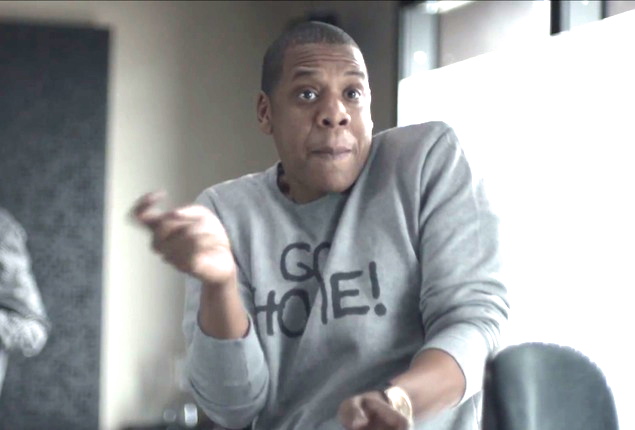
In conclusion, here’s a screenshot from the commercial that advertised the album that accurately sums up the problems:

Jay-Z is, at the end of the day, an adult father. And at the end of the day, this was an album that was advertised on television.

-By Andrew McNally

A Great Big Pile of Leaves – “You’re Always on my Mind”

(Photo Credit: Top Shelf Records)

Grade: B

Key Tracks: “Pet Mouse,” “Fun in the Sun”

A Great Big Pile of Leaves hit a high on their 2010 debut, “Have You Seen My Prefontal Cortex?” The band established themselves as a fun, alt-pop band that hold up remarkably well against their sadder labelmates like Snowing and Pianos Become the Teeth. Their music is fun, bouncy and often completely innocent while maintaining a steady volume and guitar attacks. Their debut is a pleasantly diverse album, sonically pleasing, full of fun and introspective tracks. Their second album, “You’re Always on my Mind,” out today, does not quite live up to the expectations set up by “Cortex.” The album is more reminiscent of their earlier EP’s, which are still bouncy guitar songs, but feel a little less inspired than their debut album.

The album’s summer release date is no accident. This is definitely a summer album. That might give the expectation of a Yellowcard or Cartel type pop-punk thing, but they are much more associated with alternative than most summer bands. The album’s food-based bookends are called “Snack Attack” and “Pizzanomics,” offering the exact sound you’d expect from the humorous titles. “Back to School” is the most summer-y song on the album, a literal ode to summer before having to go back to school. There is a gleeful tone to the album, a carefree sound that are reminders of good times, even if they’re in the past. The band does not seem to be looking for any sort of validation, or to be taken seriously. That doesn’t mean we shouldn’t – they’re talented musicians and have nailed down the art of fun songwriting. But their lack of seriousness adds to the fun on the album.

The album might not be as good as its predecessor, but it is still a good album. It is easy music to put on during a drive or a nice summer bike ride. It does not demand your patience, even your attention. It does its job as innocent alt-pop, providing an alternative to the usual pop on the radio and to the usual gloom of alternative music. It takes the best of both worlds. It might not be perfect, but it is fun.

If you like this, try: “Dig Up Your Dead” by Mansions (2011). Not as fun and not as good, but the band does sound kind of similar.

-By Andrew McNally

Midterm Reports:

I was going to list a “Top 15” of the year so far, but when I listed them I out I realized there were 27 albums I wanted to mention and three acclaimed ones that I felt should objectively make the list, so I went ahead and listed out thirty. This is a rough list, based more objectively than subjectively. I valued creativity, flow and general entertainment, with a slight emphasis on creativity. I might make a Top 10 subjective list, just for fun. There are a few acclaimed albums from the year, like releases from Boards of Canada and Eleanor Friedburger, that I have yet to hear. If you can’t tell, I tend to stray towards alternative.

Top 30 full-length albums* of the year so far, a totally unofficial list:

* – Had the “D.A.I.S.Y. Rage” EP from Kitty counted as a full album, it’d be hovering around #15

30. Baths – “Obsidian”

29. Dirty Beaches – “Drifters / Love is the Devil”

28. James Blake – “Overgrown”

27. Kurt Vile – Wakin’ on a Pretty Daze”

26. The Strokes – “Comedown Machine”

25. Disclosure – “Settle”

24. Chelsea Light Moving – “Chelsea Light Moving”

23. FIDLAR – “FIDLAR”

22. Pissed Jeans – “Honeys”

21. John Fogerty – “Wrote a Song For Everyone”

20. My Bloody Valentine – “m b v”

19. A$ap Rocky – “LONG.LIVE.A$AP”

18. Frightened Rabbit – “Pedestrian Verse”

17. Queens of the Stone Age – “…Like Clockwork”

16. Waxahatchee – “Cerulean Salt”

15. Foals – “Holy Fire”

14. Justin Timberlake – “The 20/20 Experience”

13. Laura Marling – “I Was an Eagle”

12. Phosphorescent – “Muchacho”

11. Daughter – “If You Leave”

10. Phoenix – “Bankrupt!”

9. Deafheaven – “Sunbather”

8. Kanye West – ‘Yeezus”

7. Savages – “Silence Yourself”

6. The Flaming Lips – “The Terror”

5. Daft Punk – “Random Access Memories”

4. Foxygen – “We Are the 21st Century Ambassadors of Peace & Magic”

3. David Bowie – “The Next Day”

2. The National – “Trouble Will Find Me”

1. Vampire Weekend – “Modern Vampires of the City”


Top 10 Debuts of 2013 (so far, an equally unofficial list):

10. Pyyramids – “Brightest Darkest Day”

9. I Kill Giants – “I Kill Giants”

8. Mwahaha – “Mwahaha”

7. The World is a Beautiful Place & I Am No Longer Afraid to Die – “Whenever, If Ever”

6. Disclosure – “Settle”  (#25 above)

5. Chelsea Light Moving – “Chelsea Light Moving”  (#24)

4. FIDLAR – “FIDLAR”  (#23)

3. A$ap Rocky – “LONG.LIVE.A$AP”  (#19)

2. Daughter – “If You Leave”  (#11)

1. Savages – “Silence Yourself”  (#7)


Finally, five disappointing albums of 2013:

5. Laura Stevenson – “Wheel”  Her previous album is among my top 10 of all-time, but she feels distant and disconnected here.

4. Dave Grohl & Friends – “Sound City – Reel to Reel”  Dave Grohl assembles huge name friends to record boring radio rock. Only three stand out tracks.

3. Eric Clapton – “Old Sock”  Clapton finally embraces his reggae influences, and could not be more boring about it.

2. The Front Bottoms – “Talon of the Hawk”  Painfully cheesy lyrics and rushed rhythms tainted one of my favorite bands.

1. The Yeah Yeah Yeahs – “Mosquito”  No real explanation here. It’s just really, unexpectedly bad.