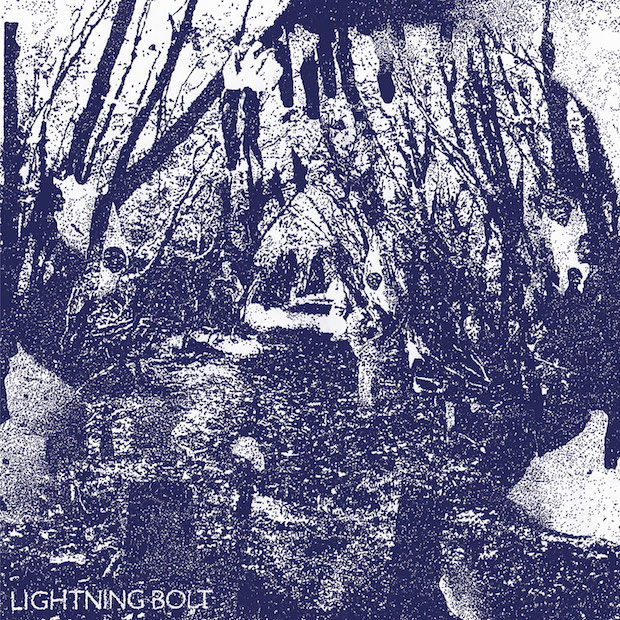
Lightning Bolt – “Fantasy Empire”

Post also featured on seroword.com

Grade: B

Key Tracks: “The Metal East” “Mythmaster”

Lightning Bolt is 21. Lightning Bolt is living on its own, balancing school and work. Lightning Bolt can drink, vote and smoke with no consequence. On their seventh album, they embrace being 21 as an actual 21 year old might – by accepting the rigidity of adulthood, accepting the routine of routine, but not embracing it.

The band, still comprised of just Brian Chippendale on drums and indecipherable vocals, and Brian Gibson on bass guitar, give the impression they’re cleaning things up. The songs on “Fantasy Empire” feel more rehearsed. They’re more rhythmic, more practiced, more worn-in. The band even recorded in a proper studio for the first time in years. This is a trajectory most bands tend to follow – they’re crazy while they’re young, but once they get a taste of success they straighten themselves up. But, Lightning Bolt has been unpredictably successful for many years, so to hear a more straight-forward, repetitive version of the duo is surprising, to say the least.

Or at least, that’s what they want us to think. Lightning Bolt’s rigidity on “Fantasy Empire” is only surprising because we’re used to their wild inconsistencies. Their songs weren’t improvised, but they sure damn sounded like it. 2005’s “Hypermagic Mountain,” one of the albums that got me into noise music, is an hour of Chippendale beating the drums into submission and Gibson shredding wildly. On “Fantasy,” there’s central rhythms and tempo changes. The vocals are rhythmic and coordinated (if not still wholly indiscriminate). But they’re still the same band. On opener “The Metal East,” the band rages on like an ambulance driver in a snowstorm – an experienced one.

The Brians were really just growing tired of the recording process and wanted a change. “Fantasy Empire” is their first album since 2009, and some of these songs have been in their concert rotation since 2010. Musical maturity is a different route for the band. Sometimes, it works, like the sudden tempo change and crescendo on “Mythmaster.” Other times, like on “Horsepower,” the lack of insanity leaves them focus-less. More often than not, things come together. The band nods to metal, like on “Runaway Train,” and to pop, like on the surprisingly rhythmic vocals of “Over the River and Through the Woods.” They’re more leveled, letting you know when you’re going to be assaulted and by which instrument. Things come together more, there’s a semi-structured cohesiveness. And the level to which the listener finds it either off-putting or a breath of fresh air, is really up to the listener. It does leave a hole, as they begin to sound like the bands they’ve inspired. But it’s a small hole, because even in it’s maturity, Lightning Bolt is still a 21 year old band – not yet rid of a few pranks, a few tricks up it’s sleeve, and a whole lot of energy.

If you like this, try: The best recent comparison to “Fantasy Empire” is Melt-Banana’s 2003 “Cell-Scape,” where they held back and wrote catchier, more accessible songs – and in doing so, their stance as the most ferocious band on Earth was only heightened, through the power of planned blasts instead of a full-on attack.

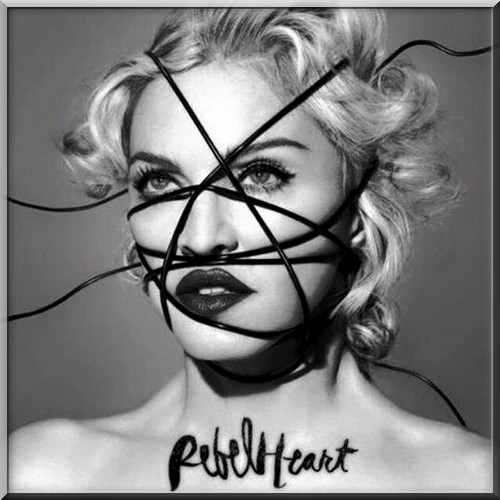
Madonna – “Rebel Heart”

Grade: B+

Key Tracks: “Living For Love” “HeartBreakCity”

Madonna’s new album has a song called “Bitch I’m Madonna,” so, what more do you need?

As we’ve settled deeply into this digital age, there’s been a feeling of resentment about the blending of music and technology, spurred on largely by Thom Yorke, Bjork, and others that don’t see the value of platforms like Spotify, and by the likes of U2, who have no idea how to harness technology to any sort of advantage. The elders seem to think that they’re outdated, and that their further output won’t be able to hold up amongst the music of younger acts. But there’s plenty of musicians fighting against the aging – like Madonna. On “Rebel Heart,” her 13th studio album, Madonna shows no signs of aging, instead standing with and against modern acts like Nicki Minaj, Diplo and Kanye, including them in the album and shoving them under her career in the process.

Madonna’s previous album, “MDNA” was lackluster. It couldn’t find the formula to match Madonna with EDM. On “Rebel Heart,” she’s learned to just be herself and let everything fall into place around here. Indeed, the album’s strongest songs are the ones where Madonna just powers through the dance music around her. On “Living For Love,” “Ghosttown” and “HeartBreakCity,” her voice dominates over all, and although they’re not always the most immediately enjoyable songs, they’re the ones with the longest staying power.

Generally, the bigger the ideas are on this album, the worse they’re pulled off. “Iconic” is the most high-concept song, a track that features Chance the Rapper and, uh, Mike Tyson. Tyson is a voiceover in the beginning, Chance is wasted in a forgettable guest spot, and Madonna herself is lost in the EDM-y overproduction. It’s a big track, one that’s immediate fun, but leaves a bit of a sour taste. “Bitch I’m Madonna” is like that too – it’s a great track overall, but it’s aided by Diplo and Nicki, and Madonna gets lost in the beats. This isn’t something that happens consistently, just on a few tracks, but it highlights the tight line Madonna walks as a 56 year old pop singer.

But, more often than not, “Rebel Heart” just works. With track titles like “Illuminati,” “Holy Water,” “Joan of Arc,” and the aforementioned “Bitch I’m Madonna,” we’re seeing a side that’s showing no reservations. She hasn’t calmed or grown weary in her years; this is the same performer we had in the Sex days. Her voice and her persona haven’t lost an edge, even going so far as to call out everyone in pop culture today on “Illuminati,” from Steve Jobs to Bieber to ISIS. Madonna is back out for blood, and it feels more natural than it has in a long time. “Rebel Heart” may not be a masterpiece, but it’s one of the better pop albums of the year so far.

-Andrew McNally

Little Tyrant – “Stop Crying/Dying (A Collection of Platonic Love Songs)”

Grade: B+

Key Track: “Everyone who Wants to Kiss me is on the Internet”

Little Tyrant, pseudonym of singer Matt Diamond, starts off their short album with the proclamation: “I had lived through a majority of my life thinking I was sad because I was alone, but then I realized that it was the opposite, I was lonely because I was sad.” Diamond, the force behind folk act Little Tyrant, makes a mission statement in the opening number “Hi (Corny Intro).” They’re setting the rest of the album up as a set of tunes for the trans community, that’s a little more ambient and a little less harsh than other singers out there.

To call this album short is to sell itself a little – at eight tracks, it sits at 10:19. But the very brief runtime lets Diamond sit on some of the music’s more important elements. After the Paul Baribeau-like blast of “Wastin’ Away,” the feedback and slowed rhythms of “Light” seem to extend longer than they actually do, in a way that plays with the listener. The album’s longest song is 2:08, the closer “Everyone who Wants to Kiss me is on the Internet,” and it serves as what is a lengthy closer, relative to the seven songs prior.

Diamond’s music is more ambient than most folksy-singer-songwriters. “Sooner” and “Light” experiment a little more in an ambient setting, both musically and vocally. Their placement towards the end of the album help ease the listener into the ambiance, slowly moving from folk blasts into it.

Diamond has stayed away from lyrics that are too harsh. Their lyrics instead reflect the basics of growing up transgender. On “Mediocre Bedding,” they sing “I sat at the bar and smoked some cigars because that’s what growing up is.” The lyrics throughout reflect Diamond seemingly calling on others to try to make the most of their positions. “Wastin’ Away” features no other lyrics other than “You’re wastin’ away,” and they’re delivered in a frontal but apologetic, ‘it’s time we addressed this’ type of way.

After a couple of listens, its apparent that “Stop Crying” packs a number of punches in only 11 minutes. It sets up an environment in a folk world, and moves into ambient, all while delivering introspective but leading lyrics roped together for a specific community. It’s one of the more interesting releases to come out of the dwelling transgender folk scene, an album created as much for others as it is for Diamond.

The album is available for download/streaming here.

If you like this, try: Porch Cat’s split with JFKFC.

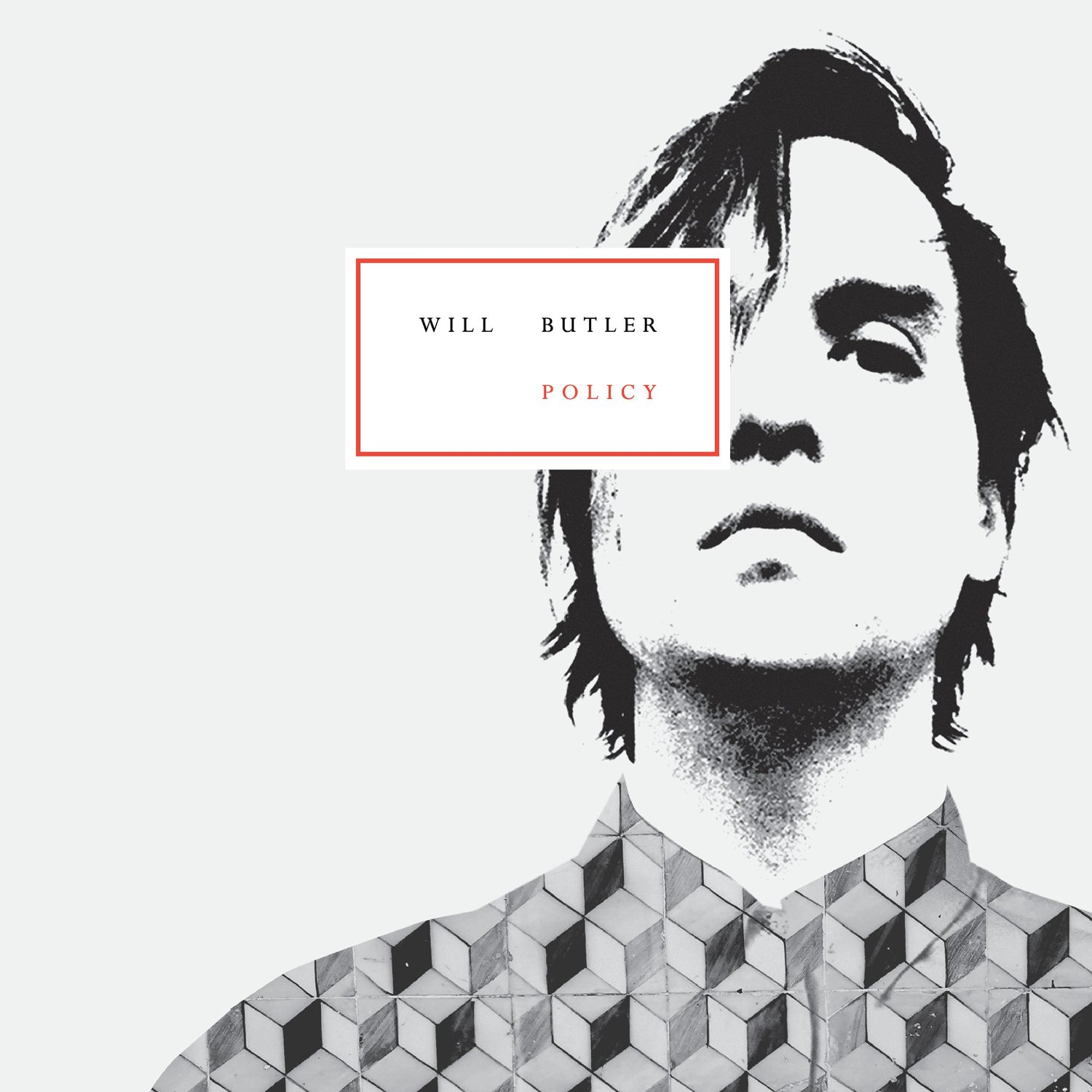
Will Butler – “Policy”

Grade: B+

Key Tracks: “Take My Side” “What I Want”

The idea of a “frontman” is one that dominated classic rock – everyone remembers Freddie Mercury, some people know Brian May’s name, not many people know Roger Taylor and John Deacon. But it’s a status that’s become outdated in the indie age, with alternative bands working more as units rather than musicians waiting for their chance to show off. Arcade Fire hasn’t melded with this change in pace. When a casual person thinks of Arcade Fire, they think of the frontcouple – Win Butler and Regine Chassagne. This is probably because Arcade Fire is huge, there’s six members (seven until recently), and everyone plays multiple instruments. So the band has an indie collective feel, like Broken Social Scene or the Polyphronic Spree. But they’re not, they’ve had a pretty core line-up since Funeral. What this has led to, in succession, is the other members besides Win and Regine trying to make their voices heard. Recently departed violinist Sarah Neufeld released a solo album in 2013, followed closely by multi-instrumentalist Richard Reed Parry. Now, Win’s brother is having his say. Will Butler, who is officially credited with playing “synthesizer, bass, backing vocals, guitar, percussion, sitar, panpipes, trombone, omnichord, glockenspiel, concertina, double bass, clarinet, gadulka and the musical saw” throughout his time in Arcade Fire, has released his first solo album.

As one of Fire’s two remaining crazy members (along with Parry), what we get from “Policy” is Butler’s contributions to Arcade Fire – one slice of the puzzle extracted, and propelled forward until it becomes its own being. “Policy” is often poppier, faster and more lively than Arcade Fire’s music. At 27 minutes, it’s a brisk outing, one that highlights the album’s quickened, but not unruly pace. A majority of the eight tracks are simple guitar-based indie, akin to the solo work of Brendan Benson. It’s a type of indie that is usually successful just because it never has to ask for any sort of originality to work. But “Policy” does still have some original things going on around it. On what’s maybe the album’s best track, “What I Want,” Butler sings wild lyrics around a vocal rhythm that keeps crescendo-ing. Remove the sweet indie sound the goofy lyrics, and it’s a noise-rock template.

“Policy” demands no comparison to Arcade Fire, in either its size or its scope, but it’s hard not to make comparisons. Will does, at times, sound like his brother. And occasionally the rhythms either cool down enough to resemble the band, or they build enough complexity to sound denser. But the album’s biggest difference might be in the lyrics. Butler’s lyrics aren’t at all similar to Arcade Fire’s cold, emotional odes. They wouldn’t fit on an album that leans more to enjoyable than painful. Instead Butler sings lines like “If I could fly / I’d beat the shit out of some birds” on opener “Take my Side,” and on “What I Want,” singing “I know a great recipe for pony macaroni.”

The album’s two outliers are the synth-y and sax-y second track, “Anna,” which almost feels like a red herring. It acts like it’s going to set a tone for the rest of the album, but Butler instead treats it like a song he’s doing for himself to get it out of the way. The biggest outlier is “Sing To Me,” a piano ballad. It’s an effective, low-key piece, and it’s got a strong, haunting tone to it, but it doesn’t really fit on “Policy.” The audience is never really set up for a ballad so soon – even as the penultimate track, it still comes after only 21 minutes.

Still, there are no bad moments on “Policy,” and even though it isn’t entirely effective as an original work and Butler doesn’t quite possess the independent power of being a solo musician, it’s a fun listen throughout. It takes a stance alongside but completely separate from Arcade Fire, and helps to signify Butler’s important position in the group.

If you like this, try: Brendan Benson’s 2012 album “What Kind of World.”

-By Andrew McNally

Jeff Rosenstock – “We Cool?”

Grade: B+

Key Tracks: “You, In Weird Cities,” “I’m Serious, I’m Sorry”

Last year at some point, The Huffington Post published an article detailing bands that write a lot about drugs. And while most readers were left marveling at the fact that Tom Waits has survived it all and is still recording, I noticed that Jeff Rosenstock’s previous band pops up in the lists. It’s worth noting, as I’ve done so many times in the past, that Bomb the Music Industry! is my favorite band. By a whole lot. St. Vincent is a relatively distant second. So I was ecstatic to see BTMI! getting this coverage, even if 1) They were already broken up (to which I wrote this weepy post), 2) Most of the songs are unabashedly sad and, 3) It was in the Huffington Post. Now that he’s on his own, Rosenstock has the freedom to broaden his range. And although he does, “We Cool?” is still dominated by sad-drunk indie-punk songs.

Rosenstock sings “Malt liquor doesn’t make you young” in “Get Old Forever,” and “I’m always getting high when no one’s around” in “You, in Weird Cities.” Those are just the first two songs. “Nausea” and “Beers Alone Again” speak for themselves. He didn’t influence this wave of sad punk and emo bands, he practically invented it. The themes on “We Cool?” might echo those of (every BTMI! album), but we’re always going to be sad and infuriated, so it’s not at all a rehash.

Turn on nearly any track on “We Cool?” and it might sound like a BTMI! song left on the cutting room floor. But it’s a different record – it flows, musically, but not in the way that “Scrambles” or “Vacation” do. “We Cool?” balances different influences against each other. Weezer hot track “Novelty Sweater” bleeds into keyboard-heavy pseudo ballad “Nausea,” which then transitions into the harmonica-featuring “Beers Alone Again.” Rosenstock isn’t as constricted to a central theme, emotion, or season, like he was in previous bands. Instead, Rosenstock is investigating what it means to be a solo singer-songwriter. Perhaps it’s the maturity that comes along with the title, or perhaps it’s the first true solo work of someone who’s already a songwriting veteran at 32, but Rosenstock falls into singer-songwriter mode often on “We Cool?” He references ‘a god you never believed in’ on “I’m Serious, I’m Sorry,” which is itself a very singer-songwriter type song. And he focuses more on his voice – something BTMI! never focused on, to the point where they wrote a song about it (“Vocal Coach,” actually maybe my least favorite BTMI! song, but for other reasons). But for a punk singer-songwriter, Rosenstock’s vocals actually come through well, especially on “Nausea” and “I’m Serious, I’m Sorry.”

There’s debate over whether this is his first or second solo album – I say second. Either is correct. “I Look Like Shit,” released in 2012, was a collection of covers, B-sides and unreleased songs that had little flow to it. “We Cool?” is Rosenstock’s first cohesive solo album, and unlike “I Look Like Shit,” it’s highly re-listenable. It gets better after a few listens, even. What ultimately makes the album strong is that it isn’t associated with any of Rosenstock’s previous bands. He’s solo; it’s what he wants to do, even more on his terms than before. Sure, BTMI!’s John DeDomenici plays on the album, but it’s a Rosenstock show now. And although he strays beyond any conventions of structure, he sticks with the reluctantly-maturing, drunk-punk adult songs. Ten years ago last month, Jeff clicked upload on an album eventually titled “Album Minus Band,” under the Bomb the Music Industry! guise, expecting no response, not even from ASOB fans. Now, he released “We Cool?” a week early for no reason, to a wide, patient fanbase.

-By Andrew McNally

Brooks Wheelan – “This is Cool, Right?”

Grade: B+

Key Bits: “new york stuff” “saturday night live stuff”

There was a sketch on Saturday Night Live recently, but not too recently, that was a play on Family Feud. It was a network edition. On one side stood CBS – host Jimmy Fallon as Jim Parsons, Taran Killam as Ashton Kutcher, John Milhiser as Jon Cryer and Noel Wells as Alyson Hannigan. On the other side stood NBC – Justin Timberlake as Fallon, Kate McKinnon (praise) as Jane Lynch, Jay Pharoah as Ice-T, and Brooks Wheelan. As himself. An SNL cast member. At the time, I laughed at the meta-humor and focused on Timberlake jumping around onstage as Fallon. But, this sketch really defined Wheelan’s presence at SNL, as a comic who was both too grounded and too weird to exist in the NBC universe. And, after his quick firing, Wheelan is out on his own – making that discord work.

It isn’t perfect. Wheelan spends basically the whole album talking about his upbringing, hoping to bank on comedy experiences to bolster his next work. But, Wheelan’s presence as both a bro-comic and an absurdist is strong here, and it’s so conclusive that it’s almost tough to know what to make of him. Wheelan talks about being an incredibly awkward child, through his love of ranking people he knows through brackets without their knowledge, and delivers it in such a way that we all can sympathize, even though that’s beyond crazy. He talks about being the youngest of three brothers in a small Iowa town, but his NYC experiences elevate those memories past the small-town boy charm.

Wheelan might jump from a joke about his brothers pranking him to a bit about how JFK really died from terrible rat breath and that the government covered it up; it’s an elaborate stand-up presence, one that shows that Wheelan is still finding his exact, specific footing.

Where Wheelan’s strengths lie, ironically, is in trying to find out exactly who he is as a comedian. The best bits he delivers on this album are family related – reacting to his father killing a possum with a rock in the garage, dipping his balls in a bottle of Scope that his older brothers used – but he also responds with absolutely unexpected reactions. He ends with pitching all his unused SNL sketches – most of which are weird, cerebral and outlandish (and outstanding, naturally).

He pitches at least eight sketches that SNL didn’t pick up, including a “Field of Dreams” where the players are Nazis, a pair of 109 year old grandfathers who are given Spencer’s gift cards, and an Australian tourist in America who can’t stop saying that Steve Irwin’s death was their 9/11. It’s brilliantly and delightfully weird, just the type of weird that could permeate SNL without making any waves. And on the album, Wheelan sounds a little resentful of his brief time at the show. He wasn’t on air much, and it sounds like it was a struggle on both sides to get his work up. Most of his failed sketches are brilliant, but just not the type to succeed on SNL, and his weird hybrid comedy just couldn’t survive there.

SNL has a history of passing on goldmines – Sarah Silverman, Zach Galifianakis, Louis CK and Larry David all had brief stints at the show before leaving unceremoniously. Wheelan never struck out to me much on SNL, but it might be because he never got his chance to. But on his own terms, on a debut album, he’s completely convincing. Wheelan is the bro-absurdist that could bridge gaps we didn’t know could be bridged.

If you like this, try: Kumail Nanjiani’s “Beta Male.” Kumail’s experiences growing up are decidedly different (Iowa v. Pakistan), but his content and delivery is similar to Wheelan’s.

A few words on Marilyn Manson’s “The Pale Emperor”

Grade: B-

Key Tracks: “Third Day of a Seven Day Binge” “The Mephistopheles of Los Angeles”

I have a distinct memory, in 2007, of downloading the lead single from Marilyn Manson’s ’07 album “Eat Me Drink Me,” called “Heart-Shaped Glasses.” I downloaded it, and realized that I was a seventeen year old grabbing a song from someone who relevancy had left behind years ago. I don’t know what I did next, but the realization of adulthood crept in so I probably bought a checkbook or scheduled a doctor’s appointment by myself or something. It’s now eight years later, and Manson’s name has been written into the history books as a somewhat flash-in-the-pan shock-rocker from the 90’s. But it’s time to make that edit.

I wasn’t planning on reviewing this album. I didn’t even know if I’d listen to it. I keep a running tab on new albums throughout the year and listen to whatever I can – Dylan’s covers album isn’t on Spotify, and Mark Ronson wasn’t tickling my fancy today, so I just threw on “The Pale Emperor,” remembering it had been getting more press than his previous few albums. I don’t know the last time I listened to a Manson album in full; I’m not positive I ever have. But I’m glad I did, because I’m finally getting the Marilyn Manson I’ve always wanted to hear – the real Marilyn Manson, the real Brian Warner.

My problem with Manson was that it never seemed real – he wore weird make-up, but so did Alice Cooper. He sang about hating people and culture, but so did everyone else. He sang about sadistic things, but so did Black Sabbath, and Iron Maiden. And when school shooters started admitting their love for Manson, he was forced to break facade and tell people not to do that. His music was meant to shock, but it was way, way too melodic. Whistle “The Beautiful People” to yourself right now. I bet you can. The Dead Kennedys were more violent and sloppier, and you can’t say that Manson would strike any nerves musically that Nine Inch Nails or, hell, Merzbow hadn’t already.

Manson fell into irrelevancy, once we all accepted his existence and decided to turn him into the butt of jokes instead of the envelope-pushing musician he was trying to be. And although the band has been releasing albums this whole time, “The Pale Emperor” is the first time we’ve seen Manson as a musician. The album doesn’t always turn the volume up; it’s poetic, melodic and, at points, bluesy. It’s even occasionally a little fun, even in it’s darkness. These feel like the songs that Warner – not Manson – has been sitting on for some time, waiting for a time to record. Maybe he waited too long, but they’re a welcome change for someone who had outplayed himself and his band.

Manson sounds like he’s actually having a good time on this record, and it’s a fun we can all engage in. It’s not all great, and it’s not overly memorable, but it’s a side of the band we’ve never seen before. Song titles like “Slave Only Dreams to Be King,” “Birds of Hell Awaiting” and “The Mephistopheles of Los Angeles” sound like typical Manson, but they’re not – because he’s not aiming for radio anymore. Manson – and the band – have finally hit the point where they don’t have to fight for hits any longer. People are either in it for the long haul, or they’re not.

I was never onboard the Manson train, I was a little too young, but this album excited me. I’ve always seen the band’s problems being the forefront of their music and their actual music on the backburner, and that’s finally switching. I titled this review “A few words on Marilyn Manson’s “The Pale Emperor”” because I wanted to talk more about his legacy than the album itself (and because I didn’t expect to go on this long); I’m not that familiar with his discography and how different this album really is. But it is a breath of fresh air from a musician who is finally able to be comfortable with himself. No forcing, no goals, and only the theatrics he wants – “The Pale Emperor” is still a dark, heavy album, but it’s finally one by Manson’s standards, not one by society’s.

-By Andrew McNally

Crying – “Get Olde/Second Wind”

Grade: B

Key Tracks: “Bloom,” “Bodega Run”

To people who have never heard Crying, this double EP is something really new. To fans, it’s very literally not new. The first half is just a reprint of last year’s “Get Olde” EP, combined with a new “Second Wind” EP. So it can’t technically be labeled as an album, and the combination does not answer the listener’s question of why this was done in the first place. Still, “Get Olde” is an excellent EP, and their blend of emo, indie and chiptune is incredibly unique.

What separates Crying from Run For Cover Records labelmates like, say, Pity Sex or Tiger’s Jaw is definitely, unequivocally the use of the digital, video-game-y sounds. It’s a primary focus of their music – the main instrument on every track. Sometimes it’s shrill, sometimes it’s melodic, other times it doesn’t seem to fit and you wonder if you’re going to get a break from it. Luckily, Crying take it upon themselves to differentiate every track, so their unique sound doesn’t become an automatic staple after the first go-around.

It’s easy to describe Crying as a chiptune band, one instrument is literally a Game Boy. But where other bands have experimented with this before, they’ve never roped in such unexpected lyrics. Similar bands often take goofy tones, mimicking the video game world they’re trying to engross. But Crying sing on a real plane – real people in a real, crushing world. “Vacation” namechecks Costco and flip phones, proving they’re living in a globalized society. And frequent references to bodegas cement the band as New York apartment-dwellers, not suburban basement-surviving nerds. It’s a distinction, because Crying’s music has a dense aura to it.

Both EP’s have their up and down moments. They both end on slow tracks (“ES” and “Close,” respectively), and neither really works that well. But both EP’s have honest and devastating lyrics, often delivered in Elaiza’s exasperated vocals. And while “Get Olde” stays right by the Boy’s side, “Second Wind” lets up some room for some drum (“Easy Flight”) and some guitar moments (“Batang Killjoy”). The second side is more varied and denser than “Get Olde,” although the band is more consistent in the release’s first half. I’ve been on to Crying for a while now; their first full-lengthed release is an extremely interesting listen. It isn’t perfect, but it’s still a fun, desperate mess, and it’s a promising release for the future.

-By Andrew McNally

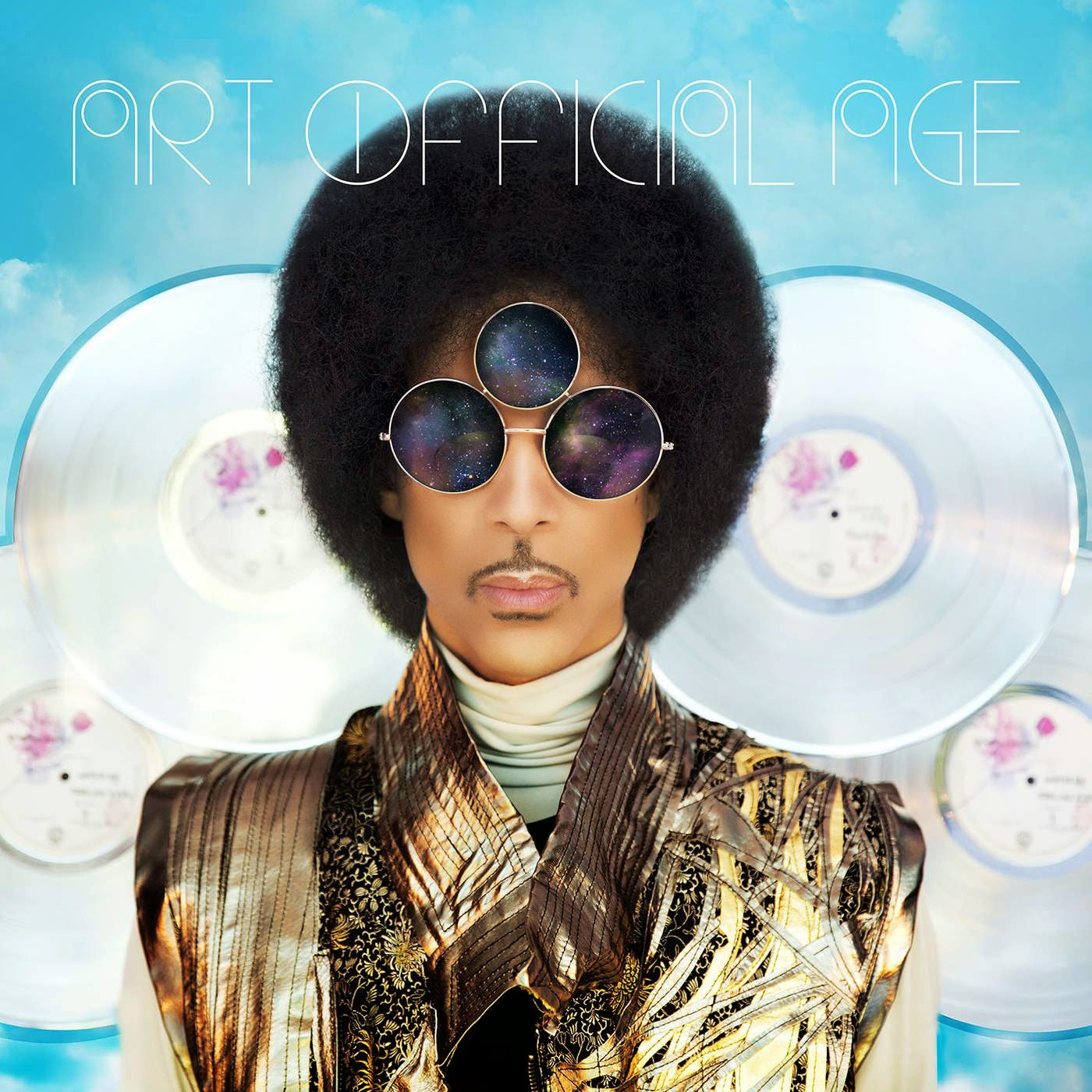
Prince’s “Art Official Age” and 3RDEYEGIRL’s “Plectrumelectrum” – A Review From the Uninitiated

Grades: Art Official Age: B+

Plectrumelectrum: D+

As a music critic, there’s been plenty of times where I’ve faked knowledge of an artist to give some insight into the recording of an album. I’ll admit it, I can’t say I’m on an equal playing field when I talk about both Ariana Grande and Foxygen, I have to look up information on someone like Grande because I’m much more inclined to listen to Foxygen in my own time. But I can’t fake Prince. Not admitting that I don’t know the first thing about Prince’s back catalog and topsy-turvy history would be unfair to him. Prince is a legend; a hero of pop music, and trying to fake my way through a review would not do him any justice. I know that he and Warner Bros. got into a bitter, bitter feud in the ’90’s, partially the reason for him to change his name to a symbol – so Warner would have to find a way to market it. And I know that he’s both feminine and seductive, yet legendary and encompassing enough for the NFL to pick him to play a Super Bowl halftime show (and one of the better ones). What I do know about Prince is that his music has jumped all around, and that’s exactly what his solo album, “Art Official Age,” does. So if you’re not familiar with his music, know that the album is inconsistent but often fun and honest. And if you are familiar, then you probably made up your mind before it even came out. Okay? Okay.

“Art Official Age” starts with a track titled “Art Official Cage,” and it’s a song that would have never existed in the “Purple Rain” years. It couldn’t have. It’s ripped from hip-hop and EDM, with big beats and air horns. It’s fun, and there’s way too much going on, but that’s part of the joy. The album jumps across fun, funky songs and big ballads, all of which are distinctly Prince and neither of which are aligned with any other pop artist. It’s the album’s best and worst quality, that it jumps so frequently and unexpectedly. Luckily, it’s good far more often than it’s bad.

The ballads come early, with the third track “Breakdown.” Prince hits some cringingly high notes, and pulls them off, obviously. “U Know” is a pseudo-ballad two tracks later, but one that has Prince rapping a bit. The hip-hop element is palpable on “U Know,” and is throughout the album. Prince constantly feeds off of genres that fed off him thirty years ago. Ballads aside, the album is a lot of fun, and Prince sounds like he’s truly enjoying it. Late album track “Funknroll” is exactly what it sounds like, a huge disco bash that’s a ton of fun and could easily be thrown on repeat for an hour without getting old. Second track “Clouds” is a strange track, with a strong spoken word that sets up the album’s loose premise of waking up in a world without gender pronouns. And leadoff single “Breakfast Can Wait” is an oddly specific, sexual song that’s exactly what you’d expect from Prince.

“Art Official Age” isn’t all great. The theme of waking up without gender pronouns are neat (and Prince to the max), but it never shows up outside of spoken word bits that are great on “Clouds” and finale “affirmation iii,” but are weak on the other tracks. And Prince seems to be borrowing just a tad too heavily from Daft Punk’s disco playbook – in that he tries lengthy, funky songs, but doesn’t pull them off as well as the duo. There are two tracks, “The Gold Standard,” and “Time,” that are far too long. The former is almost six minutes, the latter almost seven, and there isn’t much of a reason. They just inflate the album’s 53 minute runtime. But it starts strong and it ends strong, and it’s fun in between. People hanging out under rocks like myself should find a lot to groove to on this record, and find a lot of originality in it’s melting of both genres and themes.

On the inverse of that is the debut album from Prince’s backing band, 3RDEYEGIRL. Their album, “Plectrumelectrum,” flows through different genres and influences just as “Art Official Age,” but does so in a much more murkier and standard way. The band, who Prince is proudly touting as being all-female, gets off on the wrong foot with the lackluster “Wow,” a song that lacks the energy to be a true leadoff song, but has enough energy to not be a cop-out slow intro. After that, the album is a topsy-turvy ride, hitting high highs and low lows.

A low low is “Boytrouble,” an overlong and inane pop song that’s stylistically similar to far too many songs that have come before. Another low low is that the album appears to start off with a classic rock vibe for the first four or five songs, before slowly diverging into funk and hip-hop, without seeming to have any real reason. It flows well at the beginning, but the longer it goes on, the more it becomes a collection of songs instead of a fluid album. The album never seems to come to having any point, other than Prince showing off his (talented) backing band. Likewise, on “Fixurlifeup,” he sings lead, and he sings about misogyny in music and how bands shouldn’t be called “female” bands, yet he prides himself on showcasing his handpicked female backing band, contributing to the problem himself. (Not that he shouldn’t have an all-female band, just that he’s being pretty hypocritical about it).

The album isn’t all bad, though. There’s some great, exploratory songs. The title track (and longest on the album) is an instrumental classic rock jam that shows just how talented the band is. And the follow-up, “Whitecaps,” is a pleasant vocal-based pseudo-ballad. And the album has a better pacing, clocking in at a tighter 42 minutes, with some fat trimmed. The album certainly has it’s moments, it’s just very inconsistent and never has a sense of purpose. Perhaps the thing that summarizes it best is that the album’s final track is a different version of “Funknroll,” from “Art Official Age.” It’s a slightly different version that’s still good, but just not as much.

Not knowing anything about Prince didn’t harm me in listening to 3RDEYEGIRL. Their album is more direct, even if it hits different genres. It isn’t a great album and I give only a reserved recommendation for Prince fans only, but it still has some fun moments. And, they’re talented. they’re extremely talented. Non-Prince people like myself can at least enjoy it just as much (probably more) than Prince fans. As for “Art Official Age,” it’s also inconsistent, but it’s fun and energetic, and it might be a refresher for his fans. Or at least that’s what it sounded like to me.

-By Andrew McNally
J. Cole – “2014 Forest Hills Drive”

Grade: B-

Key Tracks: “Fire Squad” “No Role Modelz”

J. Cole wrote “magnum opus” all over this album. This is the album he envisioned as leaving his mark on rap, his childhood-based album, his “Here’s what New York is like” album. It’s not that, but it’s at least a solid release, largely devoid of some of his clunky lyrics of the past.

Defense seems to be the strategy on “2014 Forest Hills Drive.” It’s J. Cole’s album to lose. This is probably the most apparent in the lack of credited guests. He dominates every song, and although other voices do drop in, they’re uncredited and not the big names you’d expect. The album’s overarching theme is childhood and youth, as earlier this year J. Cole bought the house he grew up in, after it was foreclosed on in 2003. He defends this, he defends New York City, he defends his own position in rap. But the most effective is his defense of race, one of the few areas where J. Cole has been distinguished as of late. He gives a Ferguson mention on the sprawling finale, “Note to Self,” reminiscent of him being one of the first entertainers to make a visit to the town. On “Fire Squad,” he raps about white people taking over rock and rap, and how he’ll try to crack a smile when Iggy wins big at the Grammy’s. And on “No Role Modelz,” he raps, “I came fast like 911 in a white neighborhood.” At the album’s best, it’s provocative and button-pushing, a step forward for someone still looking for his place, and certainly forgiveness for Nas.

At the album’s worst, though, it falls into blander hip-hop lyrics and beats. “A Tale of Two Citiez” is particularly clunky song, just a self-serving boastful sex song. There are others on the album, and even better tracks like “Fire Squad” fall victim to some cliche moments. The album doesn’t do enough to bring in some cliche elements into other more, progressive ideas. Most of the album has surprisingly melodic and dense music, but trashy lyrics don’t always fit against them, and it gets jarring. J. Cole’s clearly working on tightening up his ideas and sound, and he’s not there yet, so an album of this stature may have jumped the gun.

“2014 Forest Hills Drive” isn’t going to be remembered as being on the same level as the albums that inspired it. It has some worthy songs, some piercing lyrics and a lot of great music (even the intro has compelling music behind it), but it’s all a little too messy so far. J. Cole doesn’t have the experience to pull this album off yet – just listen to “Note to Self,” the nearly 15-minute, improvised finale, where he namedrops everyone who helped make the album, and continuously tells the listener they don’t need to sit through the credits. It’s a big idea – challenging the listener to keep going. But, it’s also supposed to be fun, and we’re not in on it. J. Cole is coming towards mastering the formula, but it hasn’t quite all come together yet. Challenging me to go on was bold; I gave it a few minutes before I stopped.

-By Andrew McNally