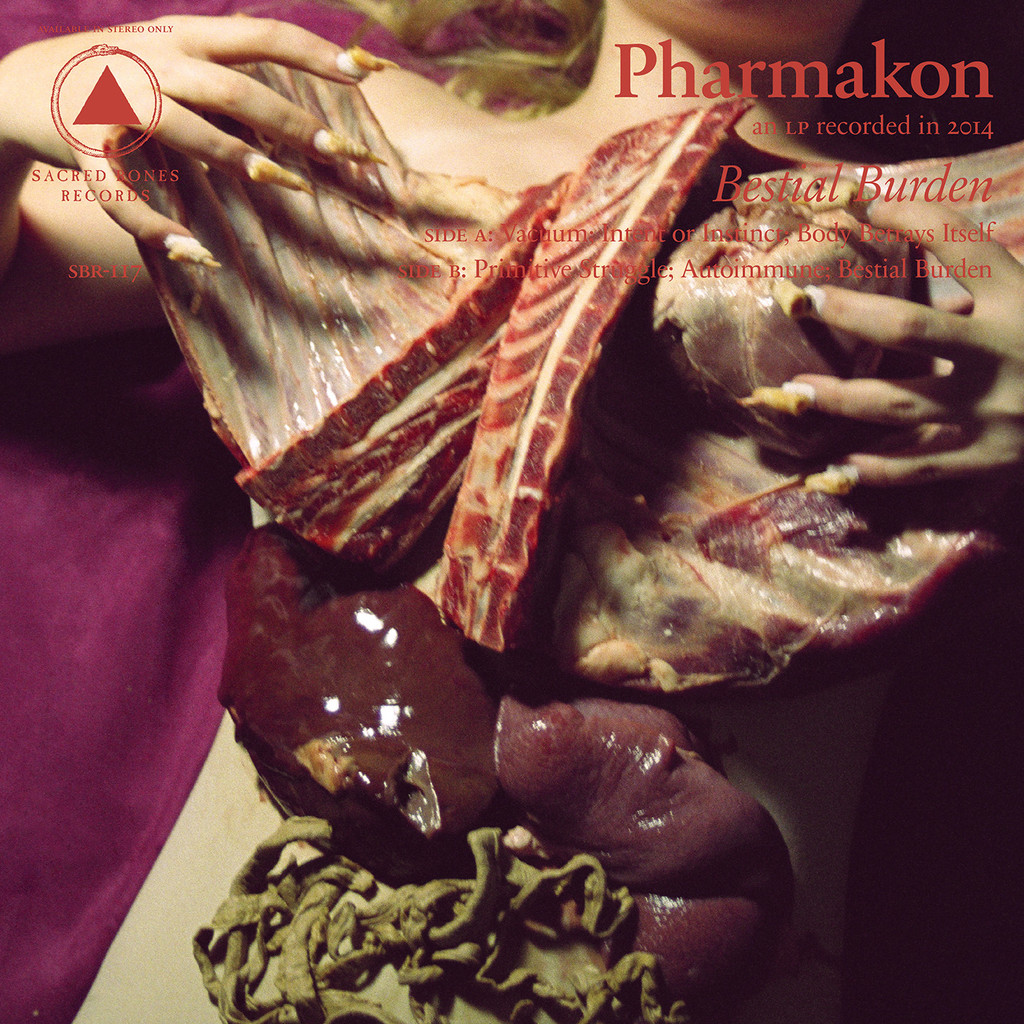
Pharmakon – “Bestial Burden”

Grade: B

Key Track: “Bestial Burden”

One of my biggest regrets of 2013 was never getting a chance to review Pharmakon’s proper debut album, “Abandon.” Pharmakon, industrial-noise based project of Margaret Chardiet, is one of the harshest acts out there, and “Abandon” still serves as just a brutal listen start to finish. Due to unforeseen health circumstances, Chardiet had to cancel the first major Pharmakon tour and get emergency surgery. While she was recovering, she wrote a follow-up: “Bestial Burden.” The album is menacing and brutal, more inward and deprecating, but also with its moments of honesty and musicality.

I take notes when I listen to albums. For the first track, “Vaccuum,” my notes only say “just breathing.” It’s an intro, one that is just the sound of heavy, panicked breaths. Sure, it’s nothing compared to the sonic assault of “Abandon,” but it sets the album’s tone. This album is frantic, not just devoted to volume but to dissonance and to issues of health and well-being. The first true track, “Intent or Instinct” is noticeably more industrial than anything on “Abandon.” For eight and a half minutes it soldiers on – the first scream comes in around the three-and-a-half minute mark, and the industrial beat never sways, even as the screaming gets more intense.

This constant, industrial tone is one that stays throughout the album. It marks a departure from the abrasive synth blasts of before, although it is still an assault on the ears. But the album is structured in its noise. The tracks have steady, unfaltering industrial beats that oftentimes border on the verge of being rhythmic. Or at least, consistent. Pharmakon have always had a way of finding rhythms in pure noise, but this album does it more cleanly and more directly than before.

After Chardiet had to undergo emergency surgery before her first European tour, she began writing a more introspective work. This album is the result. It’s noticeable in the album covers alone – “Abandon,” with a pair of skinny legs (presumably Chardiet’s), covered in maggots, to this one – insides. This album is inside the body. Songs about health and the body. The title track has the repetition of the line “I don’t belong here,” coupled with laughing.

Both “Abandon” and “Bestial Burden” have bonus tracks, and they’re indicative of the albums themselves. “Sour Sap,” from “Abandon,” is a blistering 27 minute hell journey through screaming and pure white noise. But “Bang Bang,” on “Bestial Burden,” is the straightest song Pharmakon’s ever done. Sure, it’s about getting murdered, but it gives Chardiet a chance to actually sing, instead of screaming, and she has a pretty accommodating voice. The longest track on “Bestial Burden” is “Intent or Instinct,” at eight and a half minutes. Though longer than any of the non-bonus songs on “Abandon,” the album’s songs feel shorter. And they are – there’s more shorter pieces, instead of a few long ones. It allows the album to feel like a journey through the mind and body; a disturbing trek through a broken and disturbed being. Interlude “Primitive Struggle” is just a man coughing over an increasingly fast heartbeat – so simple, but so demanding.

To jump into Pharmakon, you have to know to expect screaming, slammed-down synth notes, and a perpetual feel of pure terror lurking around the corner. “Bestial Burden” takes an inward stance, and the result is more structured, but no less full-frontal. If “Abandon” challenged insanity, then “Bestial Burden” challenges injury. It isn’t for the faint of heart. It’s abrasive and brutal, almost palpable in its intensity. Industrial-noise is called so for a reason, and although the album might not be as immediately terrifying or numbing as “Abandon,” it is still confounding and abrasive, and only for the most committed and toughest listeners. Have fun picking through it, Pharmakon is here to stay.

If you like this, try: Spinning Death Grips records backwards or something, I have no idea.

-By Andrew McNally

Ross Hammond & Grant Calvin Weston – “Blues and Daily News”

Grade: B+

Key Tracks: “Blue Teeth” “Aquarium Salt”

“Blues and Daily News,” a collaborative album between jazz guitarist Ross Hammond and drummer Grant Calvin Weston, came about by Weston recording improvised drum parts and mailing them to other artists. Hammond’s contributions led to the track “Little Melon Head,” which led to a full album recorded in the same vein. The 10 tracks are all short blasts of improvised guitar and drums, spiraling through jazz, funk and country rhythms, amongst other influences.

Hammond’s guitar is virtuosic throughout, as he improvs his way through many different styles. We get glimpses of rock, in opener “Huff, Puff, and Blow It All Down” and “Blues and Daily News.” “Aquarium Salt” is led by an ambient, minimalistic rhythm in the background. And “Blue Teeth” is centered around very twangy, slide-heavy country rhythms. “Little Melon Head” even has a Latin flare to it. Hammond’s musical knowledge of genres, and his ability to bounce through and around them is impressive. “The Big Dipper” is also a noteworthy track, simply because Hammond hits an intensity higher than any other track. Hammond’s improvisation style is structured, as much as improv can be. He feeds off his own rhythms and ideas, maintaining a consistent sound in each track without falling into doing anything actually repetitive.

But one of the album’s most interesting qualities is how the two musicians vary in their improv styles – Weston’s drumming is much more unfiltered and manic. It is impressive and technical from start to finish, and it’s more unstructured style provides a stark contrast to Hammond’s guitar. It adds a chaotic balance. Weston also shines on “The Big Dipper,” his strongest track. His drumming complements the quicker-than-normal guitar of the track. Weston is prominent on “Aquarium Salt,” as Hammond takes a backseat and lets Weston work. Weston often adds rock drumming to his jazz, as much Ginger Baker as Buddy Rich.

As mentioned, the album blends influences together. Country, ambient, rock, jazz and others are explored. The final track, “Get Ready to Meet God,” is even centered around a snippet of an interview with Muhammad Ali. There are a number of interesting ideas on “Blues and Daily News,” and although some of them could have been extended more, it makes for a unique listen. Hammond and Weston play off each other nicely, and the combination of non-jazz styles in a jazz platform makes for some fun and independent songs.

This album is especially surprising, given how it stands as a stark contrast to Hammond’s “Humanity Suite,” which I reviewed in March. Stream and download “Blues and Daily News” here.

-By Andrew McNally

Foxygen – “…And Star Power”

Grade: B

Key Tracks: “How Can You Really” “Cosmic Vibrations” “Can’t Contextualize My Mind”

All day I’ve been trying to come up with outdated words to describe this album. Rad? Killer? Kickin’? Foxygen are a classic rock band for the digital age. They always have been. But their new double album, “…And Star Power,” is so classic rock inspired that it explores it as a concept. The album is split into five parts on four sides, all of which represent some faction of a standard classic rock album. And although at 82+ minutes, it’s way, way too long, it provides for an interesting listen as a 24 track album where each song gets crazier than the last.

Side One of this album is split into two parts – the first half of a classic rock album, with the radio hits, and the second half, where only the band’s real fans keep listening. What this means for Foxygen is a start to a lengthy album with a few midtempo, standard-ish songs. It’s a risky move, trusting your fans to keep listening even though the opener is shaky. But it does provide a few great songs – “How Can You Really” is the most Foxygen-y song ever produced, a song that sounds just like any classic rock standard, except for it’s indescribable sloppiness. It and “Cosmic Vibrations” have provided two singles for Foxygen, on an album that’s otherwise devoid. Part Two of the side is one suite – the four-part Star Power Suite. The four songs, including an opening overture, are all speedy garage-rock bruisers that are a lot of fun. Only one of them stretches over three minutes, so they don’t overstay their welcome.

Side Two is subtitled “The Paranoid Side,” and it’s easily the weakest side of the album. The loose concept of this section is songs that are more psychedelic and free than standard rock settings. “I Don’t Have Anything/The Gate” and “666” are interesting songs, but it’s the longest section from a track number standpoint, and it’s got some of the most forgettable songs. “Flowers” and “Cannibal Holocaust” might sound better on a shorter album, but on one that’s already overly bloated, they just take up time.

Side Three, or Scream: Journey Through Hell takes a sudden detour into songs classic rock bands wish they could’ve pulled off, but couldn’t have at the time. The section is kicked off by the nearly seven minute “Cold Winter/Freedom,” which never has a discernible rhythm but some haunting tempo changes. The section is marked by chaos – screaming, hyper rhythms and drastic volume increases. “Can’t Contextualize My Mind” sounds exactly a Stones song left on the floor because it broke an album’s flow. “Brooklyn Police Station” “Freedom II” and “Talk” are all equally intense, hitting chaotic levels even for Foxygen. The few lyrics the songs have are often unintelligible. It’s jarring and off-putting at first, but they’re tracks that demand a few listens, and the listener is drawn back to them almost immediately.

The final side is just two tracks, sweeter outros which don’t exactly fit, given the predecessors, but they’re decent enough as is. “Everyone Needs Love” is a sweet, lengthy song, and “Hang” is a calmed and fitting finale. Their placement doesn’t really work but there isn’t much to comment on them.

“…And Star Power” sounds like their previous album, “We Are the 21st Century Ambassadors of Peace & Magic” on an immediate level – it’s classic rock inspired lunacy, with brilliant flow, quick switches between melodies and chaos, and a permanent garage feel. But it’s a very different album. (Full disclosure: “21st Century” is one of my two or three favorite albums, so take any analysis with a few grains of salt). “21st Century” is only 36 minutes long, nearly a third the length and fifteen songs fewer. And where “21st Century” prouds itself on dense, bizarre and witty lyrics (“On Blue Mountain/God will save you/Put the pieces back together” shows up in at five of the nine songs), this album centers itself on more conventional lyrics, instead aimed at the flow and the grandiose concept. Much of “…And Star Power”‘s rough transitions, competing ideas, and sheer length come from the band’s inner-fighting, well-documented since their break early last year. This album actually serves to clarify that things aren’t as bad as they seemed to us, but the output still goes to show some issues.

Foxygen have always been a high-concept band. Don’t forget, their first album was a 30 track space opera. So the concept, on the whole, works well on “…And Star Power.” They’re a classic rock band incarnate, evident in Johnathan Rado’s utter devotion to singing like Lou Reed and Mick Jagger. The album’s only fault is that it’s just long – so, so long. Twenty minutes could probably be chopped off and it would have the same effect. On top of multiple songs in each section, there’s interludes that just take up more time. But still, Foxygen are cool as hell. There’s a reason they were able to get members of the Flaming Lips, White Fence and Of Montreal to guest on the album. “…And Star Power” is the album that MGMT wishes they could make – expansive, ambitious not to but past a fault, flowing but inconsistent and downright bonkers. If you have 82 minutes to spare, and you’re into indie-garage bands taking pages from psychedelic classic rock, then “…And Star Power” is by all means worth a listen.

If you like this, try: This one’s easy. Jordaan Mason & Horse Museum’s 2009 album “divorce lawyers i shaved my head,” a concept album about a failed marriage between two people confused about their sexual identities. Each song escalates in it’s disturbing and bizarre qualities, but does so at a slow pace so the listener doesn’t pick up on it at first. It’s a confounding work. Mason does his best Jeff Mangum impression throughout.

-By Andrew McNally

Dads – “I’ll Be the Tornado”

Grade: B+

Key Tracks: “Grand Edge, MI” “Sold Year/Transitions”

Gone are the days of “Groin Twerk” and albums with ‘Radass’ in the title. Dads’ perpetual lyrical theme of growing up and drifting away comes stronger, as the Jersey duo mature in leaps and bounds over their last record. We saw this transition coming, on the decidedly not-so-emo “Pretty Good,” an EP that never really found it’s place. “I’ll Be the Tornado,” an LP, completes the transition into a serious, adult band. Except, they’re still punk.

Much like last year’s “Pretty Good,” the guys bounce around in a few different influences. This album has much more flow than “Pretty Good,” not trying to make any statements about the music, instead letting the audience accept it as it comes. The album’s acoustic opening isn’t a copout, it’s part of a build-up, and it’s unexpected. (And it’s reminiscent of this year’s largely acoustic Cardinal Cardinal EP, the side project of John Bradley). We’re still kind of expecting disassembled, roaring songs like “Get to the Beach!” but they’re not present. Instead, we get a number of flowing rock tracks, with occasional punk jams (“You Hold Back”), emo ballads (“But”) and some slight, leftover twee rhythms (“Chewing Ghosts”). “I’ll Be the Tornado” is more straightforward and accessible, if not still tough around the edges. Two part track “Sold Year/Transitions” has a rough and straining transition in the middle that’s fresher than most of the album’s other music. Dads feel comfortable falling into more traditional rock, but they can still pull it all off.

And they can pull it off because John Bradley’s lyrics, vocals and drums haven’t changed a note. “I’ll Be the Tornado” is a drum-heavy work, logical when you’re a duo with a drummer who sings lead. And Bradley’s lyrics are as ‘fresh’ as they’ve ever been. They have a certain ‘creative writing 101 course’ feel to them – poetic only in their specificity, direct, regretful and reminiscent. His lyrics are always unique, opting for straight punches rather than anything subversive. “I want to be happy,” Bradley starkly admits on “You Hold Back,” which seems a contrast to everything before and after it on the album. Bradley, and Scott Sharinger, explore feelings of unease and uncomfortable maturity, not knowing what to want or expect out of life. As with previous albums, many of their lyrics are based around falling back on memories because you can’t make anything of the future. “I need something new to obsess over,” says second track “Chewing Ghosts.” And reflections on others are present, as always. “You wanna hang Christmas lights in the summer/An excuse to spend time with each other” Bradley sings on “Sold Year/Transitions.” And Bradley also sings about his own dad’s health struggles, with references peppering the album throughout. The album is honest, even for Dads, with frank poetry and gut-hitting remembrances.

The only real fault of the album is that in its embrace of more traditional rock music, it sputters out towards the end. The album ends with “Take Back Today” and the 7+ minute “Only You,” both of which are musically pleasing songs, but aren’t the big finish the album needs. They’re both kind of ho-hum songs, not hitting the same level that the rest of the album does. So it dampers the album a bit, but not enough to discredit the eight songs before it. “I’ll Be the Tornado” is still a wildly and unexpectedly progressive album for the band, one that’s also regressive in many ways. It’s definiably Dads, but it’s more open, grittier, slower, clearer, and even more honest. Gone are the punk blasts, and they’re missed, but the replacements are more than welcomed.

If you like this, try: Prawn’s recent album, “Kingfisher,” another more mature sounding emo album, albeit one that takes an entirely different lyrical approach.

Tinashe – “Aquarius”

Grade: A-

Key Tracks: “Bet” “2 On” “Bated Breath”

There are a number of goals an artist has to have going into a debut album, but maybe the most important is signifying your sound and immediately making it your own. Tinashe does this and more, with her hip-hop/R&B blend and smart lyrics coming together in one of the year’s biggest surprises.

“Aquarius” doesn’t subscribe to any genres. This is growing typical of the hybrid R&B/hip-hop genre that is melting together and becoming it’s own being, but this album is especially inclusive. Tinashe comes out of the gate brimming with confidence, knowing she can pull off any of the ideas that come up. And she does – from sultry R&B, to smooth vocal ballads to a straight DJ Mustard track (“2 On,” which you’ve heard a million times, but it still hasn’t gotten worn out). By the end of the second track, Tinashe has already established herself as a unique voice, unafraid to try things unheard of in older R&B.

That second track, “Bet,” firmly establishes the album’s foundation. The song, distinctly R&B, is also a collaboration with Blood Orange and ends with a very lengthy, ambient guitar solo. It’s the album’s second-longest track, and it takes its sweet time. The song announces for the album that Tinashe is in total control, flowing through different styles and dominating every track. Her vocals are strong and engaging, traditionally sultry in an untraditional format. “Bated Breath” is the album’s best vocal song (and the actual longest track), a seductive ballad in the album’s final act with Tinashe’s voice soaring over the music, and one that stops on a dime halfway through and re-crescendos with an engrossing coda. Compare this with the straight hip-hop of “2 On,” and you get a well-rounded singer. Her lyrics, too, are often smart and occasionally conceptual and subversive. The most notable track is “Pretend,” about trying your hardest to ignore problems in a relationship, even for a minute. A$ap Rocky drops in for a verse, as her deadbeat boyfriend. A$ap Rocky, Future and Schoolboy Q all contribute excellent verses on the album, and are all shown up by Tinashe.

Musically, Tinashe takes as many liberties as she does vocally. The album is mostly slow-moving, melodic and low-key R&B with club beats and ambient rhythms. But it is peppered with guitar, piano, and volume. Each track is it’s own entity, and they’re nearly all distinguishable from each other. “Pretend” excels on an unexpected, minimalistic beat that’s closer to a home recording than it is a radio cut. The album is also divided into pieces, split by five interludes and an outro. Most are little more than minute-long tracks serving to shake up the flow, although the interlude titled “Indigo Child” is itself a rather experimental and slightly haunting track, one that hits the album’s loudest volume.

The album’s only real fault is a slightly bloated running-time of 55:43. Its eighteen tracks do include the six interludes, so it is less daunting than it looks, but it does sag a bit in the midsection. It could do without a few tracks; it could stand to be a little tighter. Still, as it stands, “Aquarius” might be the year’s best debut, and is certainly one of the best hip-hop albums. In a world filled with young TV personalities trying to shed their former status and make it in music – namely Miley and Ariana Grande – Tinashe has quickly emerged as one of the stars (Tinashe, only 21, was known previously not for music but for roles in “The Polar Express” and “Two and a Half Men”). “Aquarius” is an instantly enjoyable and thorough album, one that doesn’t demand multiple listens, but slyly convinces them instead. Tinashe is in total control on her debut, and it’s relentless fun.

-By Andrew McNally

Weezer – “Everything Will Be Alright in the End”

Grade: B

Key Tracks: “Ain’t Got Nobody” “Foolish Father”

Baby steps, people. Baby steps. It’s been a longtime since we’ve seen a Weezer we can trust, but we’re getting closer.

It’s no secret that Weezer fans, and fans of basic alternative radio, have suffered over the past decade. Since the excruciating “Make Believe” in 2005, Weezer has released a string of five largely terible albums. And most of them roped us in with great singles – 2005’s “Perfect Situation,” 2008’s “Pork and Beans,” 2009’s “If You’re Wondering If I Want You, I Want You To,” 2010’s “Memories.” But after a four year break (no, not some more undergrad studies), Weezer are back with an album that comes closer to revisiting their roots than they’ve seen in 12 years.

You may have heard leadoff single “Back to the Shack.” It’s honestly a pretty terrible song. Something about the weird hip-hop influence over the fuzz guitar doesn’t work, like something is just off. But the sentiment is there – an apology to fans and bandmates, from Rivers Cuomo, for years of music that didn’t sound like “My Name is Jonas” or “El Scorcho.” Indeed, Weezer go back to the basics on this album. It’s the closest thing to 90’s fuzz-rock we’ve gotten since 2002’s underappreciated “Maladroit.” And while it’s inconsistent and largely less than exciting, it’s still a nice refresh on a legacy that had become more asterisks than not.

The album deals with relationships – Cuomo’s relationships with others, women, and his father. They might be tried topics, but not for a band that’s trying to reclaim a lost sound. The last of those – Cuomo’s relationship with his father – comes through the strongest. The album’s last four tracks deal with it. “Foolish Father” is direct, but the last three songs – a trilogy – are not. “I. The Waste Land,” “II. Anonymous,” and “III. Return to Ithaka” close out the album on a big note, a booming finale of tracks that’s reminiscent of bands bigger than Weezer. Parts I and III are instrumental, but it doesn’t matter, because they hit a sound they’ve never really hit before.

Weezer also smartly give a nod to bands they’ve influenced. Bethany Cosentino, of Best Coast fame, sings on “Go Away.” And Patrick Stickles, frontman for (the best current American band) Titus Andronicus, contributes guitar on “Foolish Father.”

The 90’s garage-nerd fuzz comes back, finally, though it isn’t as strong as it used to be. This album is about on par with the Green Album – the kind of Weezer we like to hear, even if it isn’t their best work. Most of the songs aren’t that memorable, but it still makes for a good listen. Cars frontman and early Weezer producer Ric Ocasek seems to have roped the band back in, too, with his production sounding similar to the band in their heyday. It seems like we can finally say, “gone are the days of mediocre, scattershot Weezer.” “Everything Will Be Alright in the End” doesn’t have the standout songs that “Ratitude” or “the Red Album” have, but it instead offers more than just two good songs. Nearly every track on “Everything” is 90’s era garage-rock, and the only ones that aren’t are the mid-album slow jams. “Everything” isn’t going to go down among “the Blue Album” and “Pinkerton,” but it’s a serious step in the right direction, and it’s the album that we, or at least I, never thought I would hear Weezer put out anymore.

-By Andrew McNally

The World is a Beautiful Place & I Am No Longer Afraid to Die – “Broken Bodies”

Grade: B

Key Track: “If And When I Die”

Nine-member band The World is a Beautiful Place & I Am No Longer Afraid to Die aren’t exactly known for palpable, conventional music. You can probably tell by staring at their eighteen syllable name. Their mix of emo, ambiance, twee-pop and dissonance has, for a few years now, brought a fresh voice to a scene dominated largely by straight pop-punk. Their new EP, recorded alongside spoken word artist Chris Zizzamia, is even more confoundingly complex and headache-y than their previous works.

The band, who I’m going to shorten to The World Is to avoid carpal tunnel (no offense!), brought on Zizzamia to bring a form of intense narration to their ambient music. They knew it would polarize fans – only the people truly onboard with them would appreciate it, because it is tough to swallow. Zizzamia spits some beautiful poetry throughout the EP, about human bodies making up stars, intertwining, and facing invincibility, all capping off with the beautiful line “I think my name is safest in your mouth” in the finale, “Autotonsorialist.” Another great line, “I like you like I like the dark/Why would I aim to defeat it?” peppers the track “Shoppers Beef.” Zizzamia is an interesting addition to the band – it isn’t just that spoken word works well alongside the band’s music, it’s that his spoken word works well. His flowing poetry, moving through anger, hope and experiment, is told with a spitting clarity and a scathing touch. It’s a strange fit, but that’s kind of the band’s MO, after all.

The band takes pages out of every section of their own playbook on “Broken Bodies.” Through the eight tracks, there’s a long, experimental opening, build-ups to climaxes that don’t happen, a conventional song (“$100 Tip”) that fades out into a multi-minute drum segment, and a track with a full, driving beat (“Space Explorations to Solve Earthly Crises”). They hit all their own notes. There are actual vocals throughout the album, in a few tracks. Some are just Zizzamia, some are both, and occasionally we get them simultaneously.

The fault in the EP’s experimentation is that it doesn’t have quite the same cohesiveness that their full-length, “Whenever, If Ever,” had. The EP flows, but each song is it’s own distinct being, where the tracks on their album all need each other to work. Still, spoken word alongside experimental emo makes for a very unique listen, like a sadder version of the Moody Blues’ “Knights in White Satin.” The World Is have already proven themselves to be one of the strangest, most difficult and original bands we have today, and “Broken Bodies” just extends this. This would probably never work for a full album, but it’s a consistent and consistently ambitious work, one that takes a few listens and aims for both the heart and the head.

Give them yr money and download it here.

If you like this, try: I don’t know, Pink Floyd? drugs?

-By Andrew McNally

Tony Bennett & Lady Gaga – “Cheek to Cheek”

Grade: B+

Key Tracks: “Cheek to Cheek” “I Can’t Dance”

I left my heart in an interdimensional meat planet.

So let’s just get it out of the way that a small part of me hoped this album would fail, so I could write “I Left My Heart in San FranciscNO.” Okay? Moving on.

This is a strange collaboration, and it might seem like a flash in the pan for two singers who are struggling to stay relevant – but it makes a lot of sense. The younger, Lady Gaga, has a history of professional jazz singing, and getting to try her hand at some jazz standards is a branch she could never explore solo. This isn’t Lady Gaga, this is Stefani Germanotta singing. She’s exercising a side to her music that Lady Gaga won’t allow for, and she’s coming back from a relatively terrible album. And the former is a singer who was forced to reinvent himself for a younger generation in the 90’s, and has managed to stay in the public light since then – despite always performing almost entirely covers. What better way to stay relevant than to record with Lady Gaga? The biggest recording artist of ~2009-~2011, trying to stay relevant herself.

So, reasoning aside. Does this album work? Yes, pretty much throughout. The standard version of the album is 11 tight songs, not quite hitting 35 minutes. It’s quick, melodic, and fun. All eleven tracks are jazz standards, a plus since it results in two relaxed musicians having fun in the studio. A majority of the songs are quick hoppers, so the album never drags at all. The album’s best quality is that Bennett and Gaga, products of two very different generations, are clearly enjoying working on standards older than both of them.

Gaga’s and Bennett’s harmonies don’t always work on the album, sometimes they’re just two singers singing at the same time. On standards like “Cheek to Cheek” and “It Don’t Mean a Thing (If It Ain’t Got That Swing),” though, their interplay resembles that of a jazz club in the 40’s, singing through some energetic, fun, early dance songs. Each singer gets one solo song, too – Bennett handles “Sophisticated Lady” while Gaga nails the incredibly difficult “Lush Life,” a song that’s plagued jazz singers for generations. It’s worth noting that, in many of the harmonies, Gaga takes the lower registers. When given their moments, both singers shine as much as you’d expect them too. And even when their interplay isn’t at it’s strongest, the tracks are still fun.

One notable surprise is some strong music in the background. The duo step aside for a lengthy sax solo on “Let’s Face the Music and Dance,” and the band is allowed to flourish throughout the album. Jazz is about the music, and Bennett and Gaga give the musicians their due space, not taking up all of the light themselves. The band sounds tight, adding a briskness to the songs that’s sometimes missing from them.

Tony Bennett’s entrance into professional music is cited as being in 1949, six years before Lady Gaga’s mother was even born. But the beauty of these jazz standards is that they never get old. Any singer can put their mark on a jazz standard. A song like “I Can’t Dance” can sound as fresh in 2014 as it did when Sinatra did it in 1957. These eleven songs are inter-generational, and hearing two extraordinarily different singers tackle them together is a pretty unique listen. Bennett isn’t really stepping out of his normal territory, but Gaga really is – and it’s refreshing to hear, especially after the questionably re-tread routes of her last album. “Cheek to Cheek” may not be ‘great’ per se, but it’s a fun, upbeat and surprisingly successful collaboration – essentially, if you’re a fan of any part of this machine, you’ll find something to enjoy.

-By Andrew McNally

Interpol – “El Pintor”

Grade: B+

Key Tracks: “All the Rage Back Home” “Everything is Wrong”

This album is refreshing, in the sense that waking up to find a glass of tepid tap water on your nightstand at noon on a Sunday is ‘refreshing.’ Old Interpol isn’t back – even literally, as Carlos D’s departure has left the band a trio – but this album is the closest they’ve come to vintage Interpol in a decade.

“El Pintor” is both an anagram for “Interpol” and Spanish for “the painter.” Both titles fit – this is an album worthy of being self-titled, if they hadn’t already done that on their murky 2010 album. And painting – making something from nothing. The band has basically re-kickstarted themselves; Paul Banks absorbed the bass parts, and they’ve returned to a tighter and denser sound. They’ve made the best out of what was becoming a bad situation – a legacy of people saying “Well, their first two albums were great…” The trio sounds like they’ve shelved some ideas and put “Our Love to Desire” and “Interpol” behind them. To put it more simply, Interpol has not, as you would exactly expect, been affected by critics at all.

Interpol isn’t doing any flexing here. There’s nothing extravagant – no time for that. “El Pintor” is just 40 minutes long. They trimmed everything they could, leaving just the tight, existential journey that was their first two albums. “El Pintor” is structured phenomenally well, with blast after blast. “Interpol” ended on two huge duds, but there’s none of that on “El Pintor.” All ten songs are in the same vein, guitar-heavy proto-post-punk that’s fueled equally by small garages and big cities. Interpol’s tightness in their writing and production has been one of their strongest points in the past, and it is again here.

The album’s best quality may also be it’s most immediate fault. Where “Our Love to Admire” and “Interpol” were insufficient Interpol albums, they did provide some highly listenable songs – “No I in Threesome,” “The Heinrich Maneuver” and “the Lighthouse” from the former, “Barricade” and “Lights” from the latter. There aren’t any songs that demand immediate re-listens on “El Pintor.” It’s an interesting imbalance, that exists within Interpol, where their better albums work well as a whole and and don’t have more standout songs. “El Pintor” works as a whole, and it’s a little tough to just causally listen to any track. But at the same time, it makes it such a stronger album. I listen to “Barricade” all the time, but I’ll gladly say “El Pintor” is a better album. This imbalance exists on their still classic first two albums, “Turn On the Bright Lights” and “Antics.” The better an Interpol album is, the tougher it is to digest.

But, look, so much of reviewing any type of media is comparing it to something done before. And that’s usually not fair to the thing being reviewed. So let’s talk about what makes “El Pintor” subtly, but radically different from any other Interpol album – optimism. It isn’t outward, but it is noticeable. The band is still singing gloom and doom, but it’s a new light – gloom and doom has an end. Even the excellently-titled “Everything is Wrong” has an optimistic streak. It doesn’t overwhelm the album; don’t think the band is suddenly sunshine and fresh fruit, “El Pintor” is still dark and complex. But there’s a slight optimistic streak that’s never existed in the band before.

“El Pintor” might not quite live up to it’s early predecessors, but it’s a great album in its own right. It’s never more evident than in the opening track, “All the Rage Back Home,” which starts with a typical Interpol-ly broody intro before kicking into a pseudo-club beat. It’s unexpected – way unexpected – but it all works. And as much as I, personally, have enjoyed every Interpol album almost equally, it’s refreshing to say that it’s working. Interpol have adjusted to new circumstances remarkably well. They seem to be doing well. They seem happy, or, at least, content.

If you like this, try: the Strokes kinda-comeback album, “Comedown Machine.” “Angles” was garbage so that’s their true comeback.

-By Andrew McNally

U2 – “Songs of Innocence”

(Photo Credit: www.engadget.com)

(Photo Credit: http://www.engadget.com)

Grade: C-

Key Tracks: “The Miracle (Of Joey Ramone)” “Cedarwood Road”

There’s a new U2 album out. It’s called “Songs of Innocence,” and you probably found it in your iTunes account. It’s free. Take it or leave it, listen to it or don’t, because nothing has ever mattered less. It’s not very good, but it’s what you’d expect from a U2 album. Exactly.

U2’s personally invasive new album has an interesting marketing strategy – ‘what if people just, like, had it?’ The band is giving their album away for free to all iTunes users in all countries, which in any year past 2005, is about everyone. It’s bold, but when you consider the band’s often convoluted and conflicting messages, it, like the album itself, is just another thing to hold against them.

U2, on this album, are practicing both of the worst evils. There are some songs, like “California (There is No End to Love),” that don’t sound like U2’s template. And then there are some, like “Iris (Hold Me Close),” that fit their template exactly. Listen to the song and tell me it doesn’t fit in just as easily on “War,” or “Atomic Bomb,” or “Joshua Tree.” “Songs of Innocence” is filled with songs that either sound way too much like U2, or not nearly enough. U2’s go-to template isn’t exactly run dry – it’s never truly been copied (though Coldplay’s still trying), but it is tired. There’s only so many high-neck frets the Edge can touch, and he’s pretty much exhausted them. U2’s problem in 2014 is ultimately the same they faced in the 90’s – they don’t know how to do anything new.

“Songs of Innocence” is constructed in typical U2 fashion. The first song has a certain energy, and the Edge contributes an admittedly nice riff. The next four songs, meanwhile, are all slow pop-ish ballads that kill any momentum set up by the opener. The last six songs see the band relaxing and trying out different influences – there’s a great bluesy song (“Cedarwood Road”) and a pretty meh synth-based one (“Sleep Like a Baby Tonight”) among the mix. There’s also a few rockers, that could’ve benefited from a different track order. That’s pretty much been the standard since U2’s 90’s experiments.

But, look, a straight review doesn’t matter because 1) Everyone’s got this album for free, so you might as well listen to it and 2) U2’s the biggest goddamned band on this planet, so my stray observations aren’t going to influence anyone. So, let’s talk instead about this questionable marketing strategy. U2’s previous album, 2009’s kinda actually underrated “No Line on the Horizon” became a thorn for the band. Bono was unimpressed with the album’s sales. It produced only one hit, and not a big one, and it sold less than almost every prior album of theirs. So the band was a little scared that they are no longer “relevant” in today’s music, and took to a newer strategy than straight album sales. But here’s the thing – that album “underperforming” still meant hitting #1 in 30 countries, setting sales records in Brazil, becoming the seventh highest selling album in 2009 globally, and producing the highest-grossing tour in history. That’s U2 on a bad day. So was this questionable, unwarranted release necessary? No, it wasn’t. And it goes against the album’s themes.

“Songs of Innocence” is largely centered around the band’s members growing up in their native Ireland, listening to punk music. Their opener is even titled, “The Miracle (Of Joey Ramone).” And they released this album for free, that’s a very punk thing to do. But, it’s the band’s fortieth anniversary (Ruby!), and they’ve always tried to be punk, and they’ve never succeeded. Releasing your album for free is completely negated when it’s not only through the world’s biggest corporation, but against it’s customer’s wills. That’s not punk. That’s way not punk. And it’s not like U2 is the first to release their music for free, or by surprise – “Beyonce” wasn’t attached to any corporate releases, and “In Rainbows” and “The Slip” were released for free simply for fan appreciation (and both in 2008). iTunes users don’t really have a choice in whether they want to download the album or not, and sure you can just delete it right after, but still. U2 has so much shoved up their asses that it’s the absolute opposite of punk. 5 million wasn’t a big enough of a reach for the band, so they hit a bigger reach regardless of the financial losses with it.

So one final note on the marketing. If you’re gonna do a bold strategy, you’d better have the album to back it up. “Beyonce” was a rap/R&B/pop odyssey and “In Rainbows” was an unnervingly melodic album. “The Slip” didn’t work that well, and NIN didn’t have as much success with it. This album doesn’t work well. It’s like every other U2 album, pretty much no better or worse. People getting it for free are likely going to shrug and accept it, maybe listen to it once and forget about it. There’s nothing special about this album, and release strategy be damned, the quality of the music is still what’s going to grab people. Maybe, U2, you should actually just accept that you don’t know how to play any other songs. You’re still going to get millions.

If you like this, try: Going outside, for once

-By Andrew McNally