Dirty Beaches – “Drifters/Love is the Devil”

(Photo credit: Paste Magazine)

(Photo credit: Paste Magazine)

Grade: A-

Key Tracks: Drifters: “Belgrade,” “Mirage Hall”

Love is the Devil: “Alone at the Danube River,” “Like the Ocean We Part”

“Drifters/Love is the Devil” is, distinctly, a double album. In a digital age, double albums have become a rarity. These two albums, however, are not attempting to open up to today’s electronic world. Album one, “Drifters” is reminiscent of a troubled past, with a gloomy 80’s sound being it’s only clear influence. “Love is the Devil,” album two, is haunting and largely instrumental, not trying to fit into any specific era. “Drifters” is a very honest album, as Dirty Beaches – the stage name for solo musician Alex Zhang Hungtai, Taiwanese but operating in Montreal – wind through 37 minutes of some deep, unseated sonic emotions. It’s nearly impossible to pinpoint the genre of music that “Drifters” falls under, as complex and winding guitar rhythms are fitted with equally complex electronic backgrounds. The vocals are largely unintelligible, but probably intentional on Hungtai’s sake. His vocal level ranges from barely audible (“Night Walk”) to semi-rhythmless belting (“Mirage Hall”). It is not the lyrics of the album that beg for the listener’s emotional response, but the volume levels and vocal rhythms. “Drifters” is a deep and gloomy work, asking for multiple listens. Hungtai is a difficult and pained man, and this album highlights the many facets to his own existence.

If “Drifters” did not rely on the lyrics, then “Love is the Devil” certainly doesn’t. The second album is largely instrumental, as Hungtai goes even further to explore his emotions musically. The second album is drastically different, but equally painful and complicated. “Love is the Devil” focuses less on songs and more on ideas. “Drifters” is certainly not radio-friendly material, but the tracks all had at least relative song structure. Hungtai experiments with concept instead of structure on the second album. The album, also hovering near 37 minutes, jumps from flowering epics (“Alone at the Danube River”) to moments of total silence (“Like the Ocean We Part”), all successfully displaying the ideas of a lonely man, recording music by himself.

The albums, though very different, are being sold together. When listened to back-to-back, they only further emphasize Hungtai’s varied and combined emotions. Taken on a basic level, the two albums share a similar and long-running lo-fi sound. But they are thematically different, taking vocal- and structure-based songs and placing them aside instrumental and unstructured songs. This is a very complex work, and is not going to be enjoyed by everyone. But listening to these two albums is an experience, and a look inside the life of a man that feels more like an opportunity to the listener, rather than an expression from the artist.

-Andrew McNally

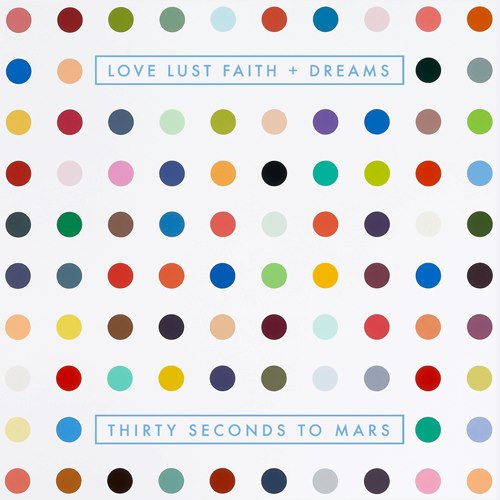
30 Seconds to Mars – “Love Lust Faith + Dreams”

30 Seconds to Mars

Grade: C

Best Tracks: “Pyres of Varanasi,” “Northern Lights”

30 Seconds to Mars have never been ones to please the critics, with their often corny and awkward pairings of genres, and at most points, their fourth album never strays too far beyond that. Bandleader Jared Leto has always embraced the corniness of his lyrics and the music of his backing band. “Love Lust Faith + Dreams” feels no less cheesy or misguided than their previous efforts.

Lyrically, Leto’s meandering musings on the vague concepts can be summed up in the album’s title. The album is split thematically into four segments, each word in the album’s title. While Leto does stretch deeper and darker than his previous albums, a majority of the metaphors presented here are still largely depthless. The ‘faith’ section in particular is largely void of originality.

Musically, however, I have to applaud 30 Seconds to Mars. For a band that has never been very respected, they do find ways to reinvent themselves. The then-popular pop-emo brand of their second album was quite a different sound than their industrial-based debut. This album is louder, more experimental and electronic based, a sharp change from their vocally loud and musically quiet, unstructured third album “This Is War.” “Love Lust Faith + Dreams” sounds, at points, like a band too heavily inspired by Muse but more inventive. It also, at points, resembles a band that enjoyed the “Inception” soundtrack far more than they should have. But I was actually impressed by the music of this album. The more experimental nature diversified the individual songs more than their previous efforts. The ‘dream’ sequence is musically effective, introduced by “Convergence,” although the whole segment seems to build to a largely unsatisfactory ending.

I would wager to say that this is 30 Seconds to Mars’ best album, but I would not go out of the way to recommend it. Musically strong but lyrically, the band is still flailing in their typically cheesy nature, grasping at large concepts and ideas but rarely hitting the mark with any depth. 30 Seconds to Mars fans will surely love it, and they might even gain some new fans. “Love Lust Faith + Dreams” is not going to down as one of the year’s best, but it is a reasonable listen for general fans of the band.

-Andrew McNally

Daft Punk – “Random Access Memories”

Daft Punk

Grade: B+

I’m one of those rare people that’s never really been onboard with Daft Punk. I’ve rarely found their music as entrancing and intriguing as most. The robot suits, to me, have seemed like an act more than an output of the music, which I’d already seen (better) in Kraftwerk. And I never cared for the repetitive rhythms and lyrics of their hits, and of club music in general. “One More Time” will grab me every now and then, but I see nothing in it beyond catchiness. “Around the World” has for years been a throwaway song to me, totally pointless and obnoxiously repetitive.

But “Random Access Memories,” admittedly, sucked me in. The first two tracks – “Give Life Back to Music” and “The Game of Love” did little for me, and were perhaps not the most momentous songs to open an album with. But the album’s third and longest track, “Giorgio by Moroder” roped me in more than any other dance song ever has. The song is winding and experimental, incorporating many instruments in a building rhythm. After the epic ends, the album twists into a peak of very danceable songs that never stretch into unnecessary lengths, and feature some great collaborations with Julian Casablancas (The Strokes), Pharrell Williams and legendary songwriter Paul Williams, all of whom contribute to some genuinely funky rhythms.

The album continues to flow in segments, as the last few tracks feature just the duo more prominently, largely devoid of collaborators and focusing more on a stripped-down, electronica sound. “Beyond” is the most traditionally Daft Punk track on the record, with the typical repetitive, faint robot vocals, and is one of the album’s weak points. But the largely instrumental tracks “Motherboard” and “Contact,” the closer, bring the album to a momentous end, and allow the group to experiment with their music and break out of their repetitive habits.

The duo stray further away from EDM and electronica on this record, their fourth. The danceable tracks actually feature funky guitar rhythms over electronica, at points. At moments on this record, Daft Punk sound like more than a duo, incorporating many instruments into their swooping songs. Chances are, if you’re reading this, you’ve already heard the album and have formed an opinion of it. When the band streamed it on Pitchfork, the world went crazy. People are down with whatever Daft Punk has to offer and, on this album, it’s a whole helping of everything. I do believe that I am a converted fan, at least for now.

Key Tracks: “Giorgio by Moroder,” “Contact”

-Andrew McNally