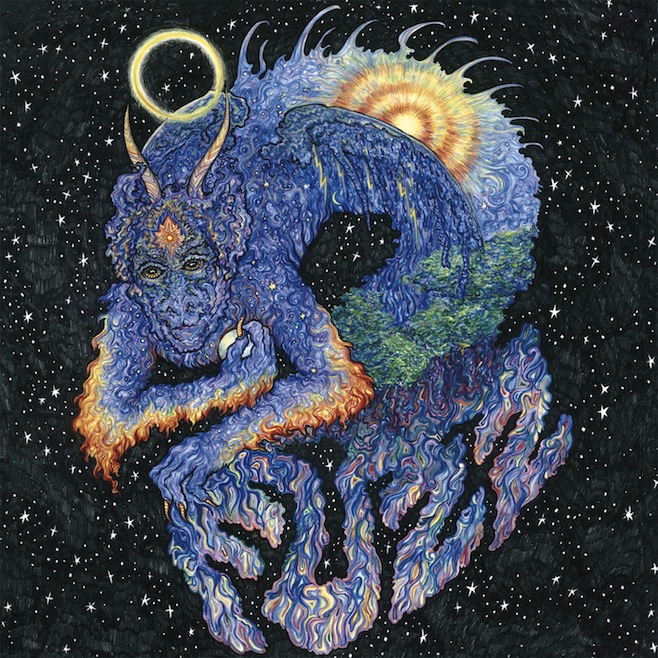
Miley Cyrus – “Bangerz”

(Photo Credit: Rolling Stone)

Grade: B

Key Tracks: “4×4,” “Wrecking Ball”

The opening track on “Bangerz,” called “Adore You,” is a very slow-crawling song about romance. It’s unexpected, but it sends a message – theatrics aside, Miley is taking her music seriously. She easily (and maybe expectedly) could’ve released an album of fun, partying Ke$ha copies, but she hasn’t. There is some of that present, but the focus is on a more mature persona. And she’s showing her maturity in countless ways; the album mixes club beats, synth and even country rhythms over songs about love and romance (sometimes). And say what you will about her VMA’s bit, anyone that still sees her as a young child star is blind to the maturity of the performance (shame on you, Robin Thicke). Maybe it wasn’t the best way to do it, but the message was sent, she watched the waves that were made, and she’s standing by it.

Although this is her fourth album as Miley Cyrus, she’s calling it a ‘debut,’ because it’s the first album she’s released since leaving behind Hannah Montana. (On last Saturday’s “SNL”, she offered a brief update on Montana: “She was murdered”). It does definitely feel like a debut, or even the debut of a new character. She’s only 20, but being a child star, going through a failed engagement and being scrutinized under the public eye since she was young have certainly given her material. Lyrically, she’s fitfully dealing with adulthood, trying to recoup by sounding seasoned but still gleefully admitting to partying, driving fast and drug use. (Yes, it is a little uncomfortable to hear a 20 year old singing about Molly, but less uncomfortable than hearing the 55 year old Madonna sing about it). “4×4″ and “We Can’t Stop” are odes to a wild life, while “Wrecking Ball” and “Adore You” show varying struggles of recovery.

The album has great diversity, not without faults. It isn’t as fun as it seems like it should be. Some songs, like “FU,” really don’t go anyway and would’ve been better off staying on the drawing board. And, as much as it’s common practice for a song to get introduced by saying a rapper/producer’s name, the number of songs that start with Miley just saying “Mike Will Made It” gets very comically repetitive/annoying. Still, the faults are predictable ones for a star attempting to re-distinguish herself.

What wasn’t expected was the guest spot contributions. Britney Spears shows up for a great spot on “SMS (Bangerz),” and Future backs up the soulful “My Darlin’.” Even Nelly sounds great on “4×4,” rapping over what I can only call electro-country on the album’s most diverse and fun song. Miley doesn’t rely on the power of her voice nearly as much as she should, but when she does, you’re reminded that she can really sing. The ballad (and big hit) “Wrecking Ball” and the surprisingly effective closer “Someone Else” are the two songs where she shines vocally. She should’ve relied on her own vocals more, and the album is certainly faulty, but “Bangerz” is still a very memorable and progressive release.

-By Andrew McNally

Cage the Elephant – “Melophobia”

(Photo Credit: IGN)

Grade: B

Key Tracks: “Come A Little Closer,” “It’s Just Forever”

Cage the Elephant’s previous album, 2011’s “Thank You Happy Birthday,” was a nearly-perfect throwback to the early 90’s grunge bands like Mudhoney, Pixies and the Meat Puppets. “Melophobia” kicks it back even further, embracing that sound with healthy doses of 60’s harmonies and 70’s rhythms.

On the whole, the songs on “Melophobia” are not quite as fast or rowdy as those on the predecessor, but previous great ballads like “Rubber Ball” and “Back Against the Wall” have shown us that the band can handle pretty much whatever they feel like trying to do. They do have moments of speed and distortion, the best being “It’s Just Forever,” a song that has a great guest spot from Alison Mosshart and sounds more like a Libertines-style garage song than anything else. “Teeth” also starts off as a late-album surprise with this speed, until it turns into music behind spoken word (something many bands try, usually unsuccessfully – it isn’t great here). This is a different Cage the Elephant, sonically, but not fundamentally. They’re still embracing decades worth of influence on each song.

Opening track “Spiderhead” has a backing keyboard beat that gives it a funky rhythm – like Fitz and the Tantrums waking up on the wrong side of the bed. Second track and leadoff single “Come a Little Closer” is a ballad in the same way 2011’s “Right Before My Eyes” is; it’s a pretty song, one that acknowledges the roughness behind it. Cage the Elephant has a way of making radio-friendly songs out of wild rhythms and rough vocals, and they continue that on “Melophobia.” The 60’s odes hit a peak on “Telescope,” whose chorus is lifted from a famous John Lennon quote (also, happy birthday John. Well timed, guys).

This album isn’t as inherently memorable as the two previous, because the songs feel a little more conventional on this album. On the whole, it doesn’t quite stand up to the band’s first two. But it is still a very enjoyable album. The band’s blending of typical structures and off-the-rails energy sounds even more perfected now, and they’re using 90’s angst on top of funkier rhythms and harmonies that sound straight from the 60’s. Although it’ll take a number of listens to learn, it further cements Cage the Elephant as one of alternative’s most unique and underrated bands.

If you like this, try: My all-time favorite album – Foxygen’s 2013 album “We Are the 21st Century Ambassadors of Peace and Magic,” a self-referential indie duo ripped straight from Lou Reed.

-By Andrew McNally

Fuzz – “Fuzz”

(Photo Credit: Pitchfork)

Grade: B

Key Tracks: “What’s In My Head?” “One”

There’s been a few bands called Fuzz already, but no one deserves to inherit the name more than Ty Segall. Segall has already made a name for himself as the most prominent man in garage rock, never fearing to turn the volume and the distortion past the max. And with this debut of yet another side project, he’s matched his output from 2012. This, his solo “Sleeper” and an album with Mikal Cronin called “Reverse Shark Attack” are his 2013 contributions. His work isn’t consistently great, but it’s usually pretty reliable. “Fuzz” isn’t as good as Ty Segall Band’s relentless 2012 album “Slaughterhouse,” but that’s easily in my top 10 favorite albums.

Here’s the thing though – this isn’t a Ty Segall project. This is a band, one that wants to be seen as one. Ty Segall’s name shows up nowhere on the cover or in the band name. He doesn’t even play guitar – he’s on drums (and still on vocals). Fuzz is easily the most comprehensive-feeling project he’s done. Even “Slaughterhouse” showed how much Segall was in control. This is where “Fuzz” excels the most. It feels like a proper band. A very loud one.

The album starts with a feedback drone on “Earthen Gate” before starting the song on a crawling pace. The pace doesn’t last, but it helps to separate this from Segall’s other heavy works. “Fuzz” has the intensity, volume and distortion of “Slaughterhouse,” but purposely leaves out the speed. The tempos are largely pretty fast, but the songs take time to develop instead of blowing through at brutal, rapid paces. And there’s some experimentation, too. The album’s midpoint has two of the three longest songs – “Hazemaze” stops periodically and resets itself, and “Loose Sutures” has a lengthy period of near silence before Segall gets a drum solo. The closer, “One,” (the longest track) sets a blisteringly fast pace behind a punk beat and lets the band mess around on an instrumental finale.

The album has a feel of very early metal, back when it was kids in garages playing fast and loud while avoiding the simplicity of punk. “Fuzz” has a powerful, thrash element to it, thanks mainly to Charles Moothart’s pillars of guitar. Some simple riffs and solos turn a garage rock album into a classic rock-resembling one. But the album does feel a little repetitive at points. The volume you’d expect from a Segall project is there – “Preacher” is among the most assaulting songs he’s been involved with. But occasionally it rests just on the volume factor, which is nothing close to shocking for fans. And having the album’s longest track have such a long period of near-silence is pretty disappointing, as listeners might expect a soloing adventure. Luckily, it ends before it starts to get too gimmicky, and it ends on such a strong and fun track. We may never hear from Fuzz again, or they could release another album by March. But their debut is more than decent, with the loud and crunchy guitars we love, some great drum work, Segall’s strong voice (and a great vocal sub from Moothart), and that nostalgia factor. It’s not the best album Segall’s had his name on, but it does stand as one of the better ones.

If you like this, try: I’ll get out of Ty Segall because there’s so many garage-punk bands I love right now: Metz, Parquet Courts, Thee Oh Sees, FIDLAR, Pangea and the unforgettable Jay Reatard all have A++ albums to check out.

Lorde – “Pure Heroine”

(Photo Credit: http://www.ddotomen.com)

Grade: A-

Key Tracks: “Royals,” “A World Alone”

Taylor Swift is twenty-three years old. Lorde, an up-and-coming singer from New Zealand, is seven years younger than her. But Lorde’s sound is already established and much more mature than Swift’s is. And she’s ousted Jake Bugg as 2013′s best new sixteen year old artist (sorry Jake). Lorde’s various singles and her “Love Club EP” have all been released within the last year, and have been strong enough to give her the meteoric rise to fame she’s enjoyed over the past two months. Her full-length, “Pure Heroine,” delivers on the minimalist pop her early singles have promised.

Fans of her hit “Royals” notice a medium tempo and a very relaxed attitude, and it’s consistent through the album. Opener “Tennis Court,” one of the three previously established songs on the album (the others being “Royals” and “Team”) sets the tone, with Lorde singing about arguments and iPhones over a synth drone. “400 Lux” sets a little more of a melodic tone – more rhythmic and a little faster, before transitioning into the minimalistic and extremely catchy big hit “Royals.” “Ribs” is a dreamier song, with both Lorde and the backing beat building up to a reverb climax that sounds like more of a finale. The next few tracks succumb to the minimalist idea too much and, although certainly not bad, aren’t as catchy or memorable. “White Teeth Teens” brings the tempo back up before leading into the great finale “A World Alone.”

Joel Little produced the album and is listed as a co-writer on six of the album’s ten songs, but Lorde still contributes enough of her own self to be a surprise for a sixteen year old. Her voice is impeccable, sometimes melodically beautiful, sometimes just a little gritty. And her lyrics are very poetic and mature, especially given what our other teen stars have given us lately. Lorde has been very influenced by royalty, and her mature look at the world is refreshingly original (and probably honest, “Royals” was written in 30 minutes). Musically, she took influence from Lana Del Ray, and that’s a little too apparent at times. But for the most part, pop, R&B, even doo-wop gets mixed together and watered down into some great minimal art pop. It’s tough to say whether Lorde will become huge, or if her music will eventually disconnect from audiences, but for now she’s given us a pretty solid and memorable debut.

-By Andrew McNally

Yuck – “Glow and Behold”

(Photo Credit: Pitchfork)

Grade: D

Key Tracks: “Middle Sea,” “Rebirth”

I have to praise Yuck for sticking around and even releasing a follow-up to their fuzz-drenched 2011 debut. Daniel Blumberg, the frontman for the band, left earlier this year. So the remaining members promoted Max Bloom to lead vocals, but the magic of their debut just isn’t here. They sound more conventional, and for a throwback band, that isn’t at all a good thing.

2011 was a good year for 90’s throwbacks – Cage The Elephant’s “Thank You Happy Birthday” channeled the Pixies and the Meat Puppets, and Yuck’s debut channeled Dinosaur Jr. and Pavement. Their debut was so drenched in feedback and reverb that it resembled shoegaze, even though the songs were too rhythmic and catchy. “Get Away” has always and will always be in my personal top 20. “Glow and Behold” turns down the reverb and fuzz. It doesn’t completely do away with it, but the focus here is much more on the songs themselves. What we get is some largely unremarkable indie-rock with a touch of distortion. The opening track, “Sunrise in Maple Shade” is a lighter instrumental track that sounds like a calm before a storm – but the storm never really comes. Only “Middle Sea,” at the album’s midpoint, can match volume with distortion properly.

Blumberg was a great frontman, because he brought a certain magic to the band. The songs seem uninspired now. Titles like “Out of Time” and “Somewhere” just sound so much more dull than 2011’s “Suicide Policeman” and “Holing Out.” And Bloom’s vocals don’t seem to fit the band’s sound. This is unfortunate, because of the circumstances (and I think promoting within shows a real sense of unity and confidence amongst members), but Blumberg’s nasally snare sounded far better in 90’s jams than Bloom’s lower, clearer vocals do. They’re channeling some more unremarkable 90’s bands now. The intentions are there, but “Glow and Behold” is both musically and vocally a disappointment to their legendary debut.

-By Andrew McNally

Justin Timberlake – “The 20/20 Experience 2 of 2”

(Photo credit: thelineofbestfit.com)

Grade: B-

Key Tracks: “True Blood,” “Take Back the Night”

It’s rare that the second album in a double album is an improvement over the first (look at the mediocre “Use Your Illusion 2,” “Hypnotize” and the second disc of “Mellon Collie and the Infinite Sadness”). But when it does happen, it’s usually because the musician has used up the potential singles and leaves more room to move around. This isn’t necessarily true of this double album, as “Take Back the Night” might be the safest song across either disc, but the ambition is just a little stronger on Part 2. Despite the clunky title.

The second track, “True Blood,” might be over nine minutes and might be about vampires, but the song adds a bit of depth to the beat and achieves that soulful sound Timberlake tried so hard to find on Part 1. And it transitions, beat and all, into “Cabaret,” an equally great and more modestly-long song that has a well-needed guest stop from Drake. Second single “TKO” is a bland seven minutes, but leadoff single “Take Back the Night” is a catchy number, whose horns and moderate tempo call back to Part 1′s “Suit & Tie.” Musically, the album’s more diverse, making it more listenable.

But, like Part 1, it has many faults. The average song length here is around 5:30, as opposed to Part 1′s 7:00. But at 74 minutes, it’s just as long and bloated as it’s 70 minute partner. the album has a lot of great ideas, but the songs are neither experimental enough to be original or conventional enough to be memorable smashes. They exist in a weird in-between, where they’re mainly all great songs that just go on for 2-5 minutes too many. And that’s not good. Also, Timberlake’s lyrics have been consistently mediocre across the two parts. The worst offender here is “Only When I Walk Away,” where Timberlake profanely curses out someone for only loving him when he leaves. Not only does hearing Timberlake swear like this sound uncomfortable, it’s not believable for a man who is so openly in love with his wife. But the worst offender is the other guest spot, Jay-Z. His summer keeps pushing him further and further from the top, and it continues as he raps about Yoko Ono’s vagina (?) on a song called “Murder.” Maybe poorly timed, as Ono just released a much more experimental, and much better, pop album.

Luckily for Timberlake, these two albums are inherently likable. They’re always catchy, the transitions between ideas are strong, and they’re fun. Almost every song stretches far past a comfortable zone, but sometimes you can get lost in it (“True Blood” especially). The only objectively bad song is, unfortunately, the bonus track that closes the album. “Pair of Wings” has both the acoustic tenderness and lyrical cheese of an N*SYNC throwaway. Otherwise, the album is enjoyable. It’s bold, it’s ambitious and it’s good enough to be a very entertaining pop album, reigning in an age of otherwise unoriginal pop singers.

-By Andrew McNally

Andrew Jackson Jihad – “Live at the Crescent Ballroom”

(Photo credit: bandcamp.com)

Grade: A-

Key Tracks: “Gift of the Magi 2: Return of Magi,” “People II 2: Still Peoplin'”

I normally wouldn’t take the time to review a live album – they’re not designed to grab any new fans. But I happened to see Andrew Jackson Jihad on this tour. Not this show, as it was recorded on their last night, in Phoenix. But I saw them at Europa in Brooklyn, days after Hurricane Sandy. The show was originally scheduled for Manhattan, but the southern portion of the borough was still without power. It was kind of an emotional time, and one that the band mentions numerous times on the album as the tour’s “dark days.” We were late to the show because public transport was a mess. We missed the opening bits of the appropriately-timed “Hurricane Waves,” from opening act Jeff Rosenstock (singer for my second favorite band, Bomb the Music Industry!). Future of the Left came on second, and for a third time proved themselves one the best live bands in all of music (I had previously seen them earlier that summer, and once opening for Against Me! way back in 2007). Jeff’s do-whatever DIY, FOTL’s political noise-punk and AJJ’s folk-punk never seemed like a logical line-up, but it was three great bands.

It only makes sense that the band would record their live album on the last stop. The band is a little worn-out and had experienced some unexpected dark days on the tour. And at one point, during “American Tune,” both the guitar and vocals cut out. After “Bad Things,” rude fans start requesting songs they know. It makes sense. Andrew Jackson Jihad has never shied away from ugliness in their music – “Back Pack” is about finding your loved one murdered, carrying her into town and wondering what her life could’ve been. It’s an imperfect show for a band that isn’t remotely looking for approval or purity.

This 2012 tour was a full band tour, not something they always do. They actually focus more on the electric songs, opening with the double-dose of “We Didn’t Come Here to Rock” and “Distance.” They do a great job placing fan favorites like “Big Bird,” “Rejoice” and “Hate, Rain On Me” among relative unknown songs, like “Kokopelli Face Tattoo,” “#armageddon” and “Inner City Basehead History Teacher.”

They spend a lot of time in between songs chatting, which can be a little cumbersome for a listener. But they have to, they were doing constant guitar switches. At the end of “People II 2: Still Peoplin’,” the band has to play an extended note so the singer can switch from acoustic to electric for the final ten seconds.

The album is surprisingly long, but they pack it with enough familiar songs to make it a very satisfying listen. With typical folk-punk, it’s fast, it’s messy and it’s got deeply unsettling lyrics. This live album won’t gain any new fans, but it is a great pick-up for current ones. Andrew Jackson Jihad is one of my favorite bands, and to have a record of the tour when I saw them is kinda special.

-By Andrew McNally

Kira Velella – “Daughter”

(Photo credit: bandcamp.com)

Grade: A-

Singer-songwriter Kira Velella’s debut EP finds her among the likes of Eleanor Friedburger, Laura Marling, and Waxahatchee, all relatively interchangeable but impeccable musicians. Velella’s soothing acoustic guitar matches her sweet, high voice in a mix that easily could’ve been bland but is pretty and catchy enough to be a very pleasing listen.

“Lover, Move” starts after a couple seconds of silence with a quiet and rhythmic guitar line. The EP’s longest song, it is just Velella, singing and playing guitar. It’s a pretty folk song – they all are. “Come Down” and “Blood Moon” are the same (although “Come Down” has a very effective moment towards the end when Velella dubs over herself vocally). “Act Your Age” and “Barn Swallow” have subtle electric guitar behind Velella, breaking up the solely acoustic sound. And the finale, “Found Her, Found Her” benefits from hand clapping and Velella’s washboard playing, which sounds as percussive as it does rhythmic.

Velella’s voice is vulnerable and beautiful. The soprano pitch of her singing complements the clean sound of her guitar. Velella wisely went for a polished production, instead of a lo-fi, fuzzy sound. It is as nostalgic for 70’s folk as it is current indie-folk, and it’s refreshing, as many indie-folk singer-songwriters have been branching a little too far out lately. It’s simple while being complex, catchy, and it all works, so it succeeds as a folk album. It’s a promising debut, and Velella’s music could fit right in alongside her established contemporaries.

The album is available here.

If you like this, try: Waxahatchee. Her all-acoustic debut, “American Weekend,” is more related to Velella, but her sophomore album, “Cerulean Salt,” is better overall.

-By Andrew McNally

Tyranny Is Tyranny – “Let It Come From Whom It May”

(Photo Credit: bandcamp)

Grade: B

Tyranny is Tyranny create a pretty heavy sound for four people. With Russell Emerson Hall and Jason Jensen on vocals and guitar, M. Guy Ficcioto on bass and vocals and Ben Aldis on drums, the band creates a demanding and achingly slow hard rock-noise rock hybrid. The album is only seven tracks but is a full-length time wise, many songs going over five minutes. Think Pissed Jeans slowed down. And the band takes a strong, anti-capitalist approach. They seem to take on the same political fervor as Propagandhi, though aimed at a different target. Their leftist lyrics add a different element to their post-noise rock genre.

The album’s first two tracks – “Manufacturing Truth” and “Owned By Thieves” take more of a direct approach, coming off as decent, heavy rock songs. “Down the K-Hole” is heavier, though, and a little faster. The vocals are more intense and the central rhythm is crunchier, more chord-based. “The Haze of Childhood” is a quiet, instrumental interlude at the album’s physical midpoint (though actually coming earlier time-wise). It’s a welcome break before the intensity kicks up again. “Apostasy” starts off with the same rhythm as the previous song, building into a properly heavy song with a grinding central line. The sixth song, “The American Dream is a Lie,” acts as the first of two magnum opuses, a heavy and constantly changing song. The second, “Always Stockholm, Never Lima” is a destructive finale, feeling like it brings the album to a close.

The vocals contributed to the album are sometimes screamed, sometimes just aggressively sung. Overall, they resemble some of those very heavy but radio-friendly hard rock bands of the early ’90’s (your Sepultura and so forth). The band’s somewhat lo-fi recording makes the lyrics unintelligible at points, but they still contribute to the album. Very liberal rock bands tend to have their own goals, and Tyranny is Tyranny feels no different. They still have some kinks to work out, but Tyranny is Tyranny sounds like the beginning of a good political post-noise rock band.

The album can be found here.

-By Andrew McNally

Surgery In An Opera – “Sad Songs For the Sad State”

(Photo Credit: bandcamp)

Grade: B

It may help that I was, by chance, listening to Brand New’s “Deja Entendu” right before I put on this DIY EP from the trio called Surgery in an Opera. The band consists of Calvin Roberts on vocals and guitar, Eldon Campbell on bass and Joshua Strong on drums. In four songs, the band invokes the image of an early 2000’s pop-punk/emo band, which nostalgia seems to be bringing back to today. The band has a sound similar to that of Brand New without the budget – that catchy emo type of sound that isn’t afraid to go either acoustic or distorted.

The first and shortest track, “The Escape Artist,” feels like a true pop-punk song. It’s energetic and catchy, with fuzzy guitars and vaguely personal lyrics. Track two, “Down the Beaten Path, or a Song For Those in the Vehicle City,” is slower but more melodic, and it blends acoustic guitar with a distorted, electric one. Again, it’s a catchy song. And it doesn’t overstay it’s welcome – because around the three minute mark, the band stops for about five seconds before quickly jumping back into a chorus. “The Worker Bee Brings Home the Honey” is a song that takes its time to build up, leading up a slow climax and features guest vocals by the very emo-sounding Campbell. Finally, “Wounds Pt. 2” starts acoustic, with very typical pop-punk lyrics. But a very distorted electric guitar kicks in pretty quickly, and Roberts ends up making a very effective use of power chords. The song ends big and loud, blowing out the volume.

Surgery In An Opera are not doing anything revolutionary, and their lo-fi/DIY approach can be seen as both a good and bad quality to their music. But “Sad Songs For the Sad State” is a good little blast of emo/pop-punk. Roberts’ vocals are fine and they’re all along with each other. It’s a promising release for a band that sounds like they know what they’re doing. And if you’re going for that bit of early aughts nostalgia, this EP is just reminiscent enough to do the trick.

The EP is available for streaming here.

If you like this, try: I Kill Giants’ self-titled debut from earlier this year. A little heavier and scream-ier, but they’re another good up-and-coming nostalgia band.

-By Andrew McNally