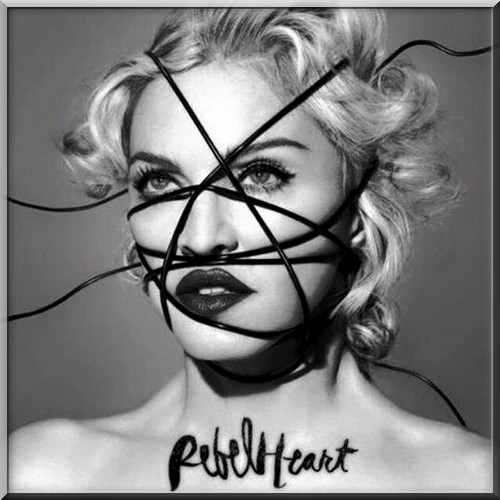
Madonna – “Rebel Heart”

Grade: B+

Key Tracks: “Living For Love” “HeartBreakCity”

Madonna’s new album has a song called “Bitch I’m Madonna,” so, what more do you need?

As we’ve settled deeply into this digital age, there’s been a feeling of resentment about the blending of music and technology, spurred on largely by Thom Yorke, Bjork, and others that don’t see the value of platforms like Spotify, and by the likes of U2, who have no idea how to harness technology to any sort of advantage. The elders seem to think that they’re outdated, and that their further output won’t be able to hold up amongst the music of younger acts. But there’s plenty of musicians fighting against the aging – like Madonna. On “Rebel Heart,” her 13th studio album, Madonna shows no signs of aging, instead standing with and against modern acts like Nicki Minaj, Diplo and Kanye, including them in the album and shoving them under her career in the process.

Madonna’s previous album, “MDNA” was lackluster. It couldn’t find the formula to match Madonna with EDM. On “Rebel Heart,” she’s learned to just be herself and let everything fall into place around here. Indeed, the album’s strongest songs are the ones where Madonna just powers through the dance music around her. On “Living For Love,” “Ghosttown” and “HeartBreakCity,” her voice dominates over all, and although they’re not always the most immediately enjoyable songs, they’re the ones with the longest staying power.

Generally, the bigger the ideas are on this album, the worse they’re pulled off. “Iconic” is the most high-concept song, a track that features Chance the Rapper and, uh, Mike Tyson. Tyson is a voiceover in the beginning, Chance is wasted in a forgettable guest spot, and Madonna herself is lost in the EDM-y overproduction. It’s a big track, one that’s immediate fun, but leaves a bit of a sour taste. “Bitch I’m Madonna” is like that too – it’s a great track overall, but it’s aided by Diplo and Nicki, and Madonna gets lost in the beats. This isn’t something that happens consistently, just on a few tracks, but it highlights the tight line Madonna walks as a 56 year old pop singer.

But, more often than not, “Rebel Heart” just works. With track titles like “Illuminati,” “Holy Water,” “Joan of Arc,” and the aforementioned “Bitch I’m Madonna,” we’re seeing a side that’s showing no reservations. She hasn’t calmed or grown weary in her years; this is the same performer we had in the Sex days. Her voice and her persona haven’t lost an edge, even going so far as to call out everyone in pop culture today on “Illuminati,” from Steve Jobs to Bieber to ISIS. Madonna is back out for blood, and it feels more natural than it has in a long time. “Rebel Heart” may not be a masterpiece, but it’s one of the better pop albums of the year so far.

-Andrew McNally

Meghan Trainor – “Title”

Grade: C+

Key Tracks: “3am” “Like I’m Gonna Lose You”

Like many pop songs, you’ve probably heard “All About That Bass” on the radio and thought, ‘I bet her album is all like that, but a little worse.’ “Title” is a solid debut for Trainor, in that it sees her properly explore different influences beyond most debuts. But, it ends up being hurt by the very same thing.

If you’ve seen pictures or videos of Trainor, or seen/heard “All About That Bass,” you’d think she has a pseudo-bubblegum pop vibe to her. The album’s first song, a cutesy 25-second vocal interlude (???), does nothing to dispel that. And the third track, after “Bass,” called “My Future Husband,” doesn’t exactly sway away from it either. But Trainor does show off a number of talents – on “3am” she adopts more of a doo-wop/soul quality to her vocals. She does try her hand at rapping, successfully on closer “Lips Are Movin” and unsuccessfully on the horribly titled “Bang Dem Sticks.” And she does pull off two ballads – the mid-album sleeper “Like I’m Gonna Lose You,” with John Legend, and “What If I” later on. Otherwise, the album is topped off with pop/R&B mixes that vary from catchy to overlong to forgettable.

As of now, it’s safe to say Trainor is known as the “All About That Bass” girl. And to her credit, that’s somewhat unfair. Trainor might only be 21, but she’s been making music independently for years. And it’s also unfair that with that song’s ever-increasing popularity (including a surprising Grammy nod for Song of the Year) mixing with her brief time in the actual industry, she might be stuck with that title. What makes Trainor’s debut more interesting than other debuts is also it’s downfall – lack of identity. By combining bubblegum pop, R&B, hip-hop, etc., we get a full array of Trainor’s talents, but we don’t really get enough of each to really know who she is as a singer. I’ve discussed this before, especially in dealing with Ariana Grande, who is having the same problem (in an opposite way). To be a female pop singer in 2015, you have to have a persona. Beyonce, Adele, Lorde, all have the personae to match the music. Trainor is still forming one (although already further along than Grande), and having a hit as big as “Bass” this early might end up being detrimental to her. Although “Title” is interesting as a debut, and Trainor’s superb songwriting skills are on focus the whole time, it isn’t consistent enough to produce a proper image. And as far as her lyrics go, she aims throughout the album for feminist anthems about body positivity and owning oneself – but a simple Google search leads to articles of how problematic “All About That Bass,” “Dear Future Husband” and “Title” are, among other tracks. The image she’s trying is one straight out of Nicki Minaj’s “Anaconda” (more a coincidence of time than an actual influence) but isn’t nearly as crafted.

There’s a few different ways to look at “Title.” On a purely musical standpoint, it can be seen as a fun collection of songs that mix throwback rhythms with modern vocals. It can also be seen as a marvel of songwriting from a talented young woman. Or, it can be seen more in-depth, as a varying, frustrating collection of songs that each try so hard to be unique that they end up uniform together. It’s tough not to look at it lightly, tough not to glaze over its flaws. So where “Title” has some pop highlights, it struggles from problematic and contradictory beliefs, and a lack of an image in Trainor. She’s certainly a talented songwriter and a versatile performer, and there’s promise on “Title.” The whole package just isn’t there yet.

If you like this, try: Into diverse pop? What a time to be alive. Into problematic female performers? Azealea Banks.

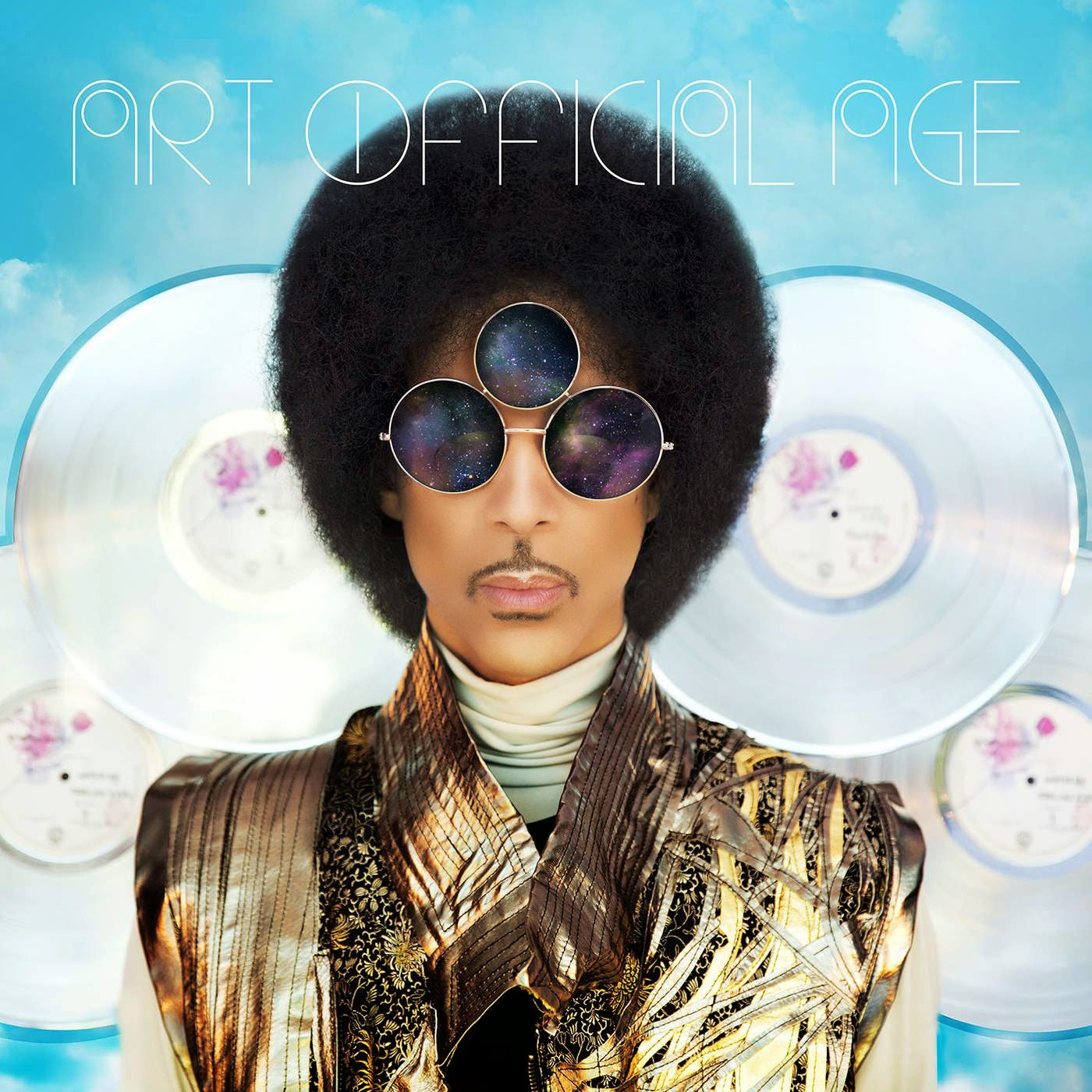
Prince’s “Art Official Age” and 3RDEYEGIRL’s “Plectrumelectrum” – A Review From the Uninitiated

Grades: Art Official Age: B+

Plectrumelectrum: D+

As a music critic, there’s been plenty of times where I’ve faked knowledge of an artist to give some insight into the recording of an album. I’ll admit it, I can’t say I’m on an equal playing field when I talk about both Ariana Grande and Foxygen, I have to look up information on someone like Grande because I’m much more inclined to listen to Foxygen in my own time. But I can’t fake Prince. Not admitting that I don’t know the first thing about Prince’s back catalog and topsy-turvy history would be unfair to him. Prince is a legend; a hero of pop music, and trying to fake my way through a review would not do him any justice. I know that he and Warner Bros. got into a bitter, bitter feud in the ’90’s, partially the reason for him to change his name to a symbol – so Warner would have to find a way to market it. And I know that he’s both feminine and seductive, yet legendary and encompassing enough for the NFL to pick him to play a Super Bowl halftime show (and one of the better ones). What I do know about Prince is that his music has jumped all around, and that’s exactly what his solo album, “Art Official Age,” does. So if you’re not familiar with his music, know that the album is inconsistent but often fun and honest. And if you are familiar, then you probably made up your mind before it even came out. Okay? Okay.

“Art Official Age” starts with a track titled “Art Official Cage,” and it’s a song that would have never existed in the “Purple Rain” years. It couldn’t have. It’s ripped from hip-hop and EDM, with big beats and air horns. It’s fun, and there’s way too much going on, but that’s part of the joy. The album jumps across fun, funky songs and big ballads, all of which are distinctly Prince and neither of which are aligned with any other pop artist. It’s the album’s best and worst quality, that it jumps so frequently and unexpectedly. Luckily, it’s good far more often than it’s bad.

The ballads come early, with the third track “Breakdown.” Prince hits some cringingly high notes, and pulls them off, obviously. “U Know” is a pseudo-ballad two tracks later, but one that has Prince rapping a bit. The hip-hop element is palpable on “U Know,” and is throughout the album. Prince constantly feeds off of genres that fed off him thirty years ago. Ballads aside, the album is a lot of fun, and Prince sounds like he’s truly enjoying it. Late album track “Funknroll” is exactly what it sounds like, a huge disco bash that’s a ton of fun and could easily be thrown on repeat for an hour without getting old. Second track “Clouds” is a strange track, with a strong spoken word that sets up the album’s loose premise of waking up in a world without gender pronouns. And leadoff single “Breakfast Can Wait” is an oddly specific, sexual song that’s exactly what you’d expect from Prince.

“Art Official Age” isn’t all great. The theme of waking up without gender pronouns are neat (and Prince to the max), but it never shows up outside of spoken word bits that are great on “Clouds” and finale “affirmation iii,” but are weak on the other tracks. And Prince seems to be borrowing just a tad too heavily from Daft Punk’s disco playbook – in that he tries lengthy, funky songs, but doesn’t pull them off as well as the duo. There are two tracks, “The Gold Standard,” and “Time,” that are far too long. The former is almost six minutes, the latter almost seven, and there isn’t much of a reason. They just inflate the album’s 53 minute runtime. But it starts strong and it ends strong, and it’s fun in between. People hanging out under rocks like myself should find a lot to groove to on this record, and find a lot of originality in it’s melting of both genres and themes.

On the inverse of that is the debut album from Prince’s backing band, 3RDEYEGIRL. Their album, “Plectrumelectrum,” flows through different genres and influences just as “Art Official Age,” but does so in a much more murkier and standard way. The band, who Prince is proudly touting as being all-female, gets off on the wrong foot with the lackluster “Wow,” a song that lacks the energy to be a true leadoff song, but has enough energy to not be a cop-out slow intro. After that, the album is a topsy-turvy ride, hitting high highs and low lows.

A low low is “Boytrouble,” an overlong and inane pop song that’s stylistically similar to far too many songs that have come before. Another low low is that the album appears to start off with a classic rock vibe for the first four or five songs, before slowly diverging into funk and hip-hop, without seeming to have any real reason. It flows well at the beginning, but the longer it goes on, the more it becomes a collection of songs instead of a fluid album. The album never seems to come to having any point, other than Prince showing off his (talented) backing band. Likewise, on “Fixurlifeup,” he sings lead, and he sings about misogyny in music and how bands shouldn’t be called “female” bands, yet he prides himself on showcasing his handpicked female backing band, contributing to the problem himself. (Not that he shouldn’t have an all-female band, just that he’s being pretty hypocritical about it).

The album isn’t all bad, though. There’s some great, exploratory songs. The title track (and longest on the album) is an instrumental classic rock jam that shows just how talented the band is. And the follow-up, “Whitecaps,” is a pleasant vocal-based pseudo-ballad. And the album has a better pacing, clocking in at a tighter 42 minutes, with some fat trimmed. The album certainly has it’s moments, it’s just very inconsistent and never has a sense of purpose. Perhaps the thing that summarizes it best is that the album’s final track is a different version of “Funknroll,” from “Art Official Age.” It’s a slightly different version that’s still good, but just not as much.

Not knowing anything about Prince didn’t harm me in listening to 3RDEYEGIRL. Their album is more direct, even if it hits different genres. It isn’t a great album and I give only a reserved recommendation for Prince fans only, but it still has some fun moments. And, they’re talented. they’re extremely talented. Non-Prince people like myself can at least enjoy it just as much (probably more) than Prince fans. As for “Art Official Age,” it’s also inconsistent, but it’s fun and energetic, and it might be a refresher for his fans. Or at least that’s what it sounded like to me.

-By Andrew McNally
Taylor Swift – “1989”

Grade: B

Key Tracks: “Out of the Woods” “Shake It Off”

Taylor Swift’s first full foray into pop music is a beautiful mess, an experimentation in something that’s never an experiment. For the most part, “1989” is standard-fare pop, behind equal parts music and vocals. Swift’s music really isn’t any different, it’s just more pop-based. It doesn’t always work, but it’s more than enjoyable enough to make up for it’s weaker moments.

“1989” plays like a typical pop album. It flows through songs upbeat and ballad, with fairly standard lyrics. Opener “Welcome to New York” is a little slow to open a pop album, but it’s got a strong synth beat and the lyrics about the country’s biggest city mark a snarky metaphorical change from small town country. The album is held up by strong synth rhythms throughout. “Style” is helped by a synth beat, as is the Imogen Heap-collaborative finale, “Clean.” And, massive smash “Shake It Off” has a pretty strong rhythm to it too.

Swift’s lyrics are pretty self-serving. She knows her audience, her lyrics pander most to pseudo-literary young women, the type of songs that are relatable to a girl in high school but have a poetic aura. If Swift’s lyrics didn’t win you over before, they probably won’t here. They’re not bad – just not for everyone. “Shake It Off” is one of her stronger songs, rallying against sexist portrayals of her relationships in the media. “Clean” marks an interesting simile between a break-up and curing addiction. But the strongest lyrical song is probably “Out of the Woods,” a track with music written by Jack Antonoff. It deals with relationships, as always, but it’s more subversive and just a little darker than listeners are used to.

What makes this album different is principle. It’s: “Hey, T Swift’s doing something kinda different,” and that works for it. Transpose these songs into a different singer’s catalog and half of them wouldn’t register any sort of response, but Swift is experimenting in conventionality. And what results is an imperfect record that feels like it wants to be imperfect. It’s cohesive and tight, and asks to be weighed as a whole instead of by individual track. It’s kind of a mess, but it succeeds because of it. It’s a fitful new direction for Swift to go in and it’s easy to forgive the mistakes.

-By Andrew McNally

Side note: This review took a while partially because I just don’t have time, but partially because I had the stream the album track by track via Tumblr. I get the marketing strategy of pulling it off Spotify but I don’t necessarily agree with it. It doesn’t sit well with fans.

Ariana Grande – “My Everything”

Grade: C-

Key Tracks: “Problem” “Bang Bang”

There are certain singers and rappers that, when they show up on a track, are automatically going to outshine the star – Beyonce, Andre 3000, Nicki Minaj. The problem with Ariana Grande is that she’s shown up by everyone. Iggy Azalea, Big Sean, Zedd, Cashmere Cat, Childish Gambino, The Weeknd, A$ap Ferg and, in an excellent Deluxe Edition-only song, Juicy J and Minaj all make appearances and they all help otherwise mediocre songs excel. On the four songs where Grande stands alone (not counting an intro), she sounds like an empty copy of a different singer.

“My Everything” does have its moments, most of which being the quicker, more EDM-embracing songs. Despite my best efforts, local rap radio has forced me to love “Problem,” a song with beats bigger than Grande’s whole first album combined.  “Break Free,” with Zedd, “Hands On Me,” with A$ap Ferg and “Bang Bang,” with Juicy J and Nicki Minaj are in the same boat. They’re great, fun songs with crushing beats but inoffensive mission statements. When Grande lets loose and has some fun, the album does too. These four songs are well-positioned, too, saving bursts of energy to come up every few tracks instead of using it all up early. Of the ballads, and there are plenty, the most noteworthy one is “Love Me Harder,” collaboration with The Weeknd, which matches some great vocals with catchy beats.

The rest of the album isn’t bad – it doesn’t ask you to form any kind of opinion. Much of the album, even the better songs, goes in one ear and out the other; cheap entertainment that’s forgotten as soon as it’s over. Grande’s voice shines throughout, and it stays as bouncy and inoffensive as it can, which results in a generally fun listen. The real issue lies in Grande’s lack of identity. She can really sing, maybe even better than most other pop singers out there right now (saving you, Adele), but her ‘carefree, bubblegum’ identity was unfortunately worn out in the early-00′s. Pop singers nowadays have to establish their own, unique beings – Adele is a soulful, 60′s throwback, Lorde is a hip-hop inspired, minimalistic hip-hop basher, Lady Gaga is a theatrical and newsmaking shock. Grande is trying to establish herself as a straight pop singer, but to do that, she’s going to have to compete with the current queen – Katy Perry. And frankly, in this current music world, only one is going to be allowed continued success.

So “My Everything” isn’t bad, just forgettable and bland, and it is never sure of where it wants to be placed. Grande is still (very) young, and she’s still finding her place. Working with big names like Zedd and Minaj could still shape her place in a crowded music scene. But for now, she’s standing as a successful but unexciting singer, and her second album provides a safe, somewhat bland listen.

-By Andrew McNally

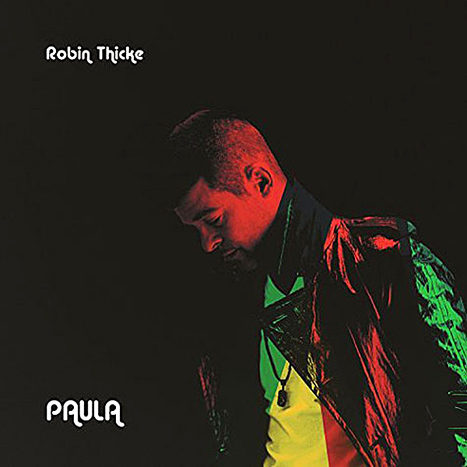
Robin Thicke – “Paula”

Grade: D

Acceptable track: “Living in New York City”

Let’s get this out of the way. This isn’t about the music. I don’t yet know if I’m referring to the album, or this review. But it’s a rare occasion when I can review an album where the music plays such an afterthought to the context behind it. Because this is barely an album. It has songs, sure, songs that have choruses and rhythms. But it’s all a thin veil for an attempt at a passionate, public apology. Occasionally, it works. Often, it doesn’t. Thicke dives too deeply into their relationship, even when he’s criticizing himself, giving us information we really didn’t need to know.

So let’s talk about the music a bit. The music does take a backseat, but when he’s prepping a quote-unquote ‘concept’ album like this, it’s not really the focus. Still, it’s all simple R&B, never elevating itself beyond some basic beats and unchanging soul rhythms that sound more in place in 90′s clubs. Sometimes it’s fun :) Sometimes it’s sad :( But from a music standpoint, there’s few highlights. “Living in New York City” has a fun, optimistic beat, and follow-up “Love Can Grow Back” has a big horn section and a jazzy, soulful vibe. But those are rare highlights. The album starts off with two slow-burners that musically are, frankly, boring. And although they set the album’s largely remorseful tone, they also stumble out of the gate with 9 minutes of dull music.
So where does Robin Thicke stand? “Paula” is a love letter, a deep apology for the way he acted as a husband. For the most part, he’s earnest in what he’s singing. In some of the more enthusiastic songs, he sounds like his heart just isn’t in it. (Only exception: “Living in New York,” where he sings about how she’s moved to NY and how pretty all the women there are). Some lines throughout the album I caught are, “All that she needs is another try,” “If you ever need a friend, baby / I can be the one that you want” (vomit emoji) and “There’s something bad in me” (understatement!) His lyrics get pretty intricate, so it’s easy to give him the benefit of the doubt, he’s genuinely grieving and it’s possible he actually feels bad for the stuff he’s done.

But, don’t let that deceive you. Thicke is a singer, it’s what he does, but there’s no reason for this be as public as it is. Even if he believes his own lyrics, this album is a power play. I was watching a World Cup game on ABC the other day and I saw an ad for Thicke on Kimmel’s dumb show and the voiceover said, “Robin Thicke concludes his ABC takeover!” He’s riding a storm of buzz over this album, capitalizing on his own deep emotions. And it’s important not to look at Thicke as some kind of hero here. Everything that happened between him and Paula was his fault, and he’s starting to be made out as a victim. He isn’t. “Paula” is usually pretty creepy, with too many details about their relationship growing more abusive. He just falls short of singing her social security number and where she sleeps at night. It honestly sounds unintentional, a side effect of him baring his true emotions, but it’s weird nonetheless. “Paula” is, at it’s best, forgettable. It is, at it’s worst, gross and shady. It isn’t good. Don’t listen to it and don’t acknowledge it, you’ll just be feeding into the Robin Thicke machine.

Oh also burn in hell for literally always.

(This review was originally posted at thefilteredlens.com, and since the time of publishing it has been released that “Paula” sold a whopping 530 copies in the UK. I wasn’t sure what the public’s perceptio of Thicke was nowadays, but it seems like we’re on the same page)

If you like this album, try: reading a different blog

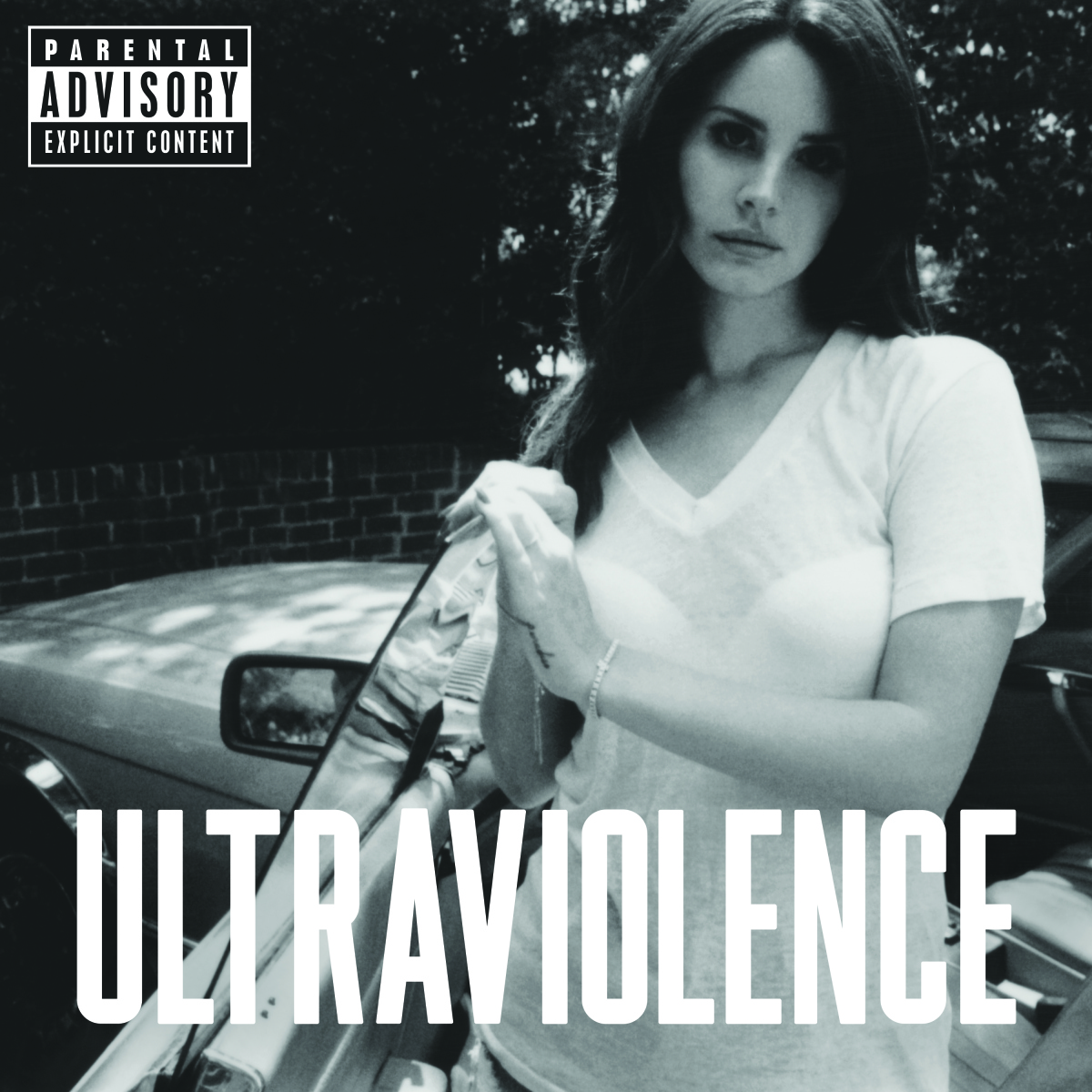
Lana Del Ray – “Ultraviolence”

ultraviolenceGrade: A-

Key Tracks: “Cruel World” “West Coast”

“Ultraviolence” is a slow album. It’s easy to overlook the album as a long, long wick attached to a room full of fireworks, burning slowly and ending before the big bang. But to look at “Ultraviolence” like that is to ignore the music’s subtleties, and the complexity of the album’s subject matter. “Ultraviolence” is a dark record, one that examines a woman who tries to ride her way to the top, but never excels past being “The Other Woman” (as evidenced by the final track). Given Del Ray’s recent, questionable comments on feminism, the album isn’t a critique on women in society today as much as it is a semi-personal narrative. It helps to strengthen the cinematic quality of the album. And it doesn’t hurt that Del Ray’s vocals are stronger this time around, rationing out a few strong performances across the album.

The album’s opener, “Cruel World,” is also the longest, at 6:39. It’s a building and intricate song, one that sets the tone by really taking it’s time to get to an engaging climax. It’s a slightly captivating song, and an unexpected one to open an album, even for Del Ray. What follows is a number of polarizing songs – sometimes engaging, other times putting up a strong barrier. Nearly all of them are a medium tempo, which should be a distraction or even a boredom, but when almost every song has it’s own identity, it doesn’t even matter. The only real exception is the excellent “West Coast,” full of tempo changes and a low-key funk that isn’t present anywhere else on the record.

Del Ray’s lyrics focus on struggling to find your identity and struggling to find success, accepting defeat in both. They’re typically dark – with titles like “Old Money,” “Pretty When You Cry,” and, of course, “Fucked My Way to the Top.” They call back memories to the pratfalls of luxury in the 20′s-50′s, even with modern references and a decidedly more provocative and profane tone. And her vocals are stronger; she’s allowed herself to open up and expand her range. “Shades of Cool” finds her in a high pitch, alternating between beautiful and off-setting. “Money Power Glory” is another track where her voice flourishes in big, grand ways. She’s often cooled down, but the rare times when she wants to take control – she does. These rare moments highlight the album’s otherwise restrained times, both benefits.

The album is bolstered by fine production, as well, courtesy mainly of Dan Auerbach (singer for the Black Keys and producer of everyone). The production is borderline cavernous, adding a faint echo and an ungraspable dark feeling throughout. It’s slickly produced – but not to the point where it’s actually pop.

“Anti-pop” isn’t a phrase, outside of a long forgotten Primus album, but it’s almost something that could describe Del Ray. With meandering tempos, cinematic music, dated lyrics and often 5+ minute lengths, her songs aren’t designed for radio. Yet they’re distinctly pop, a type of dream-pop. It’s melodic, and catchy, but in a low-key way. It isn’t possible to dance to this (as we now know, thanks to SNL). Like Nico long before her, and Lorde shortly after, Del Ray’s pop music is one of depth and density, not one of rapidity and popularity. You probably have a strong opinion of Del Ray, good or bad, and “Ultraviolence” isn’t going to change that. But it’s a strong pop release, ripe for analysis, and an improvement over her still notable debut. Like her or not, Del Ray’s strongest quality has been her ability to establish a persona in no time. And “Ultraviolence” really runs with it.

-By Andrew McNally

Mariah Carey – “Me. I Am Mariah… the Elusive Chanteuse”

(Photo Credit: NY Daily News)

Grade: B-

Key Tracks: “You’re Mine (Eternal)” “Money ($ * / …)

Mariah Carey has worked herself into an interesting point in her career – she’s already heralded as one of the most successful and talented pop singers, ever. So there’s a few directions she could go – she could sit back and enjoy all of the reaped benefits, or she could keep putting out albums that challenge other singers to get to her level. She doesn’t need to do anything too ambitious or original, especially as a pop/R&B singer. She’s just keeping active and adding more notches to her career. And that’s exactly what her fourteenth album is – it’s a collection of personal and reflective songs that feel right at home with her other works.

Of course the most important thing to analyze on any Carey album is her voice, even though it never falters. Carey, famously, has a five octave vocal range, which is almost inhuman. There are times on this album where, had I been playing the songs louder, her vocals would’ve upset the neighborhood dogs. Carey’s voice is as strong as it’s ever been, like on “Camouflage,” where different octaves are layered over each other until she becomes her own back-up singer. And on “You’re Mine (Eternal),” where her voice gets looped at the closing, into a slightly haunting drone. All throughout, her voice remains smooth and high flying, hitting extreme highs sparingly (to allow those moments to shine), and sounding typically relaxed and polished through every song.

There’s four effective guest spots on the album, all of which add some energy at the right times. “Dedicated” is saved from being too murky by an all too brief appearance from greatest rapper of all-time Nas, and the follow-up, “#Beautiful,” is helped by Miguel. Wale anchors “You Don’t Know What to Do” surprisingly well, and adds some much needed energy after a number of midtempo songs. And towards the album’s end, Fabolous delivers a strong spot on the extremely unfortunately titled “Money ($ * / …)” (I have no idea how to pronounce that title). For the most part, the guest spots are spread out, so they can provide some kicks throughout, and so it doesn’t get too bogged down at any point.

The album does have it’s faults, most of which lie more in the structure and the make-up of the album rather than in the songs themselves. As mentioned, there’s that terrible song title, which should be something to overlook, but I can’t get over it. And there’s the title: “Me. I Am Mariah… the Elusive Chanteuse.” The title track and last song is actually spoken word, with Mariah explaining what it means. “Me. I Am Mariah” is a self-portrait she drew when she was a child, that shows up on the album’s back cover, and “The Elusive Chanteuse” is the most recent of many nicknames she’s been given. They both have significance, and they both make excellent titles, but put them together and you have what will be a $2000 Jeopardy! question someday. (Also, I’m glad Carey takes time to explain the title on a spoken word track and I wish there was a way for it to fit less awkwardly into the album). The album’s 62 minutes and 15 tracks is hefty, too, especially considering she delayed the release when some early songs didn’t catch on with the public. There’s a lot of great tracks here, but there’s some dead weight, too, and it should’ve been cut. It’s daunting to the point where it’s far too overlong.

Structural issues aside, it’s great to see Carey still be herself. And there’s a lot of her on this album – its lyrics reflect back on the highs and lows of her life thus far. It’s personal and open, sometimes fun and sometimes contemplative. There’s a George Michael cover, and an ode to Reverend James Cleveland in the gospel choir finale “Heavenly (No Ways Tired / Can’t Give Up Now).” “Me. I Am Mariah” isn’t a wholly fulfilling album, but it succeeds with it’s diversity, flowing through different genres and emotions, while never straying too far away from a consistent pop/R&B sound. Carey shows she’s still as powerful as she was in 1991. She can belt like no one else, and she’s hit a point where she can do whatever she wants. And she’s very comfortable with that.

-By Andrew McNally

Lily Allen – “Sheezus”

Grade: C+

Key Tracks: “URL Badman” “Hard Out Here”

Months before Lily Allen’s third album even came out, it had already created some controversy. Her music video for lead single “Hard Out Here” was criticized for it’s use of black dancers as props, failing to convey the song’s satire against the use of people of color in things like music videos. No one can really know for sure if Allen was sincerely aiming for satire or just going for controversy – and that’s always been her style. The brilliantly named “Sheezus,” at it’s best, pries on a lack of subtlety. It gets just as direct as Lily Allen’s first two albums, but it doesn’t always stick.

After the release of her second album, “It’s Not Me, It’s You” in 2009, Allen announced her unexpected retirement. On “Sheezus,” her comeback album, she directly addresses it twice, in two of the best songs – “Sheezus,” a boastful song about her comeback and the strength of female pop singers right now in general, and “Life For Me,” a surprisingly honest song about transitioning into a more normal life after having a child. Otherwise, it’s a lot like she was never gone. Feminism, sex, loneliness and awful men are all covered here. And like before, traditional pop songs are unpredictably peppered amongst fun ones. The mixing doesn’t work as well this time, with some transitions not really fitting and the balance tipping too far into the traditional side.

“Sheezus” suffers from this imbalance. The album’s bookends – “Sheezus” and “Hard Out Here” are big, calls to arms with witty lyrics and deep implications. But they feel like they don’t quite fit, the result being trying to start controversy just for the sake of controversy. Allen’s music has seen it’s share of controversy in the past, but it’s always had a point, and that point isn’t as defined on this album. Still, Allen’s wit and directness occasionally shine through. “L8 CMMR,” about her husband, is about exactly what you’d expect. And “URL Badman” takes on the worst kinds of internet men – “When I’m a big boy / I’m gonna write for Vice” and “I don’t like girls much / They condescend me / Unless of course / They wanna play with my willy.” Songs like these show that Allen hasn’t lost her touch at all.

The album has more pop-based music than before. Her first two albums benefited from various instruments, but it’s largely conventional here. “Take My Place” has a chilling electro-rhythm, and “As Long As I Got You” is centered around an accordion, a nice adjustment after a few serious songs. “Hard Out Here” also has some EDM beats, but it’s a little strange given that it’s the album’s last real song. “Sheezus” is otherwise a little close to a traditional pop album, musically, something Lily Allen usually tries to avoid.

So for a comeback album, “Sheezus” stands it’s ground. It’s inconsistent, sometimes too tame, sometimes too controversial, sometimes finding the right path. Lily Allen is doing Lily Allen as always, but “Sheezus” isn’t as strong or defined as her previous albums. It’ll satisfy fans, and it’s great to have Allen back. “Sheezus” is only passable, but when it comes down to it, it’s a lot better than having no new Lily Allen album at all.

For a better listen, go for a version that has a bonus track, a cover of Keane’s “Somewhere Only We Know.” She’s covered Keane before and both are beautiful renditions.

-By Andrew McNally

Foster the People – “Supermodel”

(Photo Credit: fosterthepeople.com)

Grade: C-

Key Tracks: “Coming of Age” “A Beginner’s Guide to Destroying the Moon”

It must be tough to follow up on instant success. Pop rock group Foster the People’s first album, “Torches,” had the inescapable singles “Pumped Up Kicks” and “Helena Beat.” Sophomore albums are usually difficult anyways, even without following worldwide hits. “Supermodel” tries hard to deepen the band’s sound, but it ends up being a mess of empty songs that aren’t nearly as dark as they want to be.

Foster the People, led by chief songwriter Mark Foster, wanted “Supermodel” to be a concept album about the ugliness of consumerism and capitalism – relatively dark themes for a catchy alt-pop band. And that may end up being part of the problem. Take the songs purely on a musical standpoint, and all but one of them are catchy pop tunes (odd man out being “Goats In Trees,” a spoken-word-over-acoustic-guitar song). It’s simply tough to imagine any sort of believability when a band that plays commercially friendly and high-grossing music is singing about the horrors of commercialism.

The album’s other problem is tripping out of the starting gate. The first three songs – “Are You What You Want to Be?” “Ask Yourself” and leadoff single and admittedly great “Coming of Age” all tackle the exact same vague subject of self-discovery. There’s a thin line between having a consistent narrative arc and just repeating yourself, and they fall in the latter. Had the songs been split up or diversified, the whole album might be stronger – it just lacks any momentum to start.

Musically, the album is also a little lackluster. They traded in the unique synth rhythms of their two big hits for a more straightforward guitar approach. It was an attempt to sound a little heavier – but it’s quite the opposite. It’s lighter than before, especially the acoustic songs. Only the memorable “A Beginner’s Guide to Destroying the Moon” kicks the volume up at all (and is then followed by the aforementioned acoustic “Goats in Trees”). Using all-too-familiar guitar rhythms does nothing to separate Foster the People from their counterparts. Think of them like an alt version of Katy Perry – one of the biggest names in their genre, but one of the most unoriginal. Sophomore albums are notoriously difficult, and Foster the People have fallen victim. “Supermodel” will please most fans of the band, but other listeners will likely be turned off by the album’s repetition, boring music and lack of pairing between music and lyrics.

If you like this, try: fellow alt-pop group Fitz and the Tantrum’s great sophomore album from last summer, “More Than Just a Dream.” They didn’t change anything, just focused on a consistent and catchy album that isn’t too repetitive.

-By Andrew McNally